




BP 2025 (Ph. Eur. 11.6 update)
(Ph. Eur. monograph 2133) 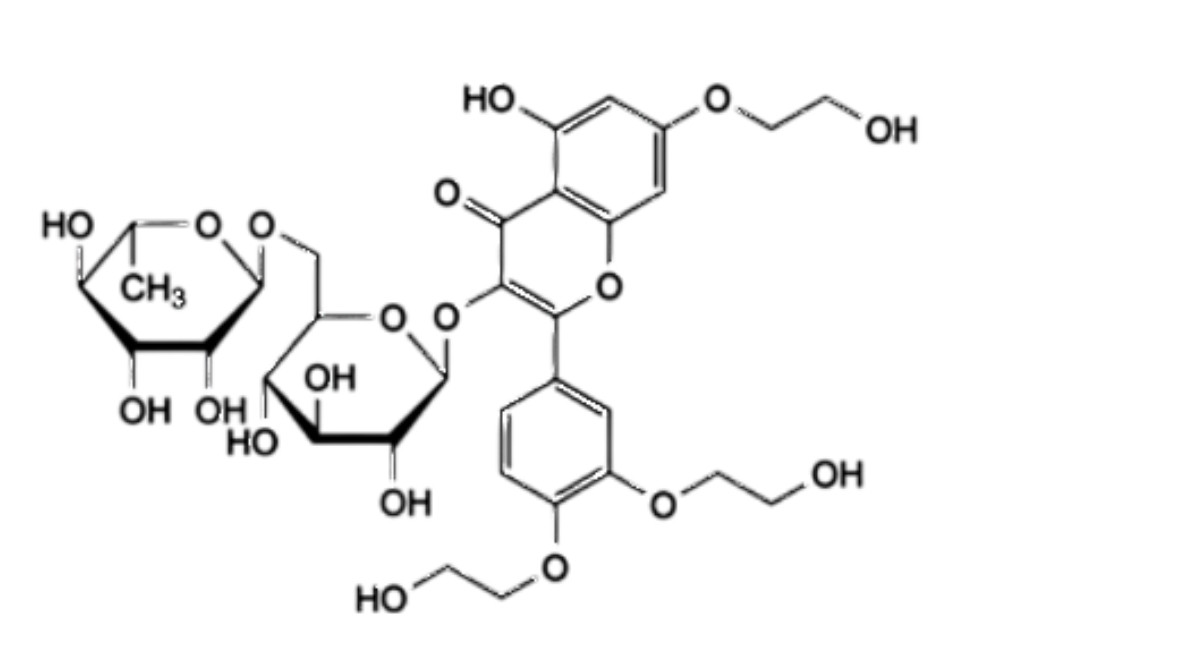
C33H42O19 743 7085-55-4
Action and use
Bioflavonoid.
Ph Eur
DEFINITION
Mixture of O-hydroxyethylated derivatives of rutoside containing minimum 80 per cent of 2-[3,4-bis(2- hydroxyethoxy)phenyl]-3-[[6-O-(6-deoxy-a-L-mannopyranosyl)-p-D-glucopyranosyl]oxy]-5-hydroxy-7-(2-hydroxyethoxy)-4H- 1-benzopyran-4-one (tris(hydroxyethyl)rutin).
Content
95.0 per cent to 105.0 per cent (dried substance).
CHARACTERS
Appearance
Yellowish-green, crystalline powder, hygroscopic.
Solubility
Freely soluble in water, slightly soluble in ethanol (96 per cent) and practically insoluble in methylene chloride.
IDENTIFICATION
A. Infrared absorption spectrophotometry (2.2.24).
Comparison troxerutin CRS.
B. Examine the chromatograms obtained in the test for composition.
Results The principal peak in the chromatogram obtained with the test solution is similar in position and size to the principal peak in the chromatogram obtained with the reference solution (a).
TESTS
Composition
Liquid chromatography (2.2.29): use the normalisation procedure.
Test solution Dissolve 10.0 mg of the substance to be examined in the mobile phase, if necessary using an ultrasonic bath and dilute to 10.0 mL with the mobile phase.
Reference solution (a) Dissolve 10.0 mg of troxerutin CRS in the mobile phase, if necessary using an ultrasonic bath and dilute to 10.0 mL with the mobile phase.
Reference solution (b) Dilute 1 mL of reference solution (a) to 10 mL with the mobile phase. Dilute 1 mL of this solution to 100 mL with the mobile phase.
Column:
- size: l = 0.25 m, Ø = 4.6 mm,
- stationary phase: end-capped octadecylsilyl silica gel for chromatography R (5 pm).
Mobile phase Mix 20 volumes of acetonitrile R and 80 volumes of a 15.6 g/L solution of sodium dihydrogen phosphate R adjusted to pH 4.4 with dilute phosphoric acid R or dilute sodium hydroxide solution R.
Flow rate 0.5 mL/min.
Detection Spectrophotometer at 350 nm.
Injection 10 µL.
Run time Twice the retention time of the main compound of troxerutin (tris(hydroxyethyl)rutin).
Relative retention With reference to tris(hydroxyethyl)rutin (retention time = about 25 min): tetrakis(hydroxyethyl)rutin = about 0.5; mono(hydroxyethyl)rutin = about 0.8; bis(hydroxyethyl)rutin = about 1.1.
System suitability Reference solution (a):
- peak-to-valley ratio: minimum 2.0, where Hp = height above the baseline of the peak due to bis(hydroxyethyl)rutin and Hv = height above the baseline of the lowest point of the curve separating this peak from the peak due to tris(hydroxyethyl)rutin;
- signal-to-noise ratio: minimum 10 for the principal peak in the chromatogram obtained with reference solution (b).
Limits:
- principal peak: minimum 80 per cent,
- any other peak: for each peak, maximum 5 per cent, except for 1 peak which can be maximum 10 per cent.
- disregard limit: area of the principal peak in the chromatogram obtained with reference solution (b).
Ethylene oxide
Head-space gas chromatography (2.2.28).
Test solution To 1.00 g of the substance to be examined in a vial, add 1.0 mL of water R. Mix to obtain a homogeneous solution. Heat at 70 °C for 45 min.
Reference solution To 1.00 g of the substance to be examined in a vial, add 50 µL of ethylene oxide solution R4 and 950 µL of water R and close tightly. Mix to obtain a homogeneous solution. Heat at 70 °C for 45 min.
Column:
- material: fused silica,
- size: l = 30 m, Ø = 0.32 mm,
- stationary phase: cyanopropyl(7)phenyl(7)methyl(86)polysiloxane R (film thickness 1 pm).
Carrier gas helium for chromatography R.
Flow rate 1.1 mL/min.
Static head-space conditions which may be used:
- equilibration temperature: 70 °C,
- equilibration time: 45 min,
- transfer line temperature: 110 °C,
- pressurisation time: 2 min,
- injection time: 12 s.
Temperature:
| Time (min) | Temperature (°C) | |
| Column
|
0 – 5 | 40 |
| 5 – 18 | 40 -> 200 | |
| Injection port | 150 | |
| Detector | 250 |
Detection Flame ionisation.
Injection 1.0 mL.
The peak due to ethylene oxide is identified by injecting solutions of ethylene oxide of increasing concentration.
Determine the content of ethylene oxide (ppm) in the substance to be examined using the following expression: 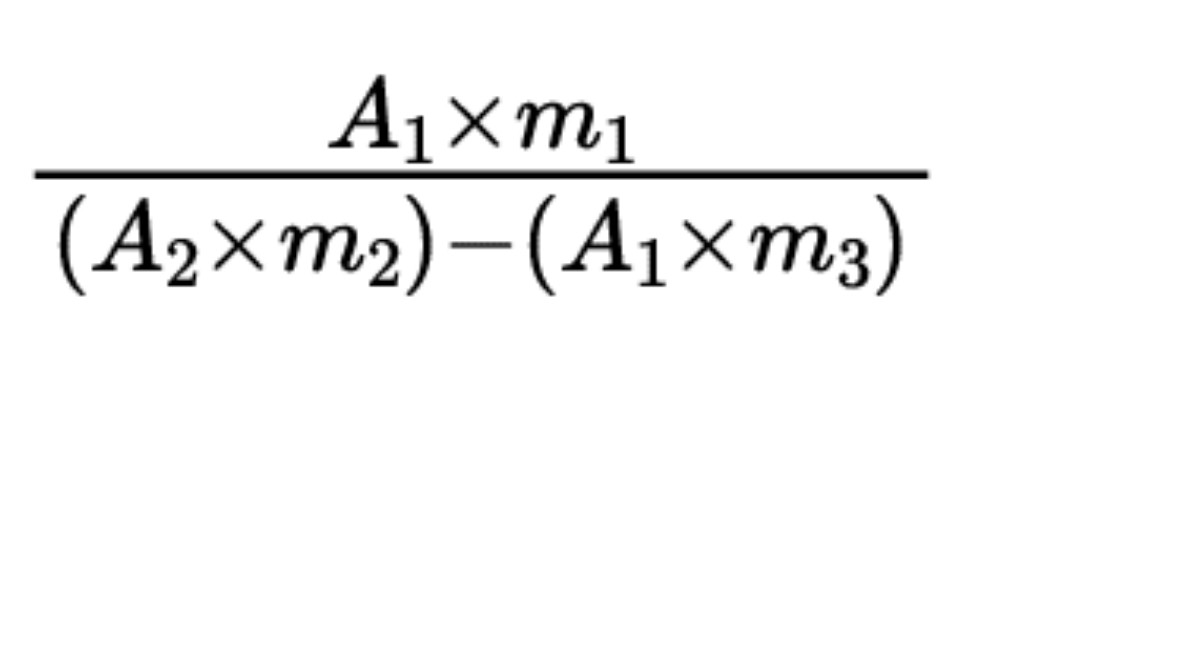
A1 = area of the peak due to ethylene oxide in the chromatogram obtained with the test solution,
A2 = area of the peak due to ethylene oxide in the chromatogram obtained with the reference solution,
m1 = mass of ethylene oxide in the reference solution, in micrograms,
m2 = mass of the substance to be examined in the test solution, in grams,
m3 = mass of the substance to be examined in the reference solution, in grams.
Limit:
— ethylene oxide: maximum 1 ppm.
Loss on drying (2.2.32)
Maximum 5.0 per cent, determined on 1.000 g by drying in an oven at 105 °C for 4 h.
Sulfated ash (2.4.14)
Maximum 0.4 per cent, determined on 1.0 g.
ASSAY
Dissolve 0.200 g in 100.0 mL of water R. Dilute 10.0 mL of this solution to 100.0 mL with water R. Dilute 10.0 mL to 100.0 mL with water R. Measure the absorbance (2.2.25) at the absorption maximum at 350 nm.
Calculate the percentage content of C33H42O19 taking the specific absorbance to be 250.
STORAGE
In an airtight container, protected from light.
Ph Eur


