




BP 2025 (Ph. Eur. 11.6 update)
(Ph. Eur. monograph 0533) 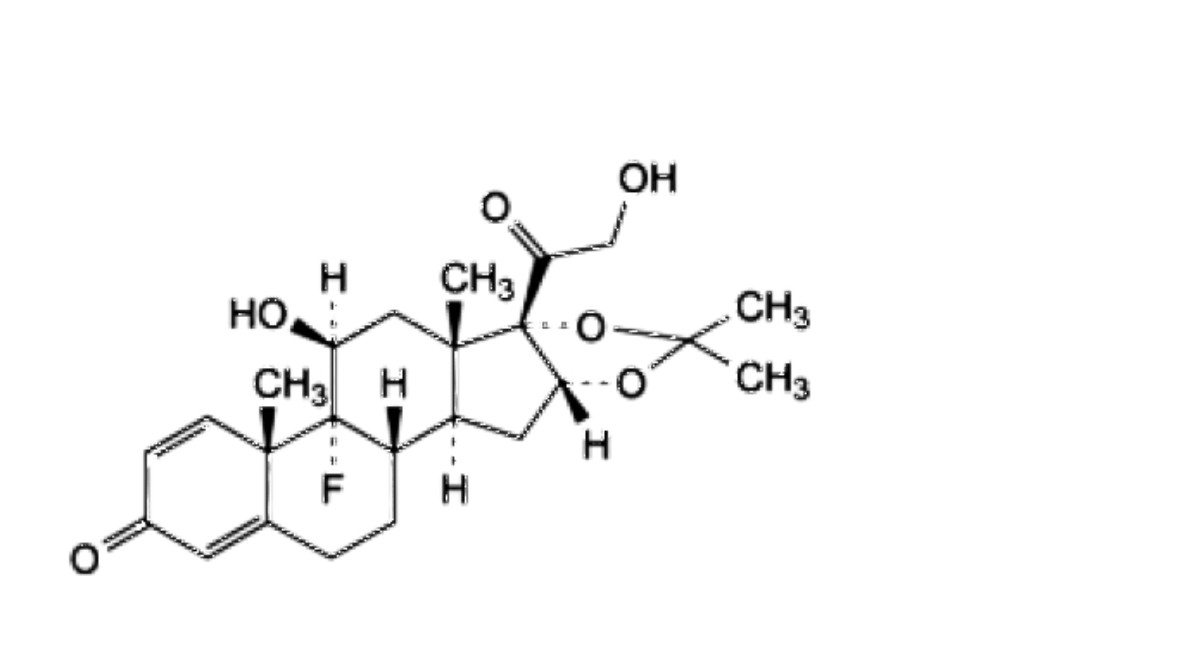
C24H31FO6 434.5 76-25-5
Action and use
Glucocorticoid.
Preparations
Triamcinolone Cream
Triamcinolone Acetonide Injection
Triamcinolone Acetonide Nasal Spray
Triamcinolone Ointment
Triamcinolone Dental Paste
Ph Eur
DEFINITION
9-Fluoro-11β,21-dihydroxy-16α,17-(1-methylethylidenedioxy)pregna-1,4-diene-3,20-dione.
Content
97.5 per cent to 102.0 per cent (anhydrous substance).
CHARACTERS
Appearance
White or almost white, crystalline powder.
Solubility
Practically insoluble in water, sparingly soluble in ethanol (96 per cent).
It shows polymorphism (5.9).
IDENTIFICATION
First identification: A, C.
Second identification: B, D.
A. Infrared absorption spectrophotometry (2.2.24).
Comparison triamcinolone acetonide CRS.
If the spectra obtained in the solid state show differences, dissolve the substance to be examined and the reference substance separately in the minimum volume of methanol R and evaporate to dryness. Using the residues, prepare halogen salt discs or mulls in liquid paraffin R and record new spectra.
B. Thin-layer chromatography (2.27). Prepare the solutions immediately before use and protect from light.
Test solution Dissolve 10 mg of the substance to be examined in methanol R and dilute to 10 mL with the same solvent.
Reference solution (a) Dissolve 20 mg of triamcinolone acetonide CRS in methanol R and dilute to 20 mL with the same solvent.
Reference solution (b) Dissolve 10 mg of triamcinolone hexacetonide CRS in reference solution (a) and dilute to 10 mL with reference solution (a).
Plate TLC silica gel F254 plate R.
Mobile phase Add a mixture of 1.2 volumes of water R and 8 volumes of methanol R to a mixture of 15 volumes of ether R and 77 volumes of methylene chloride R.
Application 5 µL.
Development Over 3/4 of the plate.
Drying In air.
Detection Examine in ultraviolet light at 254 nm, immediately after development.
System suitability Reference solution (b):
— the chromatogram shows 2 clearly separated spots.
Results The principal spot in the chromatogram obtained with the test solution is similar in position and size to the principal spot in the chromatogram obtained with reference solution (a).
C. Examine the chromatograms obtained in the assay.
Results The principal peak in the chromatogram obtained with the test solution is similar in retention time and size to the principal peak in the chromatogram obtained with reference solution (c).
D. Mix about 5 mg with 45 mg of heavy magnesium oxide R and ignite in a crucible until an almost white residue is obtained (usually less than 5 min). Allow to cool, add 1 mL of water R,05 mL of phenolphthalein solution R1 and about 1 mL of dilute hydrochloric acid R to render the solution colourless. Filter. To a freshly prepared mixture of 0.1 mL of alizarin S solution R and 0.1 mL of zirconyl nitrate solution R, add 1.0 mL of the filtrate. Mix, allow to stand for 5 min and compare the colour of the solution to that of a blank prepared in the same manner. The test solution is yellow and the blank is red.
TESTS
Specific optical rotation (2.2.7)
+ 110 to + 117 (anhydrous substance).
Dissolve 0.100 g in ethanol (96 per cent) R and dilute to 20.0 mL with the same solvent.
Related substances
Liquid chromatography (2.2.29). Carry out the test protected from light.
Test solution Dissolve 25.0 mg of the substance to be examined in mobile phase B and dilute to 25.0 mL with mobile phase B.
Reference solution (a) Dissolve 5 mg of triamcinolone acetonide for system suitability CRS (containing impurities B and C) in mobile phase B and dilute to 5.0 mL with mobile phase B.
Reference solution (b) Dilute 1.0 mL of the test solution to 100.0 mL with mobile phase B. Dilute 1.0 mL of this solution to 10.0 mL with mobile phase B.
Reference solution (c) Dissolve 25.0 mg of triamcinolone acetonide CRS in mobile phase B and dilute to 25.0 mL with mobile phase B.
Column:
- size: l = 0.25 m, Ø = 4.6 mm;
- stationary phase: end-capped octadecylsilyl silica gel for chromatography R (5 µm);
- temperature: 40 °C.
Mobile phase:
- mobile phase A: acetonitrile R, water for chromatography R (32:68 V/V);
- mobile phase B: water for chromatography R, acetonitrile R (35:65 V/V);
| Time (min) | Mobile phase A (per cent V/V) | Mobile phase B (per cent V/V) |
| 0 – 20 | 100 | 0 |
| 20 – 40 | 100 -> 0 | 0 -> 100 |
Flow rate 1.5 mL/min.
Detection Spectrophotometer at 254 nm.
Injection 20 µL of the test solution and reference solutions (a) and (b).
Identification of impurities Use the chromatogram supplied with triamcinolone acetonide for system suitability CRS and the chromatogram obtained with reference solution (a) to identify the peaks due to impurities B and C.
Relative retention With reference to triamcinolone acetonide (retention time = about 16 min): impurity C = about 0.7; impurity B = about 0.8.
System suitability Reference solution (a):
- resolution: minimum 2.5 between the peaks due to impurities C and B.
Limits:
- impurity B: not more than twice the area of the principal peak in the chromatogram obtained with reference solution (b) (0.2 per cent);
- impurity C: not more than 1.5 times the area of the principal peak in the chromatogram obtained with reference solution (b) (0.15 per cent);
- unspecified impurities: for each impurity, not more than the area of the principal peak in the chromatogram obtained with reference solution (b) (0.10 per cent);
— total: not more than 5 times the area of the principal peak in the chromatogram obtained with reference solution (b) (0.5 per cent);
— disregard limit: 0.5 times the area of the principal peak in the chromatogram obtained with reference solution (b) (0.05 per cent).
Water (2.5.12)
Maximum 2.0 per cent, determined on 0.500 g.
ASSAY
Carry out the assay protected from light.
Liquid chromatography (2.2.29) as described in the test for related substances with the following modifications.
Mobile phase Mobile phase A.
Injection Test solution and reference solution (c).
Run time 1.5 times the retention time of triamcinolone acetonide.
Retention time Triamcinolone acetonide = about 16 min.
Calculate the percentage content of C24H31FO6 taking into account the assigned content of triamcinolone acetonide CRS.
STORAGE
Protected from light.
IMPURITIES
Specified impurities B, C.
Other detectable impurities (the following substances would, if present at a sufficient level, be detected by one or other of the tests in the monograph. They are limited by the general acceptance criterion for other/unspecified impurities and/or by the general monograph Substances for pharmaceutical use (2034). It is therefore not necessary to identify these impurities for demonstration of compliance. See also 5.10. Control of impurities in substances for pharmaceutical use) A, D, E, F
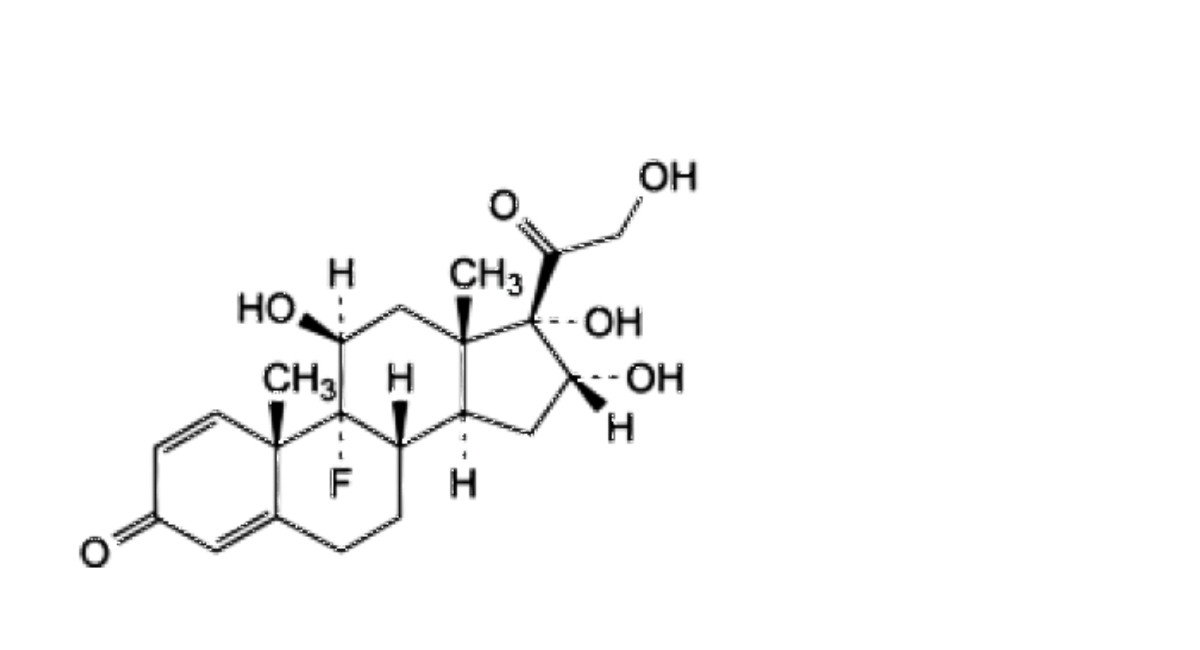
A. 9-fluoro-11β,16α,17,21-tetrahydroxypregna-1,4-diene-3,20-dione (triamcinolone),
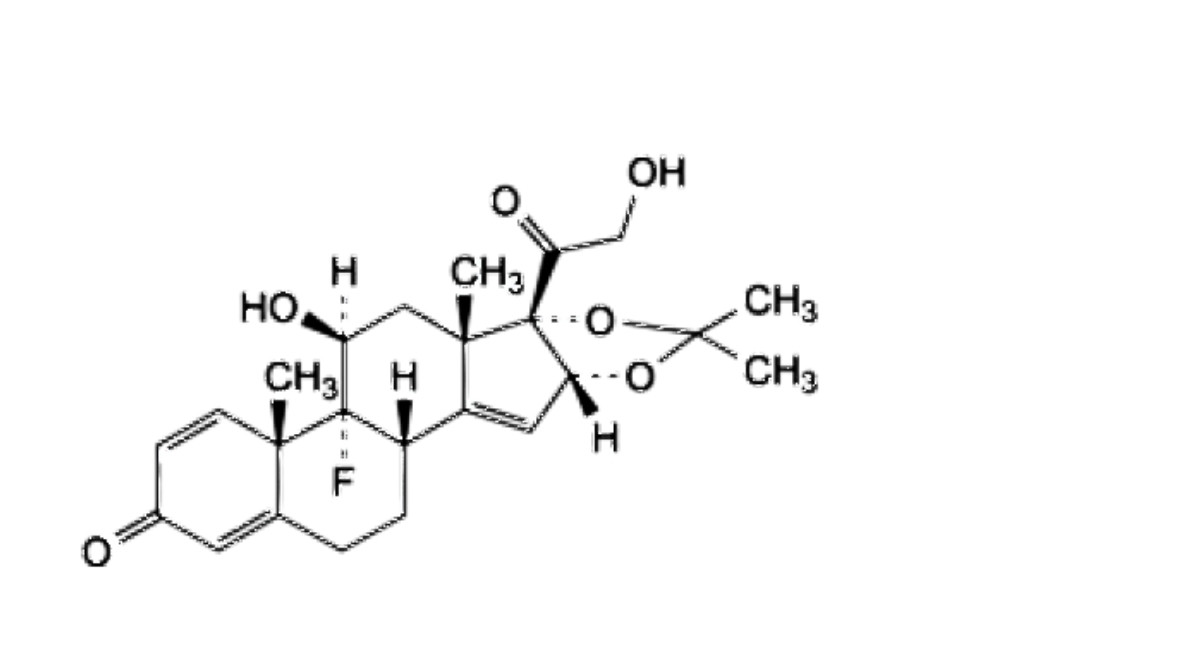
B. 9-fluoro-11β,21-dihydroxy-16α,17-(1-methylethylidenedioxy)pregna-1,4,14-triene-3,20-dione (Δ14-triamcinolone acetonide),
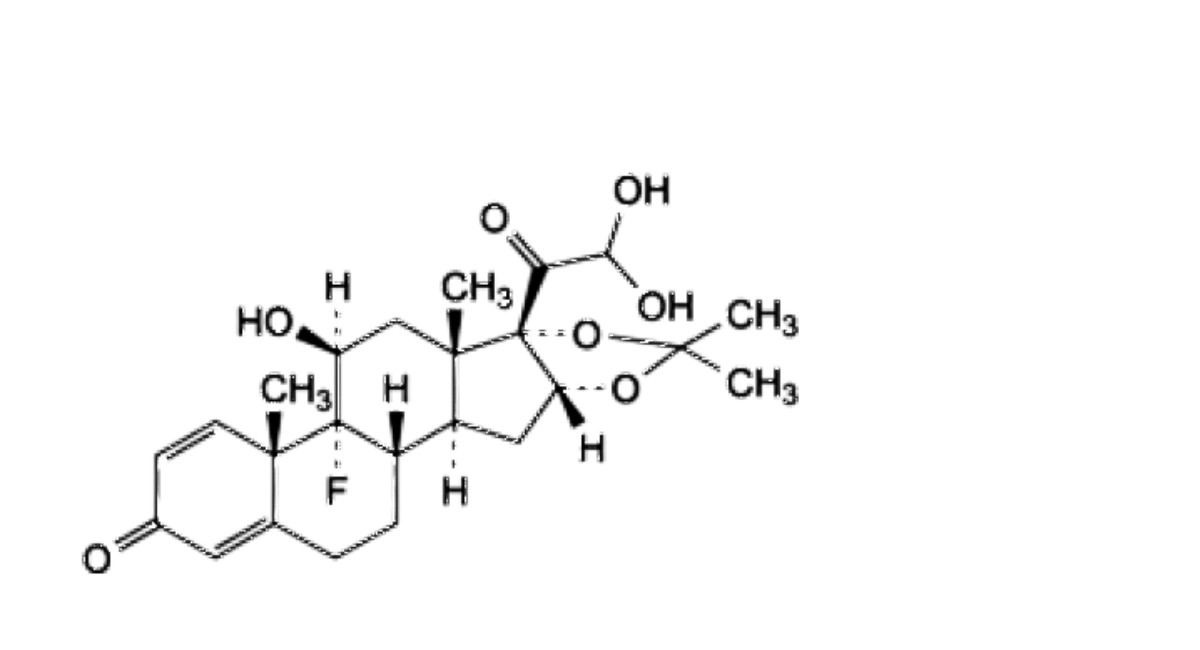
C. 9-fluoro-11β,21,21-trihydroxy-16α,17-(1-methylethylidenedioxy)pregna-1,4-diene-3,20-dione (triamcinolone acetonide 21-aldehyde hydrate).
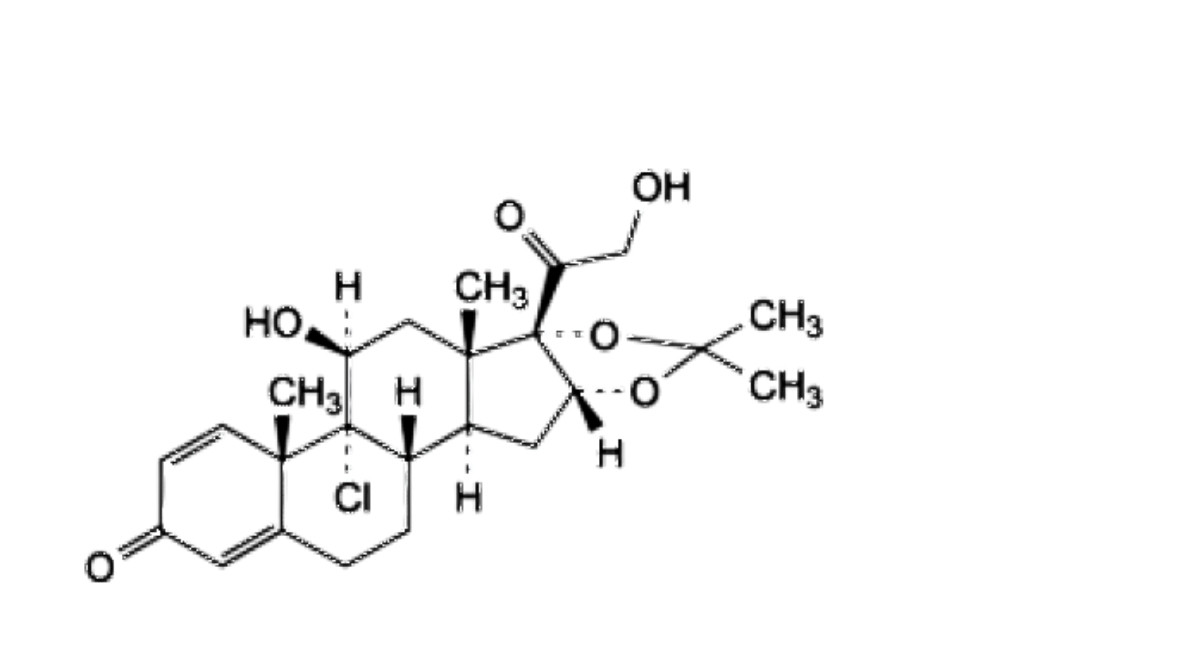
D. 9-chloro-11β,21-dihydroxy-16α,17-(1-methylethylidenedioxy)pregna-1,4-diene-3,20-dione (9α-chloro triamcinolone acetonide),
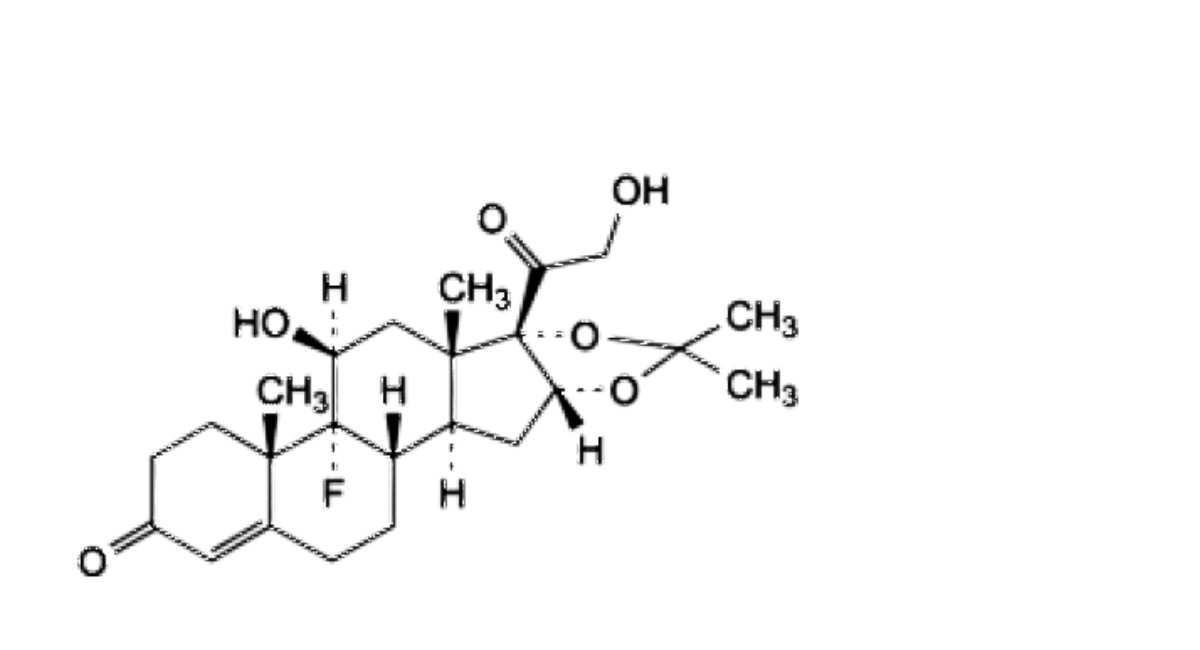
E. 9-fluoro-11β,21-dihydroxy-16α,17-(1-methylethylidenedioxy)pregna-4-ene-3,20-dione (1,2-dihydrotriamcinolone acetonide),
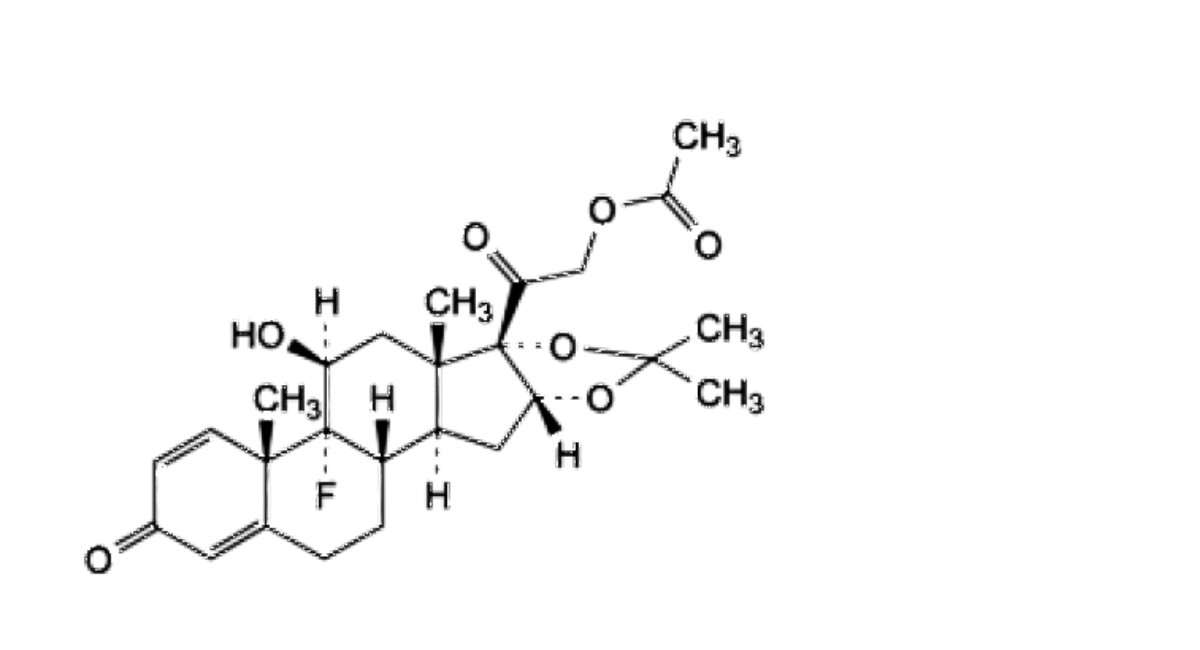
F. 9-fluoro-11β-hydroxy-16α,17-(1-methylethylidenedioxy)-3,20-dioxopregna-1,4-dien-21-yl acetate (21-acetate triamcinolone acetonide).
Ph Eur


