



(Ph. Eur. 11.6 update)
(Ph. Eur. monograph 0956)
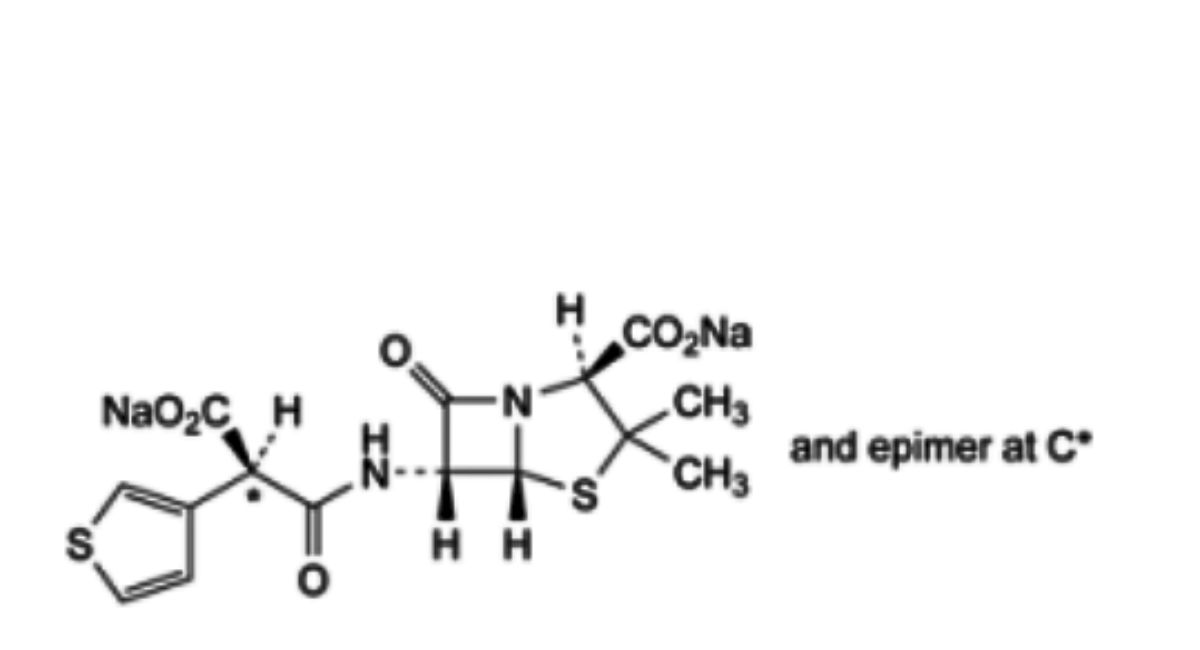
C15H14N2Na2O6S2 428.4 4697-14-7
Action and use
Penicillin antibacterial.
Preparation
Ticarcillin and Clavulanic Acid Infusion
Ph Eur
DEFINITION
Disodium (2S,5R,6R)-6-[[(2RS)-2-carboxylato-2-(thiophen-3-yl)acetyl]amino]-3,3-dimethyl-7-oxo-4-thia-1-
azabicyclo[3.2.0]heptane-2-carboxylate.
Semi-synthetic product derived from a fermentation product.
Content
89.0 per cent to 102.0 per cent (anhydrous substance).
CHARACTERS
Appearance
White or slightly yellow, hygroscopic powder.
Solubility
Freely soluble in water, soluble in methanol.
IDENTIFICATION
First identification: A, D, E.
Second identification: B, C, D.
A. Infrared absorption spectrophotometry (2.2.24).
Preparation: Dissolve 50 mg of the substance to be examined in 1 mL of water R, add 0.1 mL of hydrochloric acid R1, swirl and allow to stand in iced water for 10 min. Filter the precipitate and rinse with 2 mL of water R. Dissolve in a mixture of 1 volume of water R and 9 volumes of acetone R. Evaporate the solvent almost to dryness, then dry in an oven at 60 °C for 30 min.
Comparison: Repeat the operations using ticarcillin monosodium CRS.
B. Thin-layer chromatography (2.2.27).
Test solution: Dissolve 25 mg of the substance to be examined in methanol R and dilute to 5 mL with the same solvent.
Reference solution (a): Dissolve 25 mg of ticarcillin monosodium CRS in methanol R and dilute to 5 mL with the same solvent.
Reference solution (b): Dissolve 25 mg of carbenicillin sodium CRS and 25 mg of ticarcillin monosodium CRS in
methanol R and dilute to 5 mL with the same solvent.
Plate: TLC silanised silica gel plate R.
Mobile phase: Mix 10 volumes of acetone R and 90 volumes of a 154 g/L solution of ammonium acetate R, adjusted to pH 5.0 with glacial acetic acid R.
Application: 1 μL.
Development: Over a path of 12 cm.
Drying: In a current of hot air.
Detection: Expose to iodine vapour.
System suitability: Reference solution (b):
— the chromatogram shows 2 clearly separated spots.
Results: The principal spot in the chromatogram obtained with the test solution is similar in position, colour and size to the principal spot in the chromatogram obtained with reference solution (a).
C. Place about 2 mg in a test-tube about 15 cm long and 15 mm in diameter. Moisten with 0.05 mL of water R and add 2 mL of sulfuric acid-formaldehyde reagent R. Mix the contents of the tube by swirling; the solution is brown. Place the test-tube in a water-bath for 1 min; a dark reddish-brown colour develops.
D. It gives reaction (a) of sodium (2.3.1).
E. Specific optical rotation (see Tests).
TESTS
Solution S
Dissolve 2.50 g in carbon dioxide-free water R and dilute to 50 mL with the same solvent.
Appearance of solution
Solution S is clear (2.2.1) and not more intensely coloured than reference solution Y5 (2.2.2, Method II). pH (2.2.3)
5.5 to 7.5 for solution S.
Specific optical rotation (2.2.7)
+172 to +187 (anhydrous substance).
Dissolve 0.250 g in water R and dilute to 25.0 mL with the same solvent.
Related substances
Liquid chromatography (2.2.29).
Test solution: Dissolve 25.0 mg of the substance to be examined in mobile phase A and dilute to 25.0 mL with mobile phase A.
Reference solution (a): Dissolve 20.0 mg of ticarcillin impurity A CRS in mobile phase A and dilute to 100.0 mL with mobile phase A. Dilute 5.0 mL of this solution to 50.0 mL with mobile phase A.
Reference solution (b): Dilute 1 mL of the test solution to 50 mL with mobile phase A.
Column:
— size: l = 0.25 m, Ø = 4 mm;
— stationary phase: octadecylsilyl silica gel for chromatography R (5 μm).
Mobile phase:
— mobile phase A: 1.3 g/L solution of ammonium phosphate R adjusted to pH 7.0 with phosphoric acid R;
— mobile phase B: methanol R, mobile phase A (50:50 V/V);
| Time (min) | Mobile phase A (%V/V) | Mobile phase B (%V/V) |
| 0 – 30 | 100 → 30 | 0 → 70 |
| 30 – 40 | 30 | 70 |
Flow rate 1.0 mL/min.
Detection Spectrophotometer at 220 nm.
Injection 20 μL.
System suitability Reference solution (b):
— resolution: minimum 2.0 between the 2 principal peaks (diastereoisomers).
Limits:
— impurity A: not more than twice the area of the principal peak in the chromatogram obtained with reference
solution (a) (4 per cent);
— any other impurity: for each impurity, not more than 1.25 times the area of the principal peak in the chromatogram obtained with reference solution (a) (2.5 per cent).
N,N-Dimethylaniline (2.4.26, Method B)
Maximum 20 ppm.
2-Ethylhexanoic acid (2.4.28)
Maximum 0.5 per cent m/m.
Water (2.5.12)
Maximum 5.5 per cent, determined on 0.150 g.
Bacterial endotoxins (2.6.14)
Less than 0.05 IU/mg, if intended for use in the manufacture of parenteral preparations without a further appropriate procedure for the removal of bacterial endotoxins.
ASSAY
Liquid chromatography (2.2.29).
Test solution Dissolve 50.0 mg of the substance to be examined in the mobile phase and dilute to 100.0 mL with the mobile phase. Dilute 10.0 mL of this solution to 50.0 mL with the mobile phase.
Reference solution Dissolve 50.0 mg of ticarcillin monosodium CRS in the mobile phase and dilute to 100.0 mL with the mobile phase. Dilute 10.0 mL of this solution to 50.0 mL with the mobile phase.
Column:
— size: l = 0.25 m, Ø = 4 mm;
— stationary phase: octadecylsilyl silica gel for chromatography R (5 μm).
Mobile phase Mix 20 volumes of methanol R and 80 volumes of a 1.3 g/L solution of ammonium phosphate R adjusted to pH 7.0 with phosphoric acid R.
Flow rate 1 mL/min.
Detection Spectrophotometer at 220 nm.
Injection 20 μL.
System suitability Reference solution:
— resolution: minimum 2.5 between the 2 principal peaks;
— repeatability: maximum relative standard deviation of 1.0 per cent for the 2 peaks due to ticarcillin after 6 injections.
Calculate the percentage content of ticarcillin sodium as the sum of the areas of the 2 peaks, multiplying the content of ticarcillin monosodium by 1.054.
STORAGE
In an airtight container, at a temperature of 2 °C to 8 °C. If the substance is sterile, store in a sterile, airtight, tamper- evident container.
IMPURITIES
Specified impurities A.
Other detectable impurities (the following substances would, if present at a sufficient level, be detected by one or other of the tests in the monograph. They are limited by the general acceptance criterion for other/unspecified impurities and/or by the general monograph Substances for pharmaceutical use (2034). It is therefore not necessary to identify these impurities for demonstration of compliance. See also 5.10. Control of impurities in substances for pharmaceutical use) B, C, D, E.
![A. (2S,5R,6R)-3,3-dimethyl-7-oxo-6-[[(thiophen-3-yl)acetyl]amino]-4-thia-1-azabicyclo[3.2.0]heptane-2-carboxylic acid (decarboxyticarcillin),](https://nhathuocngocanh.com/bp/wp-content/uploads/2025/11/A.-2S5R6R-33-dimethyl-7-oxo-6-thiophen-3-ylacetylamino-4-thia-1-azabicyclo3.2.0heptane-2-carboxylic-acid-decarboxyticarcillin.jpg)
A. (2S,5R,6R)-3,3-dimethyl-7-oxo-6-[[(thiophen-3-yl)acetyl]amino]-4-thia-1-azabicyclo[3.2.0]heptane-2-carboxylic acid
(decarboxyticarcillin),
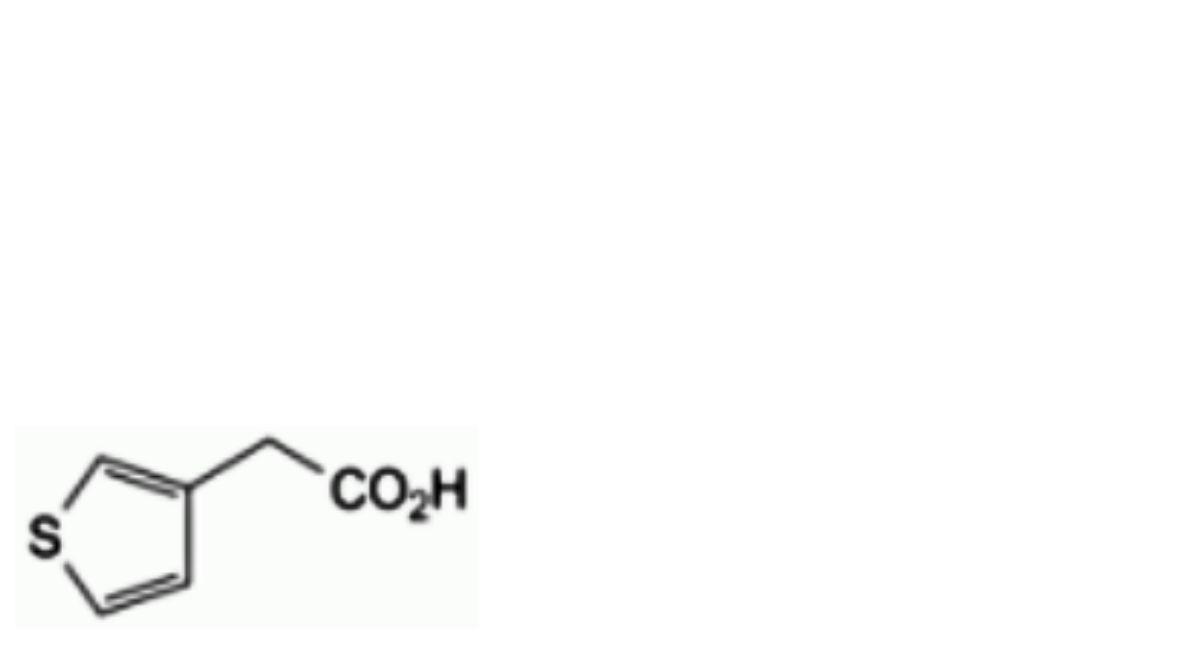
B. (thiophen-3-yl)acetic acid,
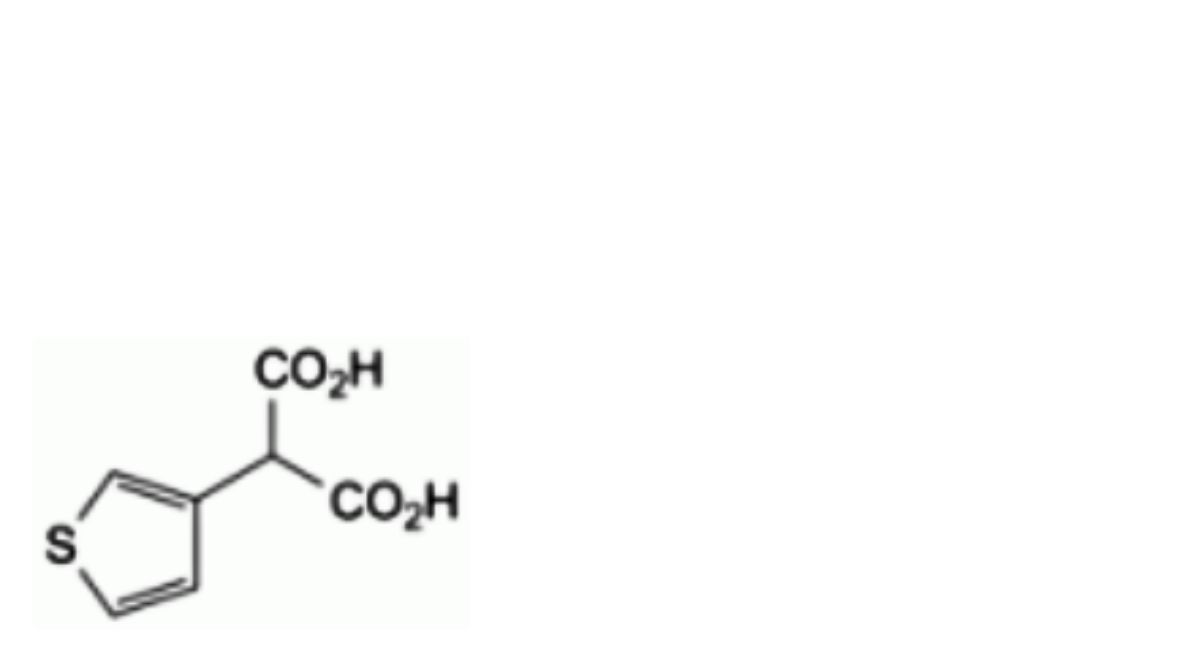
C. 2-(thiophen-3-yl)propanedioic acid (3-thienylmalonic acid),
![D. (4S)-2-[carboxy[[2-carboxy-2-(thiophen-3-yl)acetyl]amino]methyl]-5,5-dimethylthiazolidine-4-carboxylic acid (penicilloic acids of ticarcillin), (2)](https://nhathuocngocanh.com/bp/wp-content/uploads/2025/11/D.-4S-2-carboxy2-carboxy-2-thiophen-3-ylacetylaminomethyl-55-dimethylthiazolidine-4-carboxylic-acid-penicilloic-acids-of-ticarcillin-2.jpg)
D. (4S)-2-[carboxy[[2-carboxy-2-(thiophen-3-yl)acetyl]amino]methyl]-5,5-dimethylthiazolidine-4-carboxylic acid
(penicilloic acids of ticarcillin),
![E. (4S)-2-[[[2-carboxy-2-(thiophen-3-yl)acetyl]amino]methyl]-5,5-dimethylthiazolidine-4-carboxylic acid (penilloic acids of ticarcillin)](https://nhathuocngocanh.com/bp/wp-content/uploads/2025/11/E.-4S-2-2-carboxy-2-thiophen-3-ylacetylaminomethyl-55-dimethylthiazolidine-4-carboxylic-acid-penilloic-acids-of-ticarcillin.jpg)
E. (4S)-2-[[[2-carboxy-2-(thiophen-3-yl)acetyl]amino]methyl]-5,5-dimethylthiazolidine-4-carboxylic acid
(penilloic acids of ticarcillin).


