



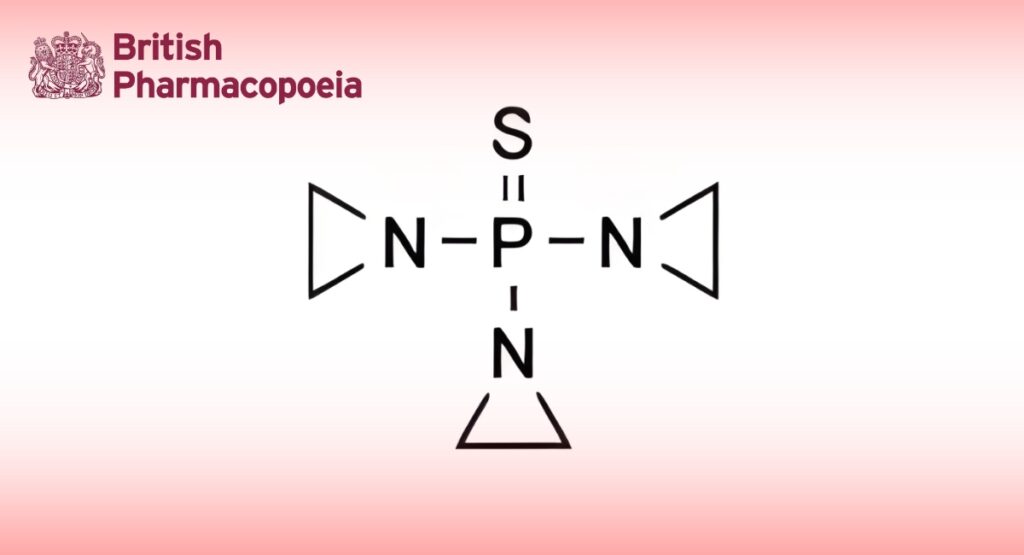
(Ph. Eur. 11.6 update)
C6H12N3PS 189.2 52-24-4
Action and use
Cytotoxic alkylating agent.
Preparation
Thiotepa Injection
DEFINITION
Thiotepa is phosphorothioic tri(ethyleneamide). It contains not less than 97.0% and not more than 102.0% of C6H12N3PS, calculated with reference to the anhydrous substance.
CHARACTERISTICS
Fine, white crystalline flakes.
Freely soluble in water, in chloroform and in ethanol (96%).
IDENTIFICATION
A. The infrared absorption spectrum, Appendix II A, is concordant with the reference spectrum of thiotepa (RS 337).
B. Burn 20 mg by the method for oxygen-flask combustion, Appendix VIII C, using 5 mL of 1.25M sodium hydroxide as the absorbing liquid. When the process is complete, dilute to 25 mL with water. To 5 mL of the resulting solution add 0.1 mL of hydrogen peroxide solution (100 vol) and 1 mL of 1M hydrochloric acid, mix and add 0.05 mL of barium chloride solution. The solution becomes turbid.
C. To 2 mL of the solution obtained in test B add 40 mL of water and 4 mL of ammonium molybdate-sulfuric acid solution, mix, add 0.1 g of L-ascorbic acid and boil for 1 minute. A blue colour is produced.
TESTS
Melting point
52° to 57°, Appendix V A.
Clarity of solution
A 2.0% w/v solution is clear, Appendix IV A.
Related substances
Carry out the method for liquid chromatography, Appendix III D, using the following freshly prepared solutions. Solutions (1) and (2) are solutions of the substance being examined in water containing 0.350% w/v and 0.00035% w/v, respectively. For solution (3) dissolve 10 mg of the substance being examined in 2 mL of methanol in a ground-glass-stoppered tube, add 50 μL of a 0.1% v/v solution of orthophosphoric acid, stopper the tube and heat in a water bath at 65° for 50 seconds (generation of methoxythiotepa). Allow the solution to cool and add 1 mL of methanol. For solution (4) dissolve 15 mg of the substance being examined in 10 mL of water, add 1 g of sodium chloride, boil in a water bath for 10 minutes and cool (generation of chloro-adduct).
The chromatographic procedure may be carried out using (a) a stainless steel column (15 cm × 4.6 mm) packed with end-capped octadecylsilyl silica gel for chromatography (5 μm) (Nucleosil C18 is suitable), (b) 15 volumes of acetonitrile and 85 volumes of 0.1M mixed phosphate buffer pH 7.0 as the mobile phase with a flow rate of 1 mL per minute and (c) a detection wavelength of 215 nm.
The chromatogram obtained with solution (3) shows a peak corresponding to methoxythiotepa with a retention time relative to thiotepa of about 1.3 and the chromatogram obtained with solution (4) shows a peak due to the chloro-adduct with a retention time relative to thiotepa of about 3.75. The test is not valid unless the resolution factor between the two principal peaks in the chromatogram obtained with solution (3) is at least 3.
For solution (1) allow the chromatography to proceed for 4 times the retention time of the principal peak. In the chromatogram obtained with solution (1) the area of any peak corresponding to the ‘chloro-adduct’ (identified from the peak in the chromatogram obtained with solution (4)) is not greater than 1.5 times the area of the principal peak in the chromatogram obtained with solution (2) (0.15%), the area of any other secondary peak is not greater than the area of the principal peak in the chromatogram obtained with solution (2) (0.1%) and the sum of the areas of all the secondary peaks is not greater than twice the area of the principal peak in the chromatogram obtained with solution (2) (0.2%).
Water
Not more than 0.5% w/w, Appendix IX C. Cool the reagents and titration vessel in ice throughout the procedure and use 1.2 g. Complete the procedure as quickly as possible.
ASSAY
Transfer 0.2 g to an iodine flask with the aid of 50 mL of a 20% w/v solution of sodium thiosulfate and titrate immediately with 0.1M hydrochloric acid VS, using 0.05 mL of methyl orange solution as indicator, until a faint red colour persists for 10 seconds. Stopper the flask, allow to stand for 30 minutes and titrate with 0.1M sodium hydroxide VS using phenolphthalein solution R1 as indicator. Subtract the volume of 0.1M sodium hydroxide VS used from the volume of 0.1M hydrochloric acid VS used. Repeat the operation without the substance being examined. The difference between the titrations represents the amount of hydrochloric acid required. Each mL of 0.1M hydrochloric acid VS is equivalent to 6.307 mg of C6H12N3PS.
STORAGE
Thiotepa should be stored at a temperature of 2° to 8°. At higher temperatures it polymerises and becomes inactive.
IMPURITIES
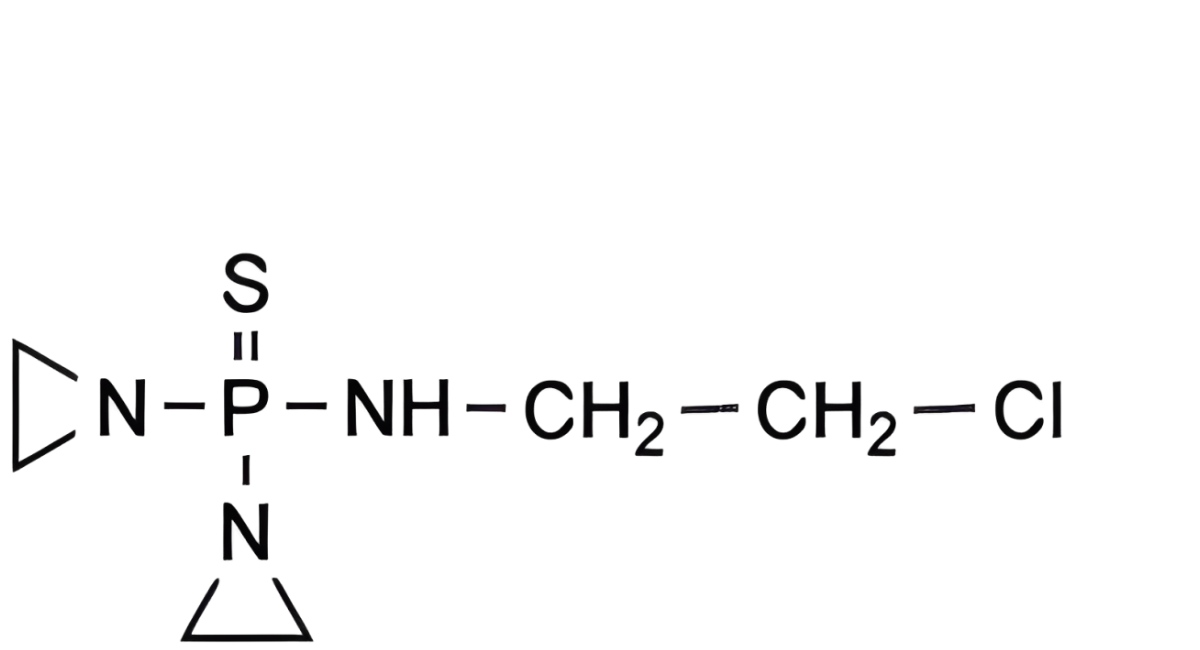
A. ‘chloro-adduct’,
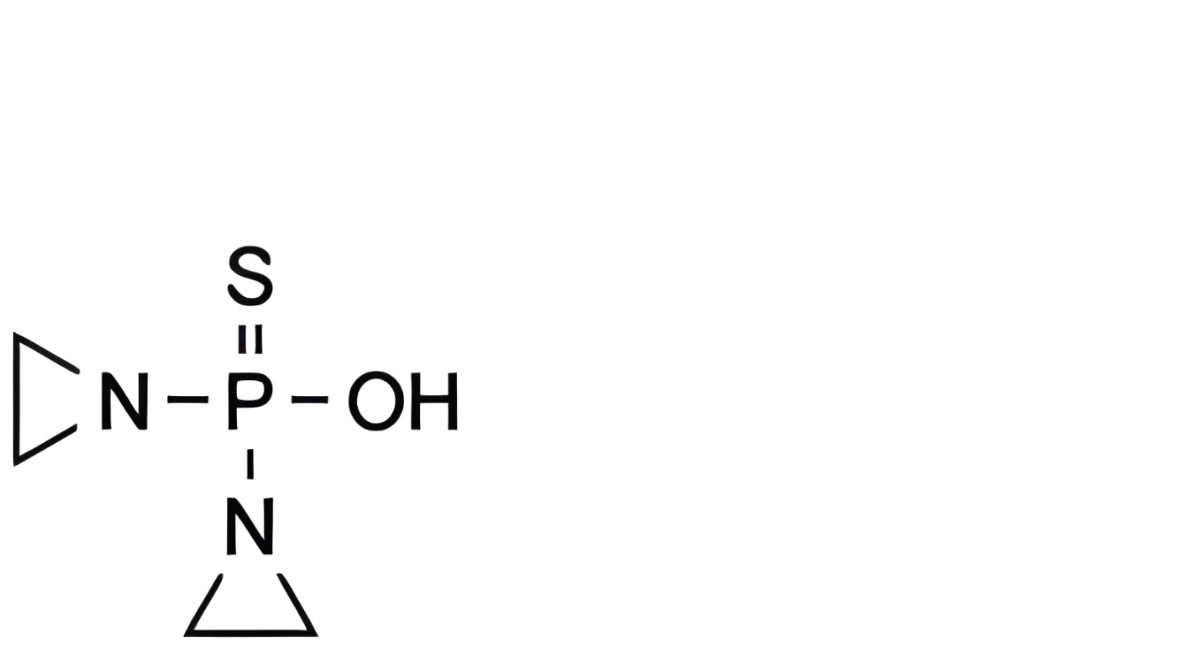
B. ‘hydroxythiotepa A’,
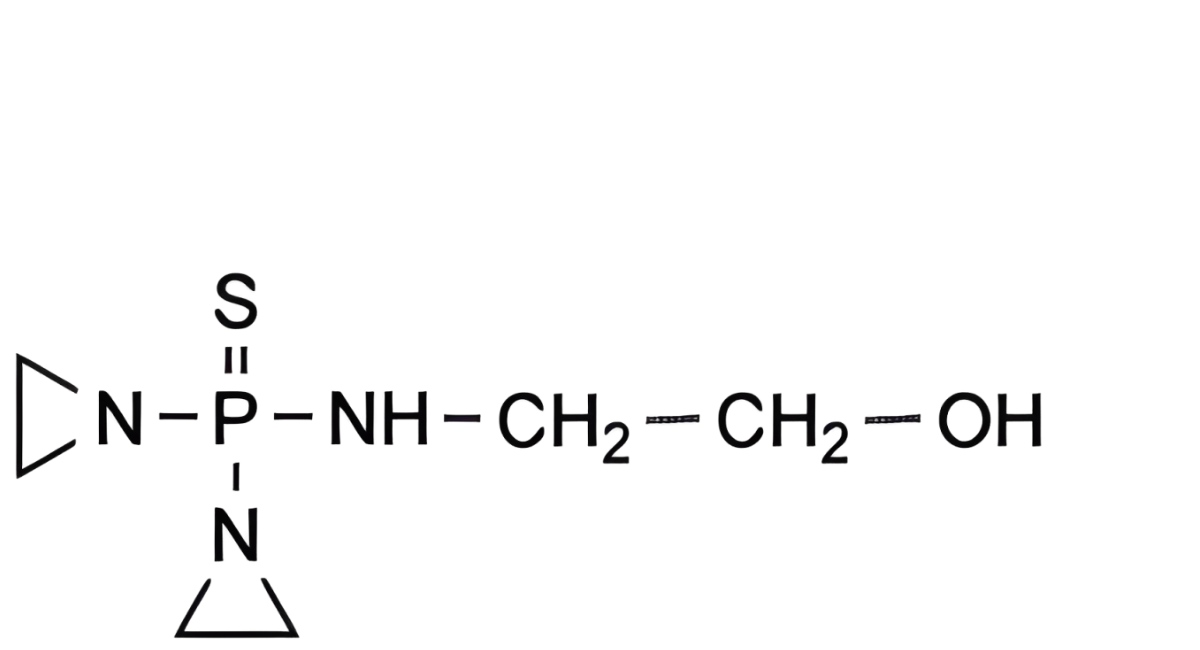
C. ‘hydroxythiotepa B’.


