



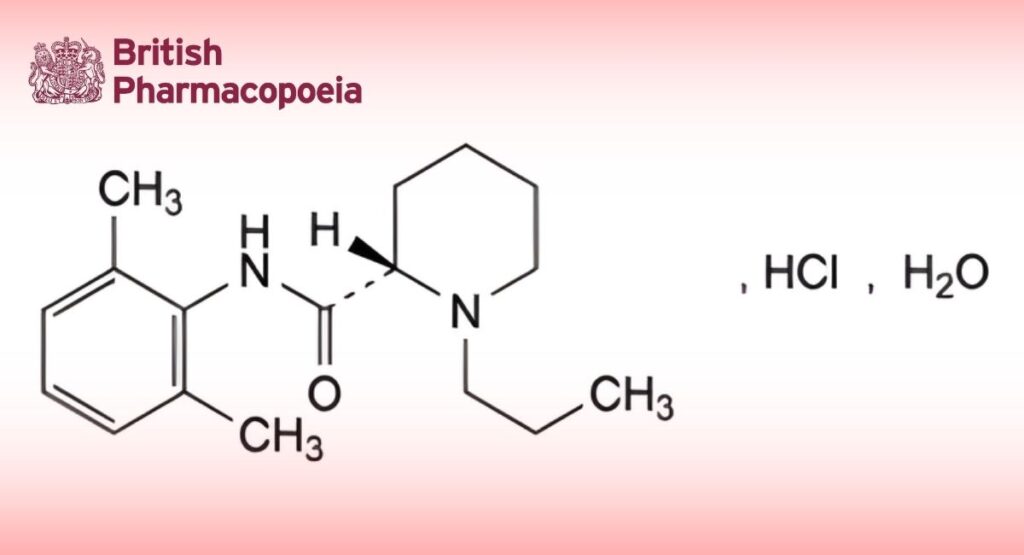
(Ph. Eur. monograph 2335)
C17H27ClN2O,H2O 328.9 132112-35-7
Action and use
Local anaesthetic.
DEFINITION
(-)-(2S)-N-(2,6-Dimethylphenyl)-1-propylpiperidine-2-carboxamide hydrochloride monohydrate.
Content
99.0 per cent to 101.0 per cent (anhydrous substance).
CHARACTERS
Appearance
White or almost white, crystalline powder.
Solubility
Soluble in water and in ethanol (96 per cent), slightly soluble in methylene chloride.
IDENTIFICATION
Carry out either tests A, C, D or tests A, B, C.
A. Infrared absorption spectrophotometry (2.2.24).
Comparison: ropivacaine hydrochloride monohydrate CRS.
B. Specific optical rotation (2.2.7): -74.0 to -64.0 (anhydrous substance).
Mix 2 mL of a 200 g/L solution of sodium hydroxide R and 30 mL of water R and dilute to 100.0 mL with ethanol (96 per cent) R (solution A). Dissolve 0.500 g of the substance to be examined in solution A and dilute to 50.0 mL with solution A.
C. It gives reaction (a) of chlorides (2.3.1).
D. Enantiomeric purity (see Tests).
TESTS
Solution S
Dissolve 0.50 g in carbon dioxide-free water R and dilute to 25.0 mL with the same solvent.
Appearance of solution
Solution S is clear (2.2.1).
pH (2.2.3)
4.5 to 6.0 for solution S.
Absorbance (2.2.25)
Maximum 0.030 at 405 nm and maximum 0.025 at 436 nm, determined on solution S prepared immediately before use, with a path length of 5 cm and using water R as the compensation liquid.
Related substances
Liquid chromatography (2.2.29).
Test solution: Dissolve 55 mg of the substance to be examined in the mobile phase and dilute to 20 mL with the mobile phase.
Reference solution (a): Dilute 1.0 mL of the test solution to 100.0 mL with the mobile phase. Dilute 1.0 mL of this solution to 10.0 mL with the mobile phase.
Reference solution (b): Dissolve 5 mg of the substance to be examined and 5 mg of bupivacaine hydrochloride CRS (impurity A) in the mobile phase and dilute to 5 mL with the mobile phase. Dilute 1 mL of this solution to 100 mL with the mobile phase.
Column:
— size: l = 0.15 m, Ø = 3.9 mm;
— stationary phase: spherical end-capped octadecylsilyl silica gel for chromatography R (4 μm).
Mobile phase: Mix 1.3 mL of a 138 g/L solution of sodium dihydrogen phosphate R and 32.5 mL of an 89 g/L solution of disodium hydrogen phosphate dodecahydrate R and dilute to 1000 mL with water R; mix equal volumes of this solution (pH 8.0) and acetonitrile R.
Flow rate: 1.0 mL/min.
Injection: 20 μL.
Detection: Spectrophotometer at 240 nm.
Run time: 2.5 times the retention time of ropivacaine.
Relative retention: With reference to ropivacaine (retention time = about 6 min): impurity A = about 1.6.
System suitability: Reference solution (b):
— resolution: minimum 6.0 between the peaks due to ropivacaine and impurity A.
Limits:
— impurity A: not more than twice the area of the principal peak in the chromatogram obtained with reference solution (a) (0.2 per cent);
— unspecified impurities: for each impurity, not more than the area of the principal peak in the chromatogram obtained with reference solution (a) (0.10 per cent);
— total: not more than 5 times the area of the principal peak in the chromatogram obtained with reference solution (a) (0.5 per cent);
— disregard limit: 0.5 times the area of the principal peak in the chromatogram obtained with reference solution (a) (0.05 per cent).
Impurity H
Liquid chromatography (2.2.29) as described in the test for related substances with the following modifications.
Test solution: Dissolve 0.100 g of the substance to be examined in the mobile phase and dilute to 10.0 mL with the mobile phase.
Reference solution: Dissolve 13.0 mg of 2,6-dimethylaniline hydrochloride R in the mobile phase and dilute to 100.0 mL with the mobile phase. Dilute 1.0 mL of the solution to 100.0 mL with the mobile phase. Dilute 1.0 mL of this solution to 10.0 mL with the mobile phase.
Retention time: Impurity H = about 2-3 min.
Limit:
— impurity H: not more than the area of the principal peak in the chromatogram obtained with the reference solution (10 ppm).
Enantiomeric purity
Capillary electrophoresis (2.2.47): use the normalisation procedure.
Test solution: Dissolve 50 mg of the substance to be examined in water R and dilute to 25 mL with the same solvent.
Reference solution (a): Dilute 1.0 mL of the test solution to 200.0 mL with water R.
Reference solution (b): Dissolve 1.5 mg of the substance to be examined and 1.5 mg of ropivacaine impurity G CRS in water R and dilute to 100 mL with the same solvent.
Capillary:
— material: fused silica;
— size: effective length = about 72 cm, total length = 80 cm, Ø = 50 μm.
Temperature 30 °C.
CZE buffer: Prepare a 13.3 g/L solution of dimethyl-β-cyclodextrin R in an 11.5 g/L solution of phosphoric acid R previously adjusted to pH 3.0 with triethanolamine R. The CZE buffer is prepared and filtered through a membrane filter (nominal pore size 0.45 μm) immediately before use.
Detection: Spectrophotometer at 206 nm.
Preconditioning of the capillary: Rinse the capillary at 100 kPa with water R for 1 min, with 0.1 M sodium hydroxide for 10 min and with water R for 3 min. If the capillary is new or dry, increase the sodium hydroxide rinse to 30 min.
Between-run rinsing: Rinse the capillary at 100 kPa with water R for 1 min, with 0.1 M sodium hydroxide for 4 min, with water R for 1 min and with the CZE buffer for 4 min.
Injection: Under pressure (5 kPa) for 5 s.
Migration: Apply a field strength of 375 V/cm with an initial ramp of 500 V/s and a positive polarity corresponding to a current of 40-45 μA.
Run time: 30 min.
System suitability:
— resolution: minimum 3.7 between the peaks due to impurity G (1 peak) and (S)-ropivacaine in the electropherogram obtained with reference solution (b); if necessary, increase the dimethyl-β-cyclodextrin concentration in the CZE buffer or vary the pH between 2.9 and 3.1 or lower the temperature;
— signal-to-noise ratio: minimum 10 for the principal peak in the electropherogram obtained with reference solution (a).
Limit:
— impurity G: maximum 0.5 per cent.
Water (2.5.12)
5.0 per cent to 6.0 per cent, determined on 0.100 g.
Sulfated ash (2.4.14)
Maximum 0.1 per cent, determined on 1.0 g.
ASSAY
Dissolve 0.250 g in a mixture of 10 mL of water R and 40 mL of ethanol (96 per cent) R. Add 5.0 mL of 0.01 M hydrochloric acid. Carry out a potentiometric titration (2.2.20), using 0.1 M sodium hydroxide. Read the volume added between the 2 points of inflexion.
1 mL of 0.1 M sodium hydroxide is equivalent to 31.09 mg of C17H27ClN2O.
IMPURITIES
Specified impurities A, G, H.
Other detectable impurities (the following substances would, if present at a sufficient level, be detected by one or other of the tests in the monograph. They are limited by the general acceptance criterion for other/unspecified impurities and/or by the general monograph Substances for pharmaceutical use (2034). It is therefore not necessary to identify these impurities for demonstration of compliance. See also 5.10. Control of impurities in substances for pharmaceutical use) B, C, D, E, F.
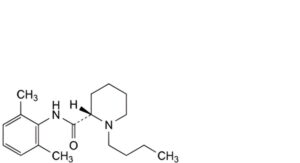
A. (S)-bupivacaine,
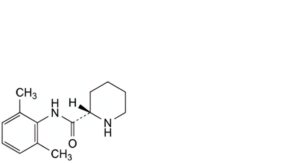
B. (-)-(2S)-N-(2,6-dimethylphenyl)piperidine-2-carboxamide,
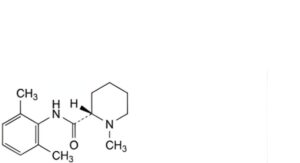
C. (-)-(2S)-N-(2,6-dimethylphenyl)-1-methylpiperidine-2-carboxamide ((S)-mepivacaine),
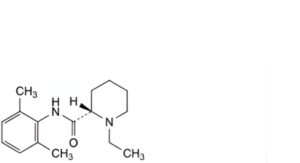
D. (-)-(2S)-N-(2,6-dimethylphenyl)-1-ethylpiperidine-2-carboxamide,
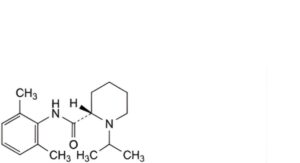
E. (-)-(2S)-N-(2,6-dimethylphenyl)-1(1-methylethyl)piperidine-2-carboxamide,
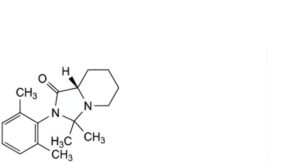
F. (8aS)-2-(2,6-dimethylphenyl)-3,3-dimethylhexahydroimidazo[1,5-a]pyridin-1(5H)-one (acetone adduct),
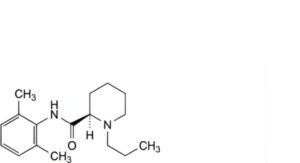
G. (+)-(2R)-N-(2,6-dimethylphenyl)-1-propylpiperidine-2-carboxamide ((R)-ropivacaine),
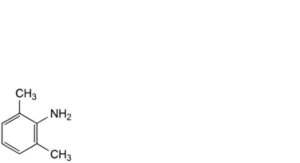
H. 2,6-dimethylaniline.


