



Edition: BP 2025 (Ph. Eur. 11.6 update)
Action and use
Adrenoceptor agonist.
Preparations
Pseudoephedrine Oral Solution
Pseudoephedrine Tablets
Ph Eur
DEFINITION
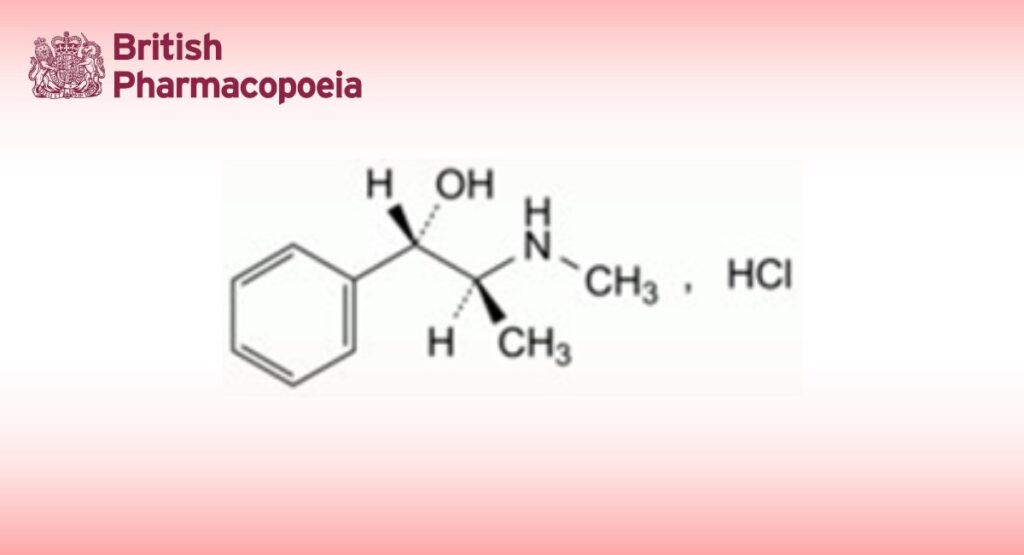
(1S,2S)-2-(Methylamino)-1-phenylpropan-1-ol hydrochloride.
Content
99.0 per cent to 101.0 per cent (dried substance).
CHARACTERS
Appearance
White or almost white, crystalline powder or colourless crystals.
Solubility
Freely soluble in water and in ethanol (96 per cent), sparingly soluble in methylene chloride.
mp
About 184 °C.
IDENTIFICATION
First identification: A, B, D.
Second identification: A, C, D.
A. Specific optical rotation (see Tests).
B. Infrared absorption spectrophotometry (2.2.24).
Comparison pseudoephedrine hydrochloride CRS.
C. Thin-layer chromatography (2.2.27).
Test solution Dissolve 20 mg of the substance to be examined in methanol R and dilute to 10 mL with the same solvent.
Reference solution (a) Dissolve 20 mg of pseudoephedrine hydrochloride CRS in methanol R and dilute to 10 mL with the same solvent.
Reference solution (b) Dissolve 10 mg of ephedrine hydrochloride CRS in reference solution (a) and dilute to 5 mL with reference solution (a).
Plate TLC silica gel plate R.
Mobile phase methylene chloride R, concentrated ammonia R, 2-propanol R (5:15:80 V/V/V). Application 10 µL.
Development Over 2/3 of the plate.
Drying In air.
Detection Spray with ninhydrin solution R and heat at 110 °C for 5 min.
System suitability Reference solution (b):
— the chromatogram shows 2 clearly separated spots.
Results The principal spot in the chromatogram obtained with the test solution is similar in position, colour and size to the principal spot in the chromatogram obtained with reference solution (a).
D. Solution S (see Tests) gives reaction (a) of chlorides (2.3.1).
TESTS
Solution S
Dissolve 1.25 g in carbon dioxide-free water R and dilute to 25.0 mL with the same solvent.
Appearance of solution
Solution S is clear (2.2.1) and colourless (2.2.2, Method II).
Acidity or alkalinity
Dilute 2 mL of solution S to 10 mL with carbon dioxide-free water R. Add 0.1 mL of methyl red solution R and 0.1 mL of 0.01 M sodium hydroxide; the solution is yellow. Add 0.2 mL of 0.01 M hydrochloric acid; the solution is red.
Specific optical rotation (2.2.7)
+ 61.0 to + 62.5 (dried substance), determined on solution S.
Related substances
Liquid chromatography (2.2.29).
Test solution Dissolve 50.0 mg of the substance to be examined in the mobile phase and dilute to 25.0 mL with the mobile phase.
Reference solution (a) Dissolve 20.0 mg of ephedrine hydrochloride CRS (impurity A) in the mobile phase and dilute to 20.0 mL with the mobile phase. Dilute 1.0 mL of this solution to 50.0 mL with the mobile phase.
Reference solution (b) Dilute 1.0 mL of the test solution to 200.0 mL with the mobile phase.
Reference solution (c) Dissolve 10 mg of ephedrine hydrochloride CRS (impurity A) in 5 mL of the test solution and dilute to 100 mL with the mobile phase.
Column:
— size: l = 0.25 m, Ø = 4.6 mm;
— stationary phase: phenylsilyl silica gel for chromatography R (5 µm).
Mobile phase Mix 6 volumes of methanol R and 94 volumes of an 11.6 g/L solution of ammonium acetate R previously adjusted to pH 4.0 with glacial acetic acid R.
Flow rate 1 mL/min.
Detection Spectrophotometer at 257 nm.
Injection 20 µL.
Run time 1.5 times the retention time of pseudoephedrine.
Relative retention With reference to pseudoephedrine (retention time = about 18 min): impurity A = about 0.9.
System suitability Reference solution (c):
— resolution: minimum 2.0 between the peaks due to impurity A and pseudoephedrine; if necessary, reduce the content of methanol in the mobile phase.
Limits:
— impurity A: not more than the area of the principal peak in the chromatogram obtained with reference solution (a) (1.0 per cent);
— any other impurity: for each impurity, not more than the area of the principal peak in the chromatogram obtained with reference solution (b) (0.5 per cent);
— sum of impurities other than A: not more than twice the area of the principal peak in the chromatogram obtained with reference solution (b) (1.0 per cent);
— disregard limit: 0.1 times the area of the principal peak in the chromatogram obtained with reference solution (b) (0.05 per cent).
Loss on drying (2.2.32)
Maximum 0.5 per cent, determined on 1.000 g by drying in an oven at 105 °C.
Sulfated ash (2.4.14)
Maximum 0.1 per cent, determined on 1.0 g.
ASSAY
Dissolve 0.170 g in 30 mL of ethanol (96 per cent) R. Add 5.0 mL of 0.01 M hydrochloric acid. Carry out a potentiometric titration (2.2.20), using 0.1 M sodium hydroxide. Read the volume added between the 2 points of inflexion.
1 mL of 0.1 M sodium hydroxide is equivalent to 20.17 mg of C10H16ClNO.
STORAGE
Protected from light.
IMPURITIES
Specified impurities A.
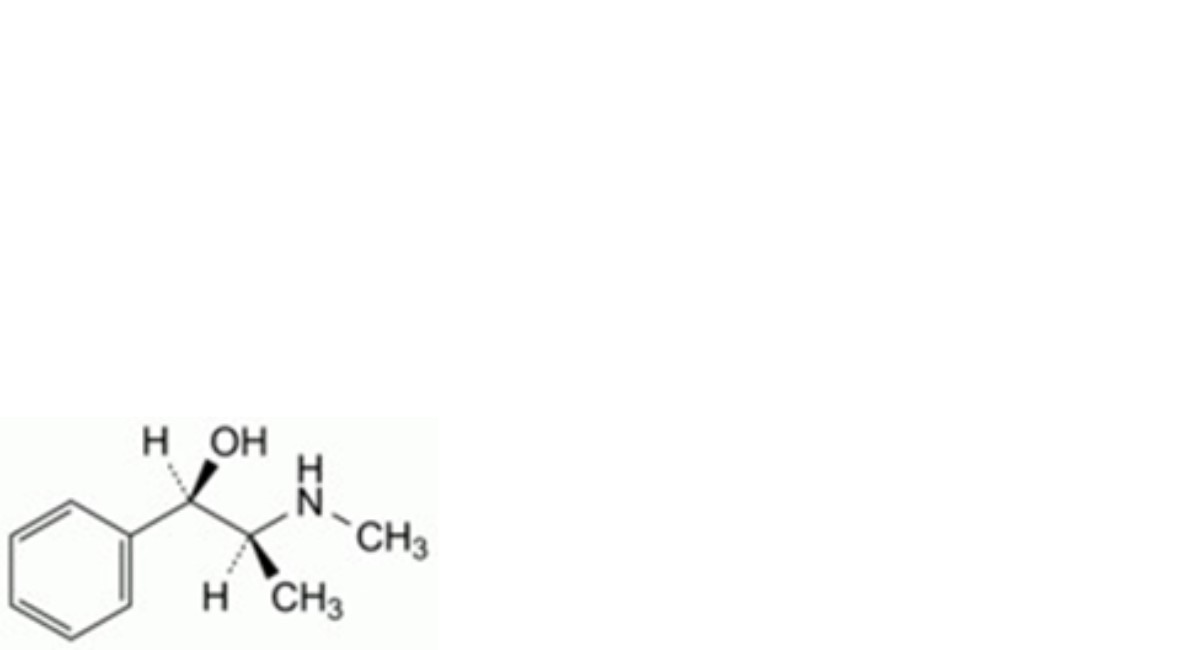
A. (1R,2S)-2-(methylamino)-1-phenylpropan-1-ol (ephedrine).
Ph Eur


