



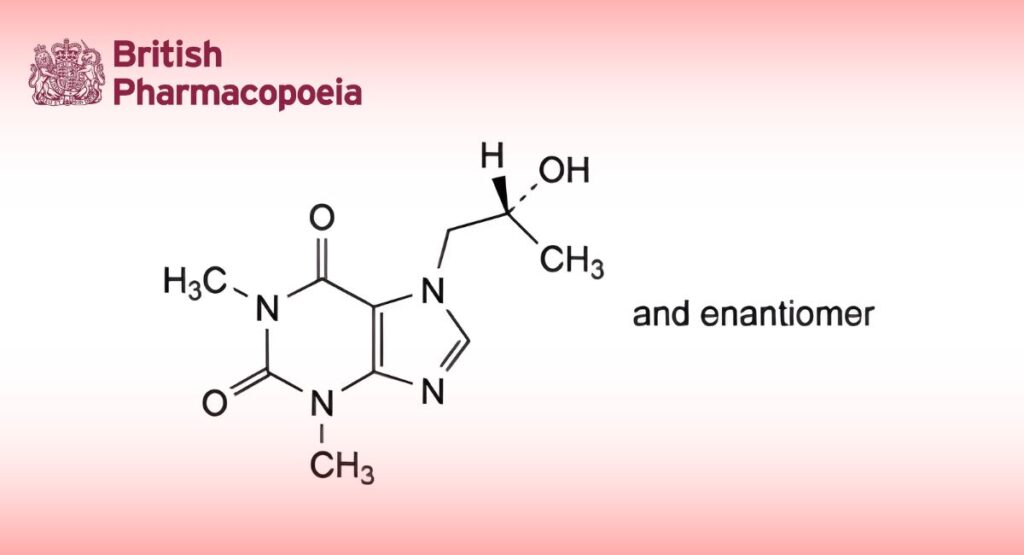
(Ph. Eur. monograph 0526)
C10H14N4O3 238.2 603-00-9
Action and use
Non selective phospho-diesterase inhibitor; treatment of reversible airways obstruction.
DEFINITION
Proxyphylline contains not less than 98.5 per cent and not more than the equivalent of 101.0 per cent of 7-[(2RS)-2-hydroxypropyl]-1,3-dimethyl-3,7-dihydro-1H-purine-2,6-dione, calculated with reference to the dried substance.
CHARACTERS
A white or almost white, crystalline powder, very soluble in water, soluble in ethanol (96 per cent).
IDENTIFICATION
First identification: B, C.
Second identification: A, C, D.
A. Melting point (2.2.14): 134 °C to 136 °C.
B. Examine by infrared absorption spectrophotometry (2.2.24), comparing with the spectrum obtained with proxyphylline CRS. Examine the substances as discs prepared using 0.5 mg to 1 mg of the substance to be examined in 0.3 g of potassium bromide R.
C. Dissolve 1 g in 5 mL of acetic anhydride R and boil under a reflux condenser for 15 min. Allow to cool and add 100 mL of a mixture of 20 volumes of ether R and 80 volumes of light petroleum R. Cool in iced water for at least 20 min, shaking from time to time. Filter, wash the precipitate with a mixture of 20 volumes of ether R and 80 volumes of light petroleum R, recrystallise from alcohol R and dry in vacuo. The crystals melt (2.2.14) at 87 °C to 92 °C.
D. It gives the reaction of xanthines (2.3.1).
TESTS
Solution S
Dissolve 2.5 g in carbon dioxide-free water R and dilute to 50 mL with the same solvent.
Appearance of solution
Solution S is clear (2.2.1) and colourless (2.2.2, Method II).
Acidity or alkalinity
To 10 mL of solution S add 0.25 mL of bromothymol blue solution R1. The solution is yellow or green. Not more than 0.4 mL of 0.01 M sodium hydroxide is required to change the colour of the indicator to blue.
Related substances
Examine by thin-layer chromatography (2.2.27), using silica gel HF254 R as the coating substance.
Test solution: Dissolve 0.3 g of the substance to be examined in a mixture of 20 volumes of water R and 30 volumes of methanol R and dilute to 10 mL with the same mixture of solvents. Prepare immediately before use.
Reference solution (a): Dilute 1 mL of the test solution to 100 mL with methanol R.
Reference solution (b): Dilute 0.2 mL of the test solution to 100 mL with methanol R.
Reference solution (c): Dissolve 10 mg of theophylline R in methanol R, add 0.3 mL of the test solution and dilute to 10 mL with methanol R.
Apply separately to the plate 10 μL of each solution. Develop over a path of 15 cm using a mixture of 1 volume of concentrated ammonia R, 10 volumes of ethanol R and 90 volumes of chloroform R. Allow the plate to dry in air and examine in ultraviolet light at 254 nm. Any spot in the chromatogram obtained with the test solution, apart from the principal spot, is not more intense than the spot in the chromatogram obtained with reference solution (a) (1 per cent) and at most one such spot is more intense than the spot in the chromatogram obtained with reference solution (b) (0.2 per cent). The test is not valid unless the chromatogram obtained with reference solution (c) shows two clearly separated spots.
Chlorides (2.4.4)
Dilute 2.5 mL of solution S to 15 mL with water R. The solution complies with the limit test for chlorides (400 ppm).
Loss on drying (2.2.32)
Not more than 0.5 per cent, determined on 1.000 g by drying in an oven at 105 °C.
Sulfated ash (2.4.14)
Not more than 0.1 per cent, determined on 1.0 g.
ASSAY
In order to avoid overheating in the reaction medium, mix thoroughly throughout and stop the titration immediately after the end-point has been reached.
Dissolve 0.200 g in 3.0 mL of anhydrous formic acid R and add 50.0 mL of acetic anhydride R. Titrate with 0.1 M perchloric acid determining the end-point potentiometrically (2.2.20).
1 mL of 0.1 M perchloric acid is equivalent to 23.82 mg of C10H14N4O3.
STORAGE
Store protected from light.


