



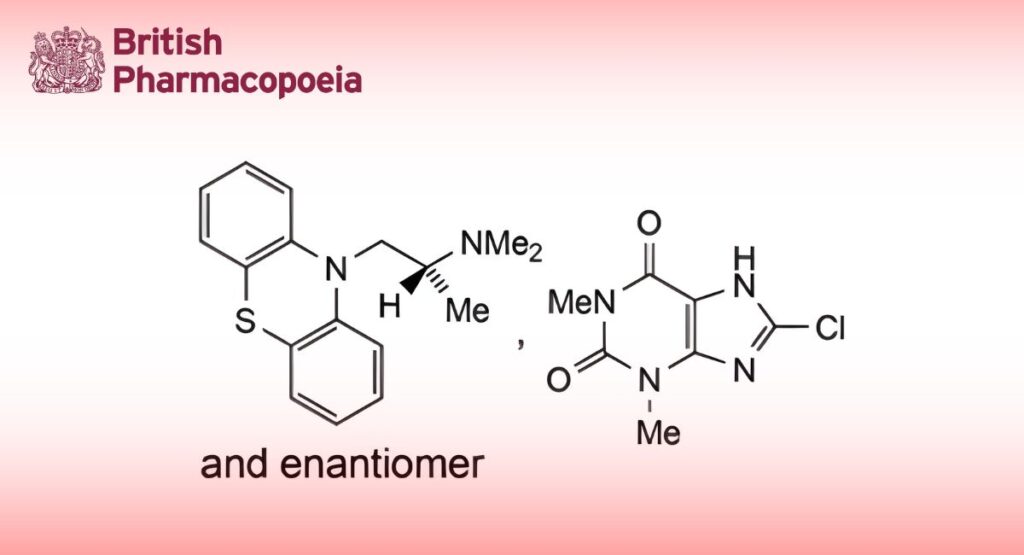
C17H20N2S,C7H7ClN4O2 499.0 17693-51-5
Action and use
Histamine H1 receptor antagonist; antihistamine.
Preparation
Promethazine Teoclate Tablets
DEFINITION
Promethazine Teoclate is the (RS)-dimethyl(2-phenothiazin-10-ylpropyl)amine salt of 8-chlorotheophylline. It contains not less than 98.0% and not more than 101.0% of C17H20N2S,C7H7ClN4O2, calculated with reference to the dried substance.
CHARACTERISTICS
A white or almost white powder.
Very slightly soluble in water; sparingly soluble in ethanol (96%); practically insoluble in ether.
IDENTIFICATION
A. Shake 0.15 g with 2.5 mL of water, add 1 mL of 5M ammonia and extract with 30 mL of ether. Wash the ether extract with 10 mL of water, dry with anhydrous sodium sulfate and evaporate the ether to dryness. Dissolve the residue in 1 mL of chloroform IR. The infrared absorption spectrum of the resulting solution, Appendix II A, is concordant with the reference spectrum of promethazine (RS 297).
B. Dissolve 5 mg in 2 mL of sulfuric acid and allow to stand for 5 minutes. A red colour is produced.
C. Shake 0.4 g with 10 mL of water, add 4 mL of 5M ammonia, shake with two 30-mL quantities of ether and add 4 mL of hydrochloric acid to the aqueous solution. Filter the white precipitate, wash with water and dry at 105°. Dissolve 10 mg of the residue in 1 mL of hydrochloric acid, add 0.1 g of potassium chlorate and evaporate to dryness. A reddish residue remains which becomes purple on exposure to the vapour of ammonia.
TESTS
Chloride
Shake 0.3 g with 30 mL of water for 2 minutes and filter. 15 mL of the filtrate complies with the limit test for chlorides, Appendix VII, but using 2 mL of nitric acid in place of the 1 mL of dilute nitric acid (350 ppm).
Related substances
Carry out the method for thin-layer chromatography, Appendix III A, using a silica gel F254 precoated plate (Merck silica gel 60 F254 plates are suitable) and a mixture of 5 volumes of diethylamine, 10 volumes of acetone and 85 volumes of cyclohexane as the mobile phase. Pour the mobile phase into an unlined tank, immediately place the prepared plate in the tank, close the tank and allow the solvent front to ascend 12 cm above the line of application. Apply separately to the plate 10 μL of each of the following solutions in a mixture of 5 volumes of diethylamine and 95 volumes of methanol. Solution (1) contains 2% w/v of the substance being examined. Solution (2) contains 0.02% w/v of isopromethazine hydrochloride BPCRS. For solution (3) dilute 1 volume of solution (1) to 200 volumes. For solution (4) dilute 1 volume of solution (1) to 500 volumes. Allow the plate to dry in air and examine under ultraviolet light (254 nm). In the chromatogram obtained with solution (1) any spot corresponding to isopromethazine is not more intense than the spot in the chromatogram obtained with solution (2) (1%), any other secondary spot is not more intense than the spot in the chromatogram obtained with solution (3) (0.5%) and not more than three such spots are more intense than the spot in the chromatogram obtained with solution (4) (0.2%). Disregard any spot remaining on the line of application.
Loss on drying
When dried to constant weight at 105°, loses not more than 0.5% of its weight. Use 1 g.
Sulfated ash
Not more than 0.1%, Appendix IX A.
ASSAY
Dissolve 1 g in 200 mL of acetone and carry out Method I for non-aqueous titration, Appendix VIII A, using 3 mL of a saturated solution of methyl orange in acetone as indicator. Each mL of 0.1M perchloric acid VS is equivalent to 49.90 mg of C17H20N2S,C7H7ClN4O2.
STORAGE
Promethazine Teoclate should be protected from light.


