



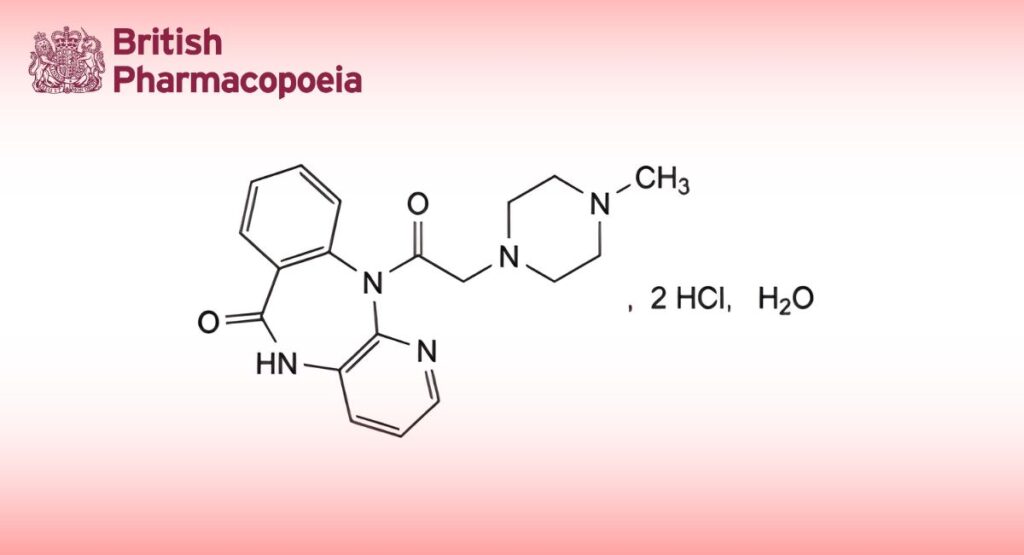
(Pirenzepine Dihydrochloride Monohydrate, Ph. Eur. monograph 2001)
C19H23Cl2N5O2,H2O 442.3
Action and use
Muscarinic M3 receptor antagonist.
DEFINITION
11-[(4-Methylpiperazin-1-yl)acetyl]-5,11-dihydro-6H-pyrido[2,3-b] [1,4]benzodiazepin-6-one dihydrochloride monohydrate.
Content
98.0 per cent to 102.0 per cent (anhydrous substance).
CHARACTERS
Appearance
White or yellowish, crystalline powder.
Solubility
Freely soluble in water, slightly soluble in methanol, very slightly soluble in anhydrous ethanol, practically insoluble in methylene chloride.
IDENTIFICATION
First identification: B, D.
Second identification: A, C, D.
A. Dissolve 30.0 mg in methanol R and dilute to 100.0 mL with the same solvent. Dilute 10.0 mL of the solution to 100.0 mL with methanol R. Examined between 240 nm and 360 nm (2.2.25), the solution shows an absorption maximum at 283 nm. The specific absorbance at the maximum is 190 to 205 (anhydrous substance).
B. Infrared absorption spectrophotometry (2.2.24).
Comparison: pirenzepine dihydrochloride monohydrate CRS.
C. Examine the chromatograms obtained in the test for impurity D.
Results: The principal zone obtained in the chromatogram obtained with test solution (b) is similar in position, colour and size to the principal zone in the chromatogram obtained with reference solution (d).
D. To 0.2 mL of solution S (see Tests) add 1.8 mL of water R. The solution gives reaction (a) of chlorides (2.3.1).
TESTS
Solution S
Dissolve 2.5 g in carbon dioxide-free water R and dilute to 25 mL with the same solvent.
Appearance of solution
Solution S is clear (2.2.1) and not more intensely coloured than reference solution GY5 (2.2.2, Method II).
pH (2.2.3)
1.0 to 2.0 for solution S.
Impurity D
Thin-layer chromatography (2.2.27).
Test solution (a): To 0.10 g add 0.1 mL of concentrated ammonia R and dilute to 10 mL with methanol R.
Test solution (b): Dilute 1 mL of test solution (a) to 10 mL with methanol R.
Reference solution (a): To 0.1 g of pirenzepine dihydrochloride monohydrate CRS add 0.1 mL of concentrated ammonia R and dilute to 10 mL with methanol R.
Reference solution (b): Dissolve 25 mg of methylpiperazine R in methanol R and dilute to 25 mL with the same solvent. Dilute 2.0 mL of the solution to 100 mL with methanol R.
Reference solution (c): Dilute 5 mL of test solution (a) to 100 mL with methanol R. Dilute 4 mL of this solution to 100 mL with methanol R. Mix 1 mL with 1 mL of reference solution (b).
Reference solution (d): Dilute 1 mL of reference solution (a) to 10 mL with methanol R.
Plate: TLC silica gel plate R.
Mobile phase: concentrated ammonia R, methanol R, ethyl acetate R, toluene R (7:25:28:40 V/V/V/V).
Application: 20 μL as zones of 20 mm by 2 mm.
Development: Over 2/3 of the plate.
Drying: In air.
Detection: Expose the plate to iodine vapour until the zone in the chromatogram obtained with reference solution (b) is clearly visible (at most 60 min).
System suitability: The test is not valid unless the chromatogram obtained with reference solution (c) shows 2 clearly separated zones.
Limit:
— impurity D: any zone corresponding to impurity D in the chromatogram obtained with test solution (a) is not more intense than the zone in the chromatogram obtained with reference solution (b) (0.2 per cent).
Related substances
Liquid chromatography (2.2.29).
Test solution: Dissolve 0.30 g of the substance to be examined in water R and dilute to 10.0 mL with the same solvent. To 1.0 mL of the solution add 5 mL of methanol R and dilute to 10.0 mL with mobile phase A.
Reference solution (a): Dilute 2.0 mL of the test solution to 100.0 mL with mobile phase A. Dilute 1.0 mL of this solution to 10.0 mL with mobile phase A.
Reference solution (b): Dissolve 0.1 g of 1-phenylpiperazine R in methanol R and dilute to 10 mL with the same solvent. Mix 1 mL of the solution with 1 mL of the test solution, add 5 mL of methanol R and dilute to 10 mL with mobile phase A.
Column:
— size: l = 0.125 m, Ø = 4.6 mm,
— stationary phase: octadecylsilyl silica gel for chromatography R (5 μm).
Mobile phase:
— mobile phase A: dissolve 2.0 g of sodium dodecyl sulfate R in water R, adjust to pH 3.2 with acetic acid R and dilute to 1000 mL with water R,
— mobile phase B: methanol R,
— mobile phase C: acetonitrile R,
| Time (min) |
Mobile phase A (per cent V/V) |
Mobile phase B (per cent V/V) |
Mobile phase C (per cent V/V) |
| 0 – 15 | 55 → 25 | 30 | 15 → 45 |
| 15 – 18 | 30 → 0 | 45 → 80 |
Flow rate: 1 mL/min.
Detection: Spectrophotometer at 283 nm.
Injection: 10 μL.
System suitability: Reference solution (b):
— resolution: minimum 5.0 between the peaks due to pirenzepine and 1 phenylpiperazine.
Limits:
— any impurity: not more than the peak area of the principal peak in the chromatogram obtained with reference solution (a) (0.2 per cent),
— total: not more than 2.5 times the area of the principal peak in the chromatogram obtained with reference solution (a) (0.5 per cent),
— disregard limit: 0.2 times the area of the principal peak in the chromatogram obtained with reference solution (a) (0.04 per cent).
Water (2.5.12)
3.5 per cent to 5.0 per cent, determined on 0.250 g.
Sulfated ash (2.4.14)
Maximum 0.1 per cent, determined on 1.0 g.
ASSAY
Dissolve 0.300 g in 50 mL of water R. Carry out a potentiometric titration (2.2.20), using 0.1 M sodium hydroxide. Read the volume at the first point of inflection.
1 mL of 0.1 M sodium hydroxide is equivalent to 42.43 mg of C19H23Cl2N5O2.
STORAGE
Protected from light.
IMPURITIES
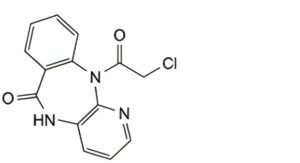
A. 11-(chloroacetyl)-5,11-dihydro-6H-pyrido[2,3-b][1,4]benzodiazepin-6-one,
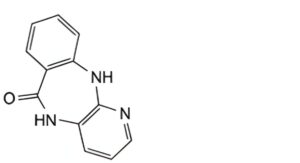
B. 5,11-dihydro-6H-pyrido[2,3-b][1,4]benzodiazepin-6-one,
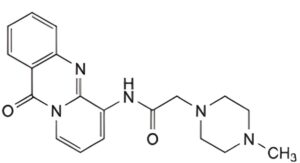
C. 6-[[(4-methylpiperazin-1-yl)acetyl]amino]-11H-pyrido[2,1-b]quinazolin-11-one,
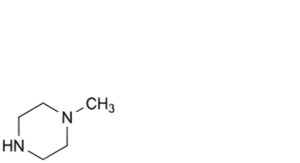
D. 1-methylpiperazine.


