



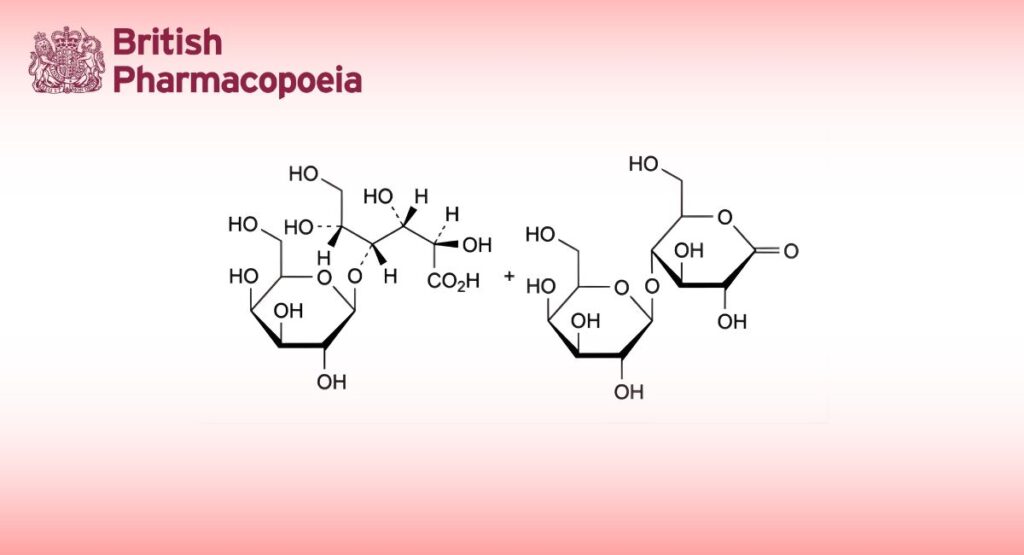
(Ph. Eur. monograph 1647)
C12H22O12 (acid form) 358.3 96-82-2
C12H20O11 (δ-lactone) 340.3 5965-65-1
DEFINITION
Mixture in variable proportions of 4-O-β-D-galactopyranosyl-D-gluconic acid and 4-O-β-D-galactopyranosyl-D-glucono-1,5-lactone.
Content
98.0 per cent to 102.0 per cent (anhydrous substance).
CHARACTERS
Appearance
White or almost white powder.
Solubility
Freely soluble in water, slightly soluble in glacial acetic acid, in anhydrous ethanol and in methanol.
mp
About 125 °C with decomposition.
IDENTIFICATION
A. Infrared absorption spectrophotometry (2.2.24).
Comparison: lactobionic acid CRS.
If the spectra obtained show differences, dissolve the substance to be examined and the reference substance separately in water R, dry at 105 °C and record new spectra using the residues.
B. Thin-layer chromatography (2.2.27).
Test solution: Dissolve 10 mg of the substance to be examined in water R and dilute to 1 mL with the same solvent.
Reference solution: Dissolve 10 mg of lactobionic acid CRS in water R and dilute to 1 mL with the same solvent.
Plate: TLC silica gel plate R.
Mobile phase: concentrated ammonia R1, ethyl acetate R, water R, methanol R (2:2:2:4 V/V/V/V).
Application:5 μL.
Development: Over 3/4 of the plate.
Detection: Spray 3 times with ammonium molybdate solution R6 and heat in an oven at 110 °C for 15 min.
Results: The principal spot in the chromatogram obtained with the test solution is similar in position and colour to the principal spot in the chromatogram obtained with the reference solution.
TESTS
Appearance of solution
The solution is clear (2.2.1) and not more intensely coloured than reference solution Y5 (2.2.2, Method II).
Dissolve 3.0 g in 25 mL of water R.
Specific optical rotation (2.2.7)
+ 23.0 to + 29.0 (anhydrous substance).
Dissolve 1.0 g in 80 mL of water R and dilute to 100.0 mL with the same solvent.
Allow to stand for 24 h.
Reducing sugars
Maximum 0.2 per cent, calculated as glucose.
Dissolve 5.0 g in 25 mL of water R with the aid of gentle heat. Cool and add 20 mL of cupri-citric solution R and a few glass beads. Heat so that boiling begins after 4 min and maintain boiling for 3 min. Cool rapidly and add 100 mL of a 2.4 per cent V/V solution of glacial acetic acid R and 20.0 mL of 0.025 M iodine. With continuous shaking, add 25 mL of a mixture of 6 volumes of hydrochloric acid R and 94 volumes of water R and, when the precipitate has dissolved, titrate the excess of iodine with 0.05 M sodium thiosulfate using 1 mL of starch solution R, added towards the end of the titration, as indicator. Not less than 12.8 mL of 0.05 M sodium thiosulfate is required.
Water (2.5.12)
Maximum 5.0 per cent, determined on 0.50 g.
Use a mixture of 1 volume of formamide R and 2 volumes of methanol R as solvent.
Total ash (2.4.16)
Maximum 0.2 per cent.
ASSAY
Dissolve 0.350 g in 50 mL of carbon dioxide-free water R, previously heated to 30 °C. Immediately titrate with 0.1 M sodium hydroxide and determine the 2 equivalence points potentiometrically (2.2.20).
The first equivalence point (V1) corresponds to the acid form of lactobionic acid and the second equivalence point (V2 -V1) corresponds to the δ-lactone form.
1 mL of 0.1 M sodium hydroxide is equivalent to 35.83 mg of C12H22O12.
1 mL of 0.1 M sodium hydroxide is equivalent to 34.03 mg of C12H20O11.
The sum of the 2 results is expressed as a percentage content of lactobionic acid.


