




(Ph. Eur. monograph 2165)
9049-76-7
DEFINITION
Hydroxypropyl starch is a partially substituted 2-hydroxypropylether of Maize starch (0344), Potato starch (0355), cassava starch, Rice starch (0349) or Pea starch (2403) chemically modified by etherification with
the reagent propylene oxide. In addition, this starch may be partially hydrolysed using acids or enzymes to
obtain ‘thinned starch’ with reduced viscosity.
Content
— hydroxypropyl groups: 0.5 per cent to 7.0 per cent.
PRODUCTION
The production of hydroxypropyl starch shall be in compliance with the requirements of the European
legislation for food additives.
Mixing of starches from different botanical sources prior to chemical modification is not allowed.
CHARACTERS
Appearance
White or slightly yellowish powder.
Solubility
Practically insoluble in cold water and in ethanol (96 per cent).
IDENTIFICATION
A. Examined under a microscope, using not less than 20 × magnification and using a mixture of equal volumes of glycerol R and water R, it appears as follows according to the botanical source stated on the
label.
— Maize-based hydroxypropyl starch: it presents either angular polyhedral granules of irregular sizes
with diameters of about 2-23 μm or rounded or spheroidal granules of irregular sizes with diameters of
about 25-35 μm; the central hilum consists of a distinct cavity or 2-to-5-rayed cleft and there are no
concentric striations; between orthogonally orientated polarising plates or prisms, the starch granules
show a distinct black cross intersecting at the hilum.
— Potato-based hydroxypropyl starch: it presents granules, either irregularly shaped, ovoid or pear-shaped, usually 30-100 μm in size but occasionally exceeding 100 μm, or rounded, 10-35 μm in size; there are occasional compound granules having 2-4 components; the ovoid and pear-shaped granules
have an eccentric hilum and the rounded granules a centric or slightly eccentric hilum; all granules
show clearly visible concentric striations; between orthogonally orientated polarising plates or prisms,
the starch granules show a distinct black cross intersecting at the hilum.
— Cassava-based hydroxypropyl starch: it presents spherical granules with one truncated side,
typically 5-35 μm in diameter and having a circular or several-rayed central cleft; some granules may
also be egg-shaped or cap-shaped; the hilum is centric, sometimes slightly fissured; between
orthogonally orientated polarising plates or prisms, the starch granules show a distinct black cross
intersecting at the hilum.
— Rice-based hydroxypropyl starch: it presents polyhedral, simple granules 1-10 μm, mostly 4-6 μm,
in size; these simple granules often gather in ellipsoidal, compound granules 50-100 μm in diameter;
the granules have a poorly visible central hilum and there are no concentric striations; between
orthogonally orientated polarising plates or prisms, the starch granules show a distinct black cross
intersecting at the hilum.
— Pea-based hydroxypropyl starch: it presents a majority of large elliptical granules, 25-45 μm in size, sometimes irregular or reniform; it also presents a minority of small rounded granules, 5-8 μm in size;
granules can present cracks or irregularities; sometimes, granules show barely visible concentric
striations; exceptionally, granules show a slit along the main axis; between orthogonally orientated
polarising plates or prisms, the starch granules show a distinct black cross.
B. Suspend 1 g in 50 mL of water R, boil for 1 min and cool. A translucent or clear mucilage is formed.
C. To 1 mL of the mucilage obtained in identification test B add 0.05 mL of iodine solution R1. An orange-
red or dark blue colour is produced, which disappears on heating.
D. Introduce 0.1 g into a 100 mL volumetric flask and add 12.5 mL of dilute sulfuric acid R. Place the flask
in a water-bath and heat until the sample is dissolved. Cool and dilute to 100 mL with water R. Introduce
1 mL of this solution into a 25 mL graduated test-tube with glass stopper and, with the tube immersed in cold water, add dropwise 8 mL of sulfuric acid R. Mix well and place the tube in a water-bath for exactly 3 min. Immediately transfer the tube to an ice-bath until the solution is chilled. Add 0.6 mL of ninhydrin solution R2, carefully allowing the reagent to run down the walls of the test-tube. Immediately shake well, and place the tube in a water-bath at 25 °C for 100 min. Dilute to 25 mL with sulfuric acid R and mix by inverting the tube several times. Do not shake. A violet colour develops within 5 min.
TESTS
pH (2.2.3)
4.5 to 8.0.
Shake 5.0 g with 25.0 mL of carbon dioxide-free water R for 60 s. Allow to stand for 15 min.
Foreign matter
Examined under a microscope using a mixture of equal volumes of glycerol R and water R, not more than
traces of matter other than starch granules are present.
Oxidising substances (2.5.30)
Maximum 20 ppm, calculated as H2O2
Sulfur dioxide (2.5.29)
Maximum 50 ppm.
Iron (2.4.9)
— For hydroxypropyl starch obtained from maize, potato, cassava or rice: maximum 20 ppm.
Shake 1.0 g with 20 mL of dilute hydrochloric acid R. Filter. The filtrate complies with the test for iron.
— For hydroxypropyl starch obtained from pea: maximum 50 ppm.
Shake 1.0 g with 50 mL of dilute hydrochloric acid R. Filter. The filtrate complies with the test for iron.
Loss on drying
(2.2.32) determined on 1.000 g by drying in an oven at 130 °C for 90 min:
— maximum 15.0 per cent for hydroxypropyl starch obtained from maize, cassava, rice or pea;
— maximum 20.0 per cent for hydroxypropyl starch obtained from potato.
Sulfated ash (2.4.14)
Maximum 0.6 per cent, determined on 1.0 g.
Microbial contamination
TAMC: acceptance criterion 103 CFU/g (2.6.12).
TYMC: acceptance criterion 102 CFU/g (2.6.12).
Absence of Escherichia coli (2.6.13).
Absence of Salmonella (2.6.13).
ASSAY
Nuclear magnetic resonance spectrometry (2.2.33).
Internal standard solution: Disperse 50.0 mg of 3-trimethylsilyl-1-propanesulfonic acid sodium salt CRS in about 5 g of deuterium oxide R1, weighed to the nearest 0.1 mg. Store in a sealed bottle.
Test solution: Disperse 20 g of the substance to be examined in 200.0 mL of carbon dioxide-free water R at room temperature. Agitate for 15 min and filter. Repeat the operation twice. If problems of poor dispersibility or slow filtration are encountered, use cooled carbon dioxide-free water R for the washing operation. Dry the washed starch for at least 4 h in an oven in vacuo at 30 ± 5 °C. Determine the moisture content (W) on 5 g of this washed and dried sample using the test for loss on drying. Weigh 12.0 mg (dried substance) of the washed and dried sample in a 5 mm NMR tube. Add 0.1 mL of deuterium chloride solution R and 0.75 mL of deuterium oxide R1. Cap the tube, mix, and place it in a water-bath until a clear solution is obtained (3 min to 1 h maximum). When a clear solution is obtained, allow to cool to room temperature. Dry the exterior of the tube and weigh to the nearest 0.1 mg. Add 0.05 mL of the internal standard solution and weigh to the nearest 0.1 mg. Determine the mass of the internal standard solution introduced. Mix thoroughly.
Apparatus FT-NMR spectrometer at minimum 300 MHz.
Acquisition of 1H NMR spectra The following parameters may be used:
— sweep width: 8 ppm (-1.0 to + 7 ppm);
— irradiation frequency offset: none;
— time domain: 64 K at least;
— pulse width: 90°;
— pulse delay: 10 s;
— dummy scans: 0;
— number of scans: 8.
Use the CH3 signal of the internal standard for shift referencing. The shift of the singlet is set to 0 ppm.
Record the FID signal.
Call the integration sub-routine after phase corrections and baseline correction between -0.5 ppm and
+ 6 ppm.
Measure the peak areas of the doublet from the methyl groups of the hydroxypropyl function at + 1.2 ppm
(A2), and of the methyl groups at 0 ppm of the internal standard (A1) without 13C-satellites.
Results: Measure the signal coming from the 3 protons of the methyl group in the hydroxypropyl function; calculate the hydroxypropyl groups content as a percentage m/m (dried substance) using the following expression:
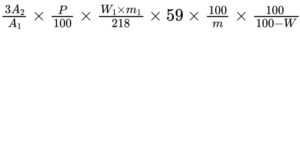
3 = numerical value representing the 3 methyl groups in the internal standard.
A1 = area of the methyl groups in the internal standard;
A2 = area of the methyl groups of hydroxypropyl;
P = percentage content of 3-trimethylsilyl-1-propanesulfonic acid sodium salt CRS;
W1 = mass fraction of the internal standard in the internal standard solution, in milligrams per gram;
m1 = mass of the internal standard solution in the NMR tube, in grams;
218 = molar mass of the internal standard, in grams per mole;
59 = molar mass of the hydroxypropyl group, in grams per mole;
m = mass of the washed and dried sample in the NMR tube, in milligrams;
W = moisture content, as a percentage m/m.
LABELLING
The label states the botanical source of the starch and the type of modification.
FUNCTIONALITY-RELATED CHARACTERISTICS
This section provides information on characteristics that are recognised as being relevant control parameters for one or more functions of the substance when used as an excipient (see chapter 5.15). Some of the characteristics described in the Functionality-related characteristics section may also be present in the mandatory part of the monograph since they also represent mandatory quality criteria. In such cases, a cross-reference to the tests described in the mandatory part is included in the Functionality-related characteristics section. Control of the characteristics can contribute to the quality of a medicinal product by improving the consistency of the manufacturing process and the performance of the medicinal product during use. Where control methods are cited, they are recognised as being suitable for the purpose, but other methods can also be used. Wherever results for a particular characteristic are reported, the control method must be indicated.
The following characteristics may be relevant for hydroxypropyl starch used as film former in oral solid
dosage forms.
Hydroxypropyl groups content
(see Assay).
Appearance of a film
Dissolve 15 g in 50 mL of water R, heat at 80 °C for 10 min and spread on glass plate. A clear film is formed.


