



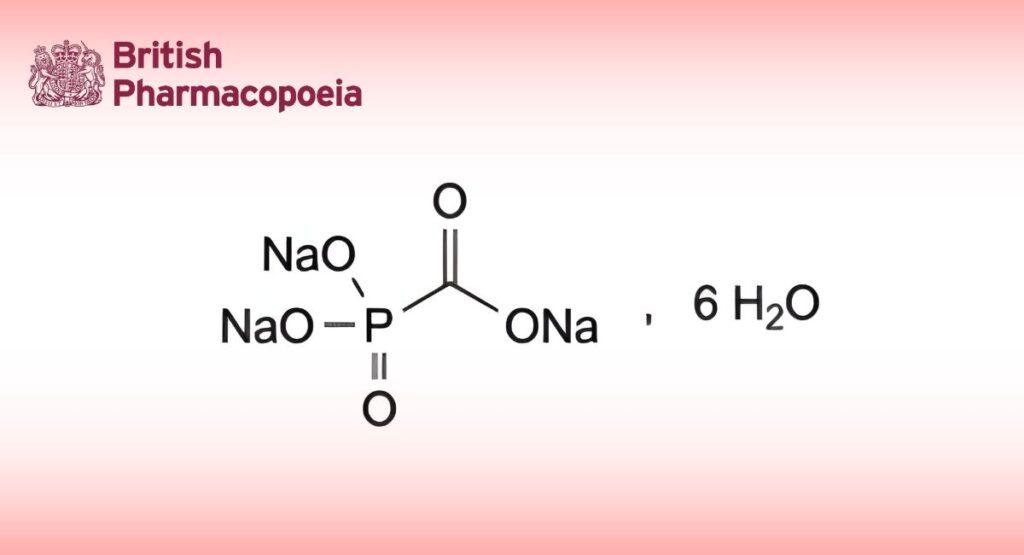
(Foscarnet Sodium Hexahydrate, Ph. Eur. monograph 1520)
CNa3O5P,6H2O 300.0 34156-56-4
Action and use
Antiviral (cytomegalovirus).
Preparation
Foscarnet Infusion
DEFINITION
Trisodium phosphonatoformate hexahydrate.
Content
98.5 per cent to 101.0 per cent (dried substance).
CHARACTERS
Appearance
White or almost white, crystalline powder.
Solubility
Soluble in water, practically insoluble in ethanol (96 per cent).
IDENTIFICATION
A. Infrared absorption spectrophotometry (2.2.24).
Comparison foscarnet sodium hexahydrate CRS.
B. It gives reaction (a) of sodium (2.3.1).
TESTS
Solution S
Dissolve 0.5 g in carbon dioxide-free water R and dilute to 25 mL with the same solvent.
Appearance of solution
Solution S is not more opalescent than reference suspension I (2.2.1) and is colourless (2.2.2, Method II).
pH (2.2.3)
9.0 to 11.0 for solution S.
Impurity D
Gas chromatography (2.2.28).
Test solution: Dissolve 0.250 g of the substance to be examined in 9.0 mL of a 6 g/L solution of glacial acetic acid R using a magnetic stirrer. Add 1.0 mL of anhydrous ethanol R and mix.
Reference solution: Dissolve 25.0 mg of foscarnet impurity D CRS in anhydrous ethanol R and dilute to 100.0 mL with the same solvent. Dilute 1.0 mL of this solution to 10.0 mL with anhydrous ethanol R.
Column:
— material: fused silica;
— size: l = 25 m, Ø = 0.31 mm;
— stationary phase: phenyl(5)methyl(95)polysiloxane R (film thickness 0.5 μm).
Carrier gas helium for chromatography R.
Split ratio 1:20.
Temperature:
| Time (min) |
Temperature (°C) |
|
| Column | 0 – 8 | 100 → 180 |
| Injection port | 200 | |
| Detector | 250 |
Detection Flame ionisation.
Injection 3 μL
Limit:
— impurity D: not more than the area of the principal peak in the chromatogram obtained with the reference solution (0.1 per cent).
Related substances
Liquid chromatography (2.2.29).
Test solution: Dissolve 25 mg of the substance to be examined in the mobile phase and dilute to 10.0 mL with the mobile phase.
Reference solution (a): Dilute 1.0 mL of the test solution to 50.0 mL with the mobile phase. Dilute 1.0 mL of this solution to 10.0 mL with the mobile phase.
Reference solution (b): Dissolve 5 mg of foscarnet impurity B CRS in the mobile phase, add 2 mL of the test solution and dilute to 50 mL with the mobile phase.
Reference solution (c): Dissolve the contents of a vial of foscarnet impurity mixture CRS (impurities A and C) in 1 mL of mobile phase.
Column:
— size: l = 0.10 m, Ø = 4.6 mm;
— stationary phase: octadecylsilyl silica gel for chromatography R (3 μm).
Mobile phase: Dissolve 3.22 g of sodium sulfate decahydrate R in water for chromatography R, add 3 mL of glacial acetic acid R and 6 mL of a 44.61 g/L solution of sodium pyrophosphate R and dilute to 1000 mL with water for chromatography R (solution A); dissolve 3.22 g of sodium sulfate decahydrate R in water for chromatography R, add 6.8 g of sodium acetate R and 6 mL of a 44.61 g/L solution of sodium pyrophosphate R and dilute to 1000 mL with water for chromatography R (solution B). Mix about 700 mL of solution A and about 300 mL of solution B to obtain a solution of pH 4.4. To 1000 mL of this solution, add 0.25 g of tetrahexylammonium hydrogen sulfate R and 100 mL of methanol R1.
Flow rate 1.0 mL/min.
Detection Spectrophotometer at 230 nm.
Injection 40 μL.
Run time 2.5 times the retention time of foscarnet.
Identification of impurities: Use the chromatogram supplied with foscarnet impurity mixture CRS and the chromatogram obtained with reference solution (c) to identify the peaks due to impurities A and C; use the chromatogram obtained with reference solution (b) to identify the peak due to impurity B.
Relative retention: With reference to foscarnet (retention time = about 5 min): impurity A = about 0.7;
impurity B = about 1.5; impurity C = about 2.0.
System suitability Reference solution (b):
— resolution: minimum 7.0 between the peaks due to foscarnet and impurity B.
Limits:
— impurities A, B, C: for each impurity, not more than the area of the principal peak in the chromatogram obtained with reference solution (a) (0.2 per cent);
— unspecified impurities: for each impurity, not more than 0.25 times the area of the principal peak in the
chromatogram obtained with reference solution (a) (0.05 per cent);
— total: not more than twice the area of the principal peak in the chromatogram obtained with reference solution (a) (0.4 per cent);
— disregard limit: 0.2 times the area of the principal peak in the chromatogram obtained with reference solution (a) (0.04 per cent); disregard any peak with a relative retention less than 0.6.
Phosphate and phosphite
Liquid chromatography (2.2.29).
Test solution: Dissolve 60.0 mg of the substance to be examined in water R and dilute to 25.0 mL with the same solvent.
Reference solution (a): Dissolve 28 mg of sodium dihydrogen phosphate monohydrate R in water R and dilute to 100 mL with the same solvent.
Reference solution (b): Dissolve 43 mg of sodium phosphite pentahydrate R in water R and dilute to 100 mL with the same solvent.
Reference solution (c): Dilute 1.0 mL of reference solution (a) and 1.0 mL of reference solution (b) to 25 mL with water R.
Reference solution (d): Dilute 3 mL of reference solution (a) and 3 mL of reference solution (b) to 25 mL with water R.
Column:
— size: l = 0.05 m, Ø = 4.6 mm;
— stationary phase: anion-exchange resin R.
Mobile phase Dissolve 0.102 g of potassium hydrogen phthalate R in water for chromatography R, add 2.5 mL of 1 M nitric acid and dilute to 1000 mL with water for chromatography R.
Flow rate 1.4 mL/min.
Detection Spectrophotometer at 290 nm (indirect detection).
Injection 20 μL of the test solution and reference solutions (c) and (d).
System suitability Reference solution (d):
— resolution: minimum 2.0 between the peaks due to phosphate (1 peak) and phosphite;
— signal-to-noise ratio: minimum 10 for the principal peak.
Limits:
— phosphate: not more than the area of the corresponding peak in the chromatogram obtained with reference solution (c) (0.3 per cent);
— phosphite: not more than the area of the corresponding peak in the chromatogram obtained with reference solution (c) (0.3 per cent).
Loss on drying (2.2.32)
35.0 per cent to 37.0 per cent, determined on 1.000 g by drying in an oven at 150 °C.
Bacterial endotoxins (2.6.14)
Less than 83.3 IU/g, if intended for use in the manufacture of parenteral preparations without a further appropriate procedure for the removal of bacterial endotoxins.
ASSAY
Dissolve 0.200 g in 50 mL of water R. Titrate with 0.05 M sulfuric acid, determining the end-point potentiometrically (2.2.20) at the 1 point of inflexion.
1 mL of 0.05 M sulfuric acid is equivalent to 19.20 mg of CNa3O5P.
STORAGE
Protected from light.
IMPURITIES
Specified impurities A, B, C, D.
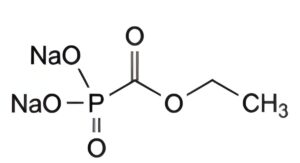
A. disodium (ethoxycarbonyl)phosphonate,
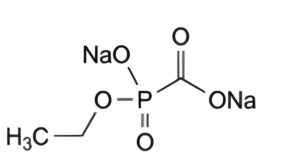
B. disodium (ethoxyoxydophosphanyl)formate,
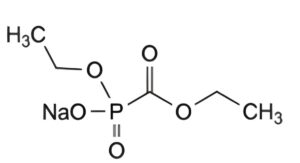
C. ethyl sodium (ethoxycarbonyl)phosphonate,
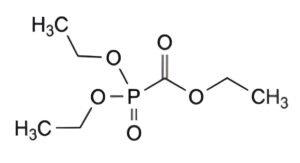
D. ethyl (diethoxyphosphoryl)formate.


