Edition: BP 2025 (Ph. Eur. 11.6 update)
Celiprolol Tablets
General Notices
Action and use
Beta-adrenoceptor antagonist.
DEFINITION
Celiprolol Tablets contain Celiprolol Hydrochloride.
The tablets comply with the requirements stated under Tablets and with the following requirements.
Content of celiprolol hydrochloride, C20H33N3O4,HCl
95.0 to 105.0% of the stated amount.
IDENTIFICATION
Mix with the aid of ultrasound a quantity of the powdered tablets containing 200 mg of Celiprolol Hydrochloride with 100 mL of dichloromethane for 30 minutes, filter (Whatman filter paper No. 42 is suitable), remove the dichloromethane using a rotary evaporator and dry the residue over phosphorus pentoxide at 110° at a pressure not exceeding 2 kPa for 1 hour. The infrared absorption spectrum of the dried residue, Appendix II A, is concordant with the reference spectrum of celiprolol hydrochloride (RS 420).
TESTS
Dissolution
Comply with the dissolution test for tablets and capsules, Appendix XII B1.
TEST CONDITIONS
(a) Use Apparatus 2 rotating the paddle at 50 revolutions per minute.
(b) Use 900 mL of water at a temperature of 37° as the medium.
PROCEDURE
(1) Withdraw a sample of 10 mL of the medium and filter; to 1 volume of the filtrate add sufficient water to produce 20 volumes and filter using a 0.45 µm membrane filter. Measure the absorbance of the filtrate, suitably diluted with water if necessary, at the maximum at 231 nm, Appendix II B, using water in the reference cell.
(2) Measure the absorbance of a 0.011% w/v solution of celiprolol hydrochloride BPCRS in the dissolution medium at the maximum at 231 nm, Appendix II B, using water in the reference cell.
DETERMINATION OF CONTENT
Calculate the total content of celiprolol hydrochloride, C20H33N3O4,HCl, in the medium using the declared content of C20H33N3O4,HCl in celiprolol hydrochloride BPCRS.
Related substances
Carry out method for liquid chromatography, Appendix III D, using the following solutions.
(1) Disperse with the aid of ultrasound a quantity of the powdered tablets containing 0.1 g of Celiprolol Hydrochloride in 100 mL of the mobile phase for 15 minutes with occasional shaking, cool and filter using a 0.45-µm membrane filter. (2) Dilute 1 volume of solution (1) to 50 volumes with the mobile phase and further dilute 1 volume of this solution to 20 volumes with the mobile phase.
(3) Prepare a solution containing 0.1% w/v of celiprolol hydrochloride BPCRS in water, add 5 drops of 5M sodium hydroxide and heat at 70° for 20 minutes (generation of impurity A).
CHROMATOGRAPHIC CONDITIONS
(a) Use a stainless steel column (30 cm × 3.9 mm) packed with octadecylsilyl silica gel for chromatography (10 µm) (Waters µBondapak is suitable).
(b) Use isocratic elution and the mobile phase described below.
(c) Use a flow rate of 1.5 mL per minute.
(d) Use ambient column temperature.
(e) Use a detection wavelength of 233 nm.
(f) Inject 20 µL of each solution.
(g) For solution (1) allow the chromatography to proceed for twice the retention time of the principal peak.
MOBILE PHASE
A mixture of 25 volumes of acetonitrile and 75 volumes of 0.025M sodium dihydrogen phosphate monohydrate adjusted to pH 3.0 with 3M orthophosphoric acid. If necessary adjust the composition of the mobile phase so that, in the chromatogram obtained with solution (3), the peak due to celiprolol impurity A is resolved from the solvent front.
SYSTEM SUITABILITY
The test is not valid unless, in the chromatogram obtained with solution (3), the peak due to celiprolol impurity A is resolved from the solvent front.
LIMITS
In the chromatogram obtained with solution (1):
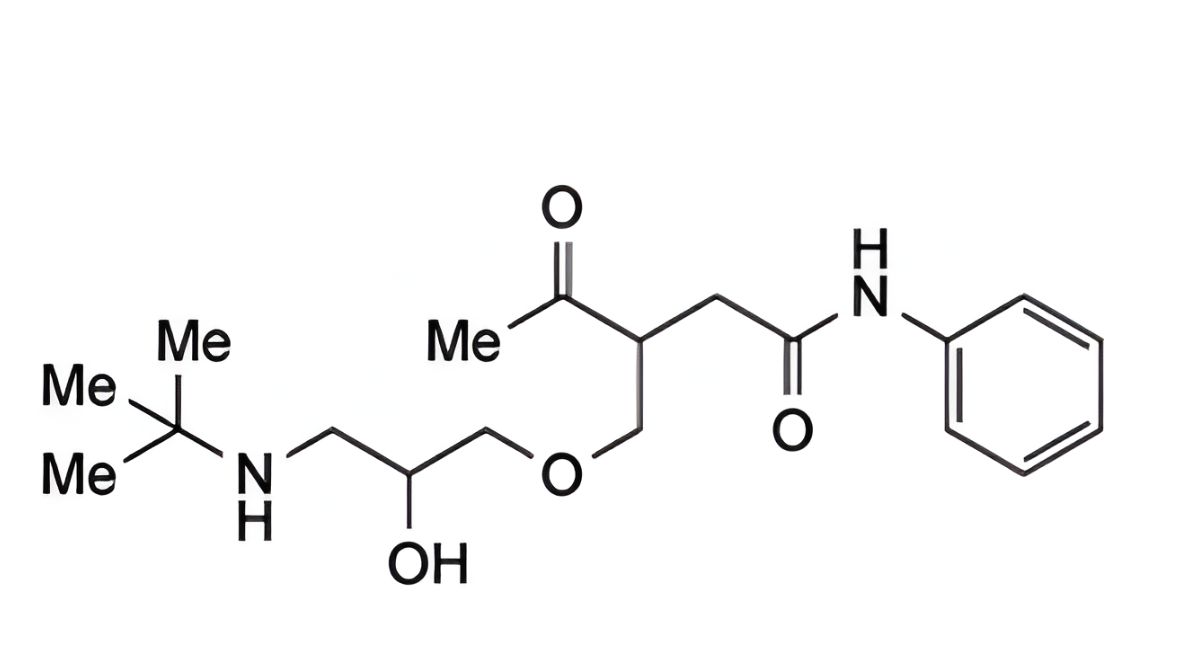
the area of any peak due to celiprolol impurity A is not greater than twice the area of the principal peak in the chromatogram obtained with solution (2) (0.2%);
the area of any other secondary peak is not greater than the area of the principal peak in the chromatogram obtained with solution (2) (0.1%);
not more than one such peak has an area not greater than 3 times the area of the principal peak in the chromatogram obtained with solution (2) (0.3%);
the sum of the areas of any secondary peaks is not greater than 5 times the area of the principal peak in the chromatogram obtained with solution (2) (0.5%).
Disregard any peak with an area of less than a fifth of the area of the peak in the chromatogram obtained with solution (2) (0.02%).
ASSAY
Carry out method for liquid chromatography, Appendix III D, using the following solutions.
(1) Disperse with the aid of ultrasound a quantity of the powdered tablets containing 0.1 g of Celiprolol Hydrochloride in 100 mL of the mobile phase for 15 minutes, cool and filter. Dilute 1 volume of the filtrate to 50 volumes with the mobile phase and filter using a 0.45 µm membrane filter.
(2) 0.002% w/v solution of celiprolol hydrochloride BPCRS in the mobile phase.
CHROMATOGRAPHIC CONDITIONS
The chromatographic conditions described under Related substances may be used.
DETERMINATION OF CONTENT
Calculate the content of C20H33N3O4,HCl in the tablets using the declared content of C20H33N3O4,HCl in celiprolol hydrochloride BPCRS.
STORAGE
Celiprolol Tablets should be protected from light.
IMPURITIES
The impurities limited by the requirements of this monograph include those listed under Celiprolol Hydrochloride and the following: