(Ph. Eur. monograph 0068)
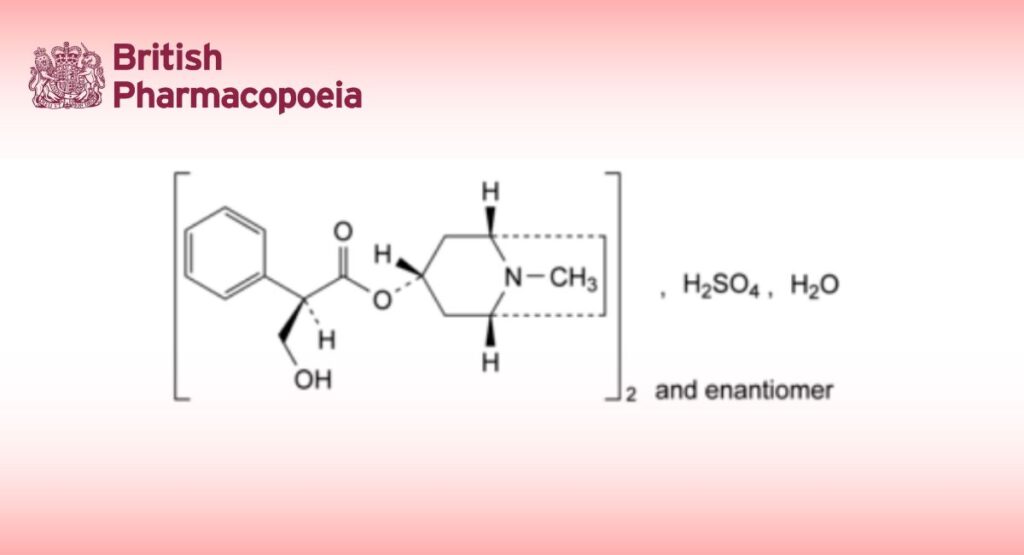
C34H48N2O10S,H2O 695 5908-99-6
Action and use
Anticholinergic.
Preparations
Atropine Eye Drops
Atropine Eye Ointment
Atropine Injection
Atropine Oral Solution
Atropine Tablets
DEFINITION
Bis[(1R,3r,5S)-8-methyl-8-azabicyclo[3.2.1]oct-3-yl (2RS)-3-hydroxy-2-phenylpropanoate] sulfate monohydrate.
Content
99.0 per cent to 101.0 per cent (anhydrous substance).
CHARACTERS
Appearance
White or almost white, crystalline powder or colourless crystals.
Atropine Sulfate
Solubility
Very soluble in water, freely soluble in ethanol (96 per cent).
IDENTIFICATION
First identification: A, B, E.
Second identification: C, D, E, F.
A. Optical rotation (see Tests).
B. Infrared absorption spectrophotometry (2.2.24).
Comparison atropine sulfate CRS.
C. Dissolve about 50 mg in 5 mL of water R and add 5 mL of picric acid solution R. The precipitate, washed with water R and dried at 100-105 °C for 2 h, melts (2.2.14) at 174 °C to 179 °C.
D. To about 1 mg add 0.2 mL of fuming nitric acid R and evaporate to dryness in a water-bath. Dissolve the residue in 2 mL of acetone R and add 0.1 mL of a 30 g/L solution of potassium hydroxide R in methanol R. A violet colour develops.
E. It gives the reactions of sulfates (2.3.1).
F. It gives the reaction of alkaloids (2.3.1).
TESTS
pH (2.2.3)
4.5 to 6.2.
Dissolve 0.6 g in carbon dioxide-free water R and dilute to 30 mL with the same solvent.
Optical rotation (2.2.7)
-0.50° to + 0.05° (measured in a 2 dm tube).
Dissolve 2.50 g in water R and dilute to 25.0 mL with the same solvent.
Related substances
Liquid chromatography (2.2.29).
Test solution Dissolve 24 mg of the substance to be examined in mobile phase A and dilute to 100.0 mL with mobile phase A.
Reference solution (a): Dilute 1.0 mL of the test solution to 100.0 mL with mobile phase A. Dilute 1.0 mL of this solution to 10.0 mL with mobile phase A.
Reference solution (b): Dissolve 5 mg of atropine impurity B CRS in the test solution and dilute to 20 mL with the test solution. Dilute 5 mL of this solution to 25 mL with mobile phase A.
Reference solution (c): Dissolve the contents of a vial of atropine for peak identification CRS (containing impurities A, D, E, F, G and H) in 1 mL of mobile phase A.
Reference solution (d): Dissolve 5 mg of tropic acid R (impurity C) in mobile phase A and dilute to 10 mL with mobile phase A. Dilute 1 mL of the solution to 100 mL with mobile phase A. Dilute 1 mL of this solution to 10 mL with mobile phase A.
Column:
— size: l = 0.10 m, Ø = 4.6 mm;
— stationary phase: polar end-capped octadecylsilyl silica gel for chromatography R (3 μm).
Mobile phase:
— mobile phase A: dissolve 3.5 g of sodium dodecyl sulfate R in 606 mL of a 7.0 g/L solution of potassium dihydrogen phosphate R previously adjusted to pH 3.3 with a 5.8 g/L solution of phosphoric acid R, and mix with 320 mL of acetonitrile R1;
— mobile phase B: acetonitrile R1;
| Time (min) |
Mobile phase A (per cent V/V) |
Mobile phase B (per cent V/V) |
| 0 – 2 | 95 | 5 |
| 2 – 20 | 95 → 70 | 5 → 30 |
Flow rate: 1 mL/min.
Detection: Spectrophotometer at 210 nm.
Injection: 10 μL.
Identification of impurities: Use the chromatogram supplied with atropine for peak identification CRS and the chromatogram obtained with reference solution (c) to identify the peaks due to impurities A, D, E, F, G and H; use the chromatogram obtained with reference solution (b) to identify the peak due to impurity B; use the chromatogram obtained with reference solution (d) to identify the peak due to impurity C.
Relative retention: With reference to atropine (retention time = about 11 min): impurity C = about 0.2;
impurity E = about 0.67; impurity D = about 0.73; impurity F = about 0.8; impurity B = about 0.89; impurity H = about 0.93; impurity G = about 1.1; impurity A = about 1.7.
System suitability: Reference solution (b):
— resolution: minimum 2.5 between the peaks due to impurity B and atropine.
Limits:
— correction factors: for the calculation of content, multiply the peak areas of the following impurities by the corresponding correction factor: impurity A = 0.6; impurity C = 0.6;
— impurities E, H: for each impurity, not more than 3 times the area of the principal peak in the chromatogram obtained with reference solution (a) (0.3 per cent);
— impurities A, B, C, D, F, G: for each impurity, not more than twice the area of the principal peak in the
chromatogram obtained with reference solution (a) (0.2 per cent);
— unspecified impurities: for each impurity, not more than the area of the principal peak in the chromatogram obtained with reference solution (a) (0.10 per cent);
— total: not more than 5 times the area of the principal peak in the chromatogram obtained with reference solution (a) (0.5 per cent);
— disregard limit: 0.5 times the area of the principal peak in the chromatogram obtained with reference solution (a) (0.05 per cent).
Water (2.5.12)
2.0 per cent to 4.0 per cent, determined on 0.500 g.
Sulfated ash (2.4.14)
Maximum 0.1 per cent, determined on 1.0 g.
ASSAY
Dissolve 0.500 g in 30 mL of anhydrous acetic acid R, warming if necessary. Cool the solution. Titrate with 0.1 M perchloric acid, determining the end-point potentiometrically (2.2.20).
1 mL of 0.1 M perchloric acid is equivalent to 67.68 mg of C34H48N2O10S.
STORAGE
Protected from light.
IMPURITIES
Specified impurities A, B, C, D, E, F, G, H.
A. (1R,3r,5S)-8-methyl-8-azabicyclo[3.2.1]oct-3-yl 2-phenylpropenoate (apoatropine),
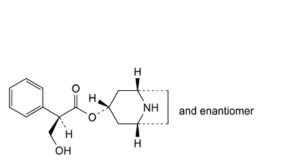
B. (1R,3r,5S)-8-azabicyclo[3.2.1]oct-3-yl (2RS)-3-hydroxy-2-phenylpropanoate (noratropine),
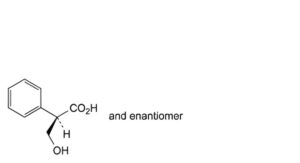
C. (2RS)-3-hydroxy-2-phenylpropanoic acid (tropic acid),
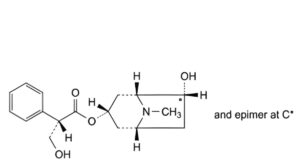
D. (1R,3S,5R,6RS)-6-hydroxy-8-methyl-8-azabicyclo[3.2.1]oct-3-yl (2S)-3-hydroxy-2-phenylpropanoate (6-
hydroxyhyoscyamine),
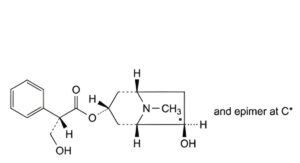
E. (1S,3R,5S,6RS)-6-hydroxy-8-methyl-8-azabicyclo[3.2.1]oct-3-yl (2S)-3-hydroxy-2-phenylpropanoate (7-
hydroxyhyoscyamine),
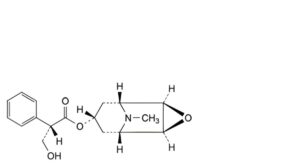
F. (1R,2R,4S,5S,7s)-9-methyl-3-oxa-9-azatricyclo[3.3.1.0 ]non-7-yl (2S)-3-hydroxy-2-phenylpropanoate (hyoscine),
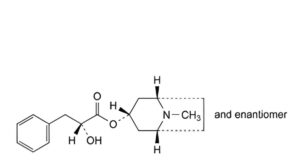
G. (1R,3r,5S)-8-methyl-8-azabicyclo[3.2.1]oct-3-yl (2RS)-2-hydroxy-3-phenylpropanoate (littorine),
H. unknown structure.