



Edition: BP 2025 (Ph. Eur. 11.6 update)
Action and use
Dopamine receptor antagonist; neuroleptic.
Preparation
Zuclopenthixol Acetate Injection
DEFINITION
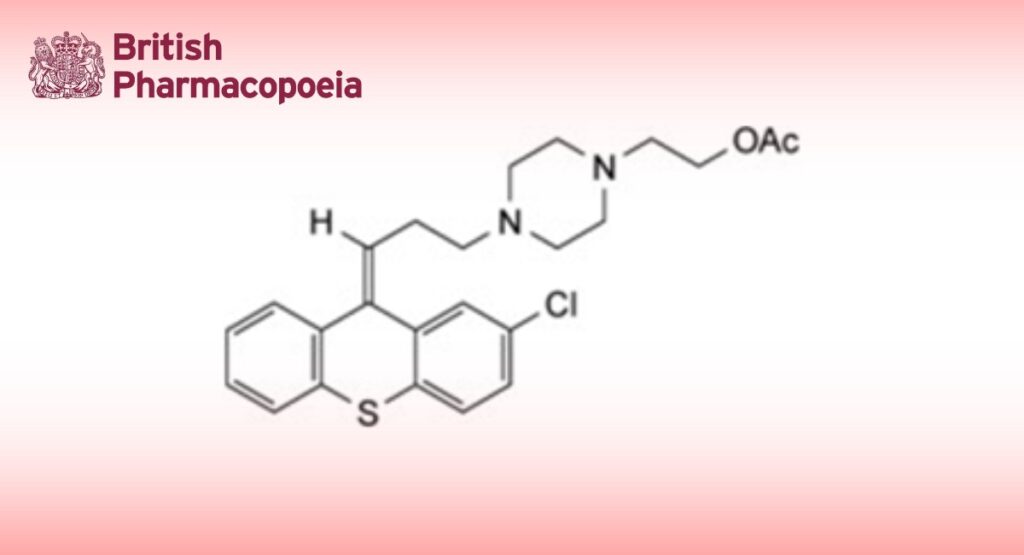
Zuclopenthixol Acetate is (Z)-2-4-[3-(2-chlorothioxanthene-9-ylidene)propyl]piperazin-1-ylethyl acetate. It contains not less than 98.0% and not more than 102.0% of C24H27ClN2O2S, calculated with reference to the dried substance.
CHARACTERISTICS
A yellowish, viscous oil.
Very slightly soluble in water; very soluble in dichloromethane, in ethanol (96%) and in ether.
IDENTIFICATION
A. The light absorption of a 0.0015% w/v solution in ethanol (96%), Appendix II B, in the range 210 to 350 nm exhibits two maxima at 230 and 268 nm. The absorbances at the maxima are about 1.18 and 0.51 respectively.
B. The infrared absorption spectrum, Appendix II A, is concordant with the reference spectrum of zuclopenthixol acetate (RS 363).
TESTS
Related substances
Carry out the method for thin-layer chromatography, Appendix III A, using the following solutions protected from light.
(1) 0.250% w/v of the substance being examined in dichloromethane.
(2) Dilute 1 volume of solution (1) to 100 volume with dichloromethane, further dilute 1 volume of this solution to 10 volumes with the same solvent.
(3) Dilute 1 volume of solution (2) to 2 volumes with dichloromethane.
(4) 0.00050% w/v of 2- chlorothioxanthone BPCRS in dichloromethane.
(5) 0.000625% w/v of zuclopenthixol hydrochloride BPCRS in a solution containing 3 drops of diethylamine in dichloromethane.
CHROMATOGRAPHIC CONDITIONS
(a) Use as the coating silica gel F254 (Merck silica gel 60 F254 plates are suitable).
(b) Use an unlined tank and the mobile phase as described below.
(c) Apply 4 μL of each solution.
(d) Develop the plate to 10 cm.
(e) After removal of the plate, allow it to dry in air, spray with a mixture of equal volumes of sulfuric acid and absolute ethanol, heat at 110° for 5 minutes and examine under ultraviolet light (365 nm) immediately.
MOBILE PHASE
10 volumes of diethylamine, 40 volumes of dichloromethane and 50 volumes of cyclohexane.
LIMITS
In the chromatogram obtained with solution (1):
any spot corresponding to 2-chlorothioxanthone is not more intense than the spot in the chromatogram obtained with solution (4) (0.2%);
any spot corresponding to zuclopenthixol is not more intense than the spot in the chromatogram obtained with solution (5) (0.25%);
any other secondary spot is not more intense than the spot in the chromatogram obtained with solution (2) (0.1%);
not more than three other secondary spots are more intense than the spot in the chromatogram obtained with solution (3) (0.05%).
trans-Isomer
Carry out the method for liquid chromatography, Appendix III D, using the following solutions in dichloromethane protected from light.
(1) 0.040% w/v of the substance being examined.
(2) 0.00046% w/v of trans-clopenthixol acetate dihydrochloride BPCRS (equivalent to 0.00040% w/v of trans-clopenthixol acetate).
(3) 0.020% w/v of the substance being examined and 0.023% w/v of trans-clopenthixol acetate dihydrochloride BPCRS.
CHROMATOGRAPHIC CONDITIONS
(a) Use stainless steel column (25 cm x 4.6 mm) packed with silica gel for chromatography (5 µm) (Spherisorb S 5W is suitable).
(b) Use isocratic elution and the mobile phase described below.
(c) Use a flow rate of 2 mL per minute.
(d) Use ambient temperature.
(e) Use a detection wavelength of 254 nm.
(f) Inject 15 μL of each solution.
MOBILE PHASE
0.03 volume of 13.5M ammonia, 45 volumes of dichloromethane, 45 volumes of heptane and 50 volumes of acetonitrile.
SYSTEM SUITABILITY
The test is not valid unless, in the chromatogram obtained with solution (3), the resolution between the principal peaks is at least 2.6.
LIMITS
In the chromatogram obtained with solution (1), the area of any peak corresponding to trans-clopenthixol acetate is not greater than the area of the peak in the chromatogram obtained with solution (2) (1%).
Loss on drying
When dried at 60° at a pressure not exceeding 0.7 kPa for 3 hours, loses not more than 0.4% of its weight, Appendix XI D. Use 1 g.
Sulfated ash
Not more than 0.1%, Appendix IX A.
ASSAY
Dissolve 0.2 g in 50 mL of anhydrous acetic acid and carry out Method I for non-aqueous titration, Appendix VIII A, determining the end point potentiometrically. Each mL of 0.1M perchloric acid VS is equivalent to 22.15 mg of C24H27ClN2O2S.
STORAGE
Zuclopenthixol Acetate should be protected from light and stored at a temperature not exceeding -20°.
IMPURITIES
A. trans-clopenthixol acetate(trans-isomer),
B. 2-chlorothioxanthone,
C. zuclopenthixol.


