



Edition: BP 2025 (Ph. Eur. 11.6 update)
Action and use
Bisphosphonate; treatment of osteolytic lesions, hypercalcaemia.
DEFINITION
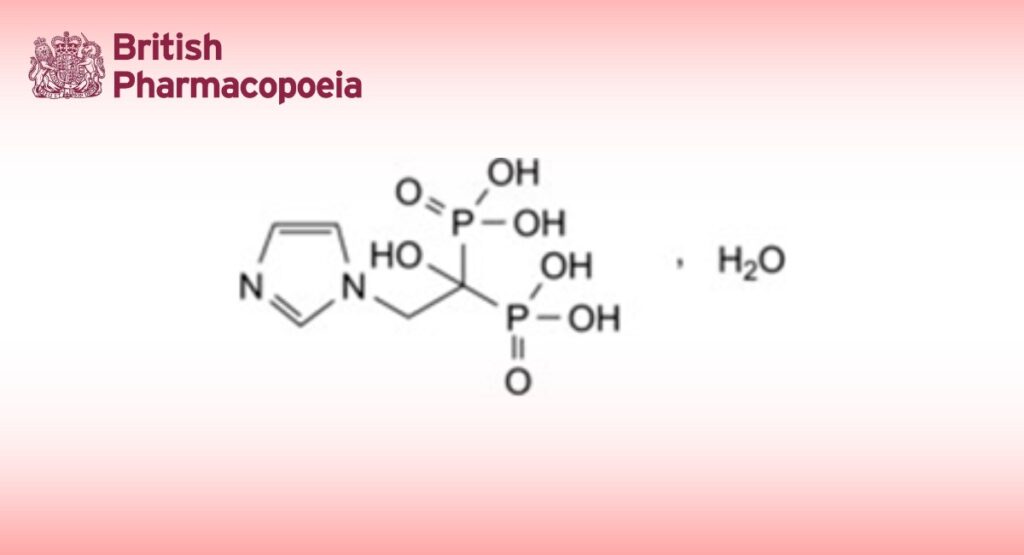
[1-Hydroxy-2-(1H-imidazol-1-yl)ethane-1,1-diyl]bis(phosphonic acid) monohydrate.Content
99.0 per cent to 102.0 per cent (anhydrous substance).
CHARACTERS
Appearance
White or almost white, crystalline powder.
Solubility
Slightly soluble in water, practically insoluble in anhydrous ethanol and in heptane.
IDENTIFICATION
A. Infrared absorption spectrophotometry (2.2.24).
Comparison zoledronic acid monohydrate CRS.
B. Water (see Tests).
TESTS
Appearance of solution
The solution is clear (2.2.1) and not more intensely coloured than reference solution B7 or BY7 (2.2.2, Method II). Dissolve 0.5 g in a 4 g/L solution of sodium hydroxide R and dilute to 50.0 mL with the same solution.
pH (2.2.3)
1.8 to 2.8.
Dissolve 0.150 g in carbon dioxide-free water R and dilute to 50.0 mL with the same solvent. Sonicate for 10 min, if necessary.
Related substances
Liquid chromatography (2.2.29).
Solution A Dissolve 10.8 g of sodium octanesulfonate R and 37 mg of sodium edetate R in water for chromatography R, add 10 mL of perchloric acid R and 2 mL of phosphoric acid R and dilute to 1000 mL with water for chromatography R.
Test solution Dissolve 40.0 mg of the substance to be examined in the mobile phase, sonicate for 30 min, and dilute to 20.0 mL with the mobile phase.
Reference solution (a) Dissolve 2 mg of zoledronic acid impurity A CRS, 5 mg of zoledronic acid impurity B CRS and 2 mg of sodium nitrate R in the mobile phase and dilute to 50 mL with the mobile phase. To 1 mL of the solution add 7 mL of the mobile phase and dilute to 20 mL with the test solution.
Reference solution (b) Dilute 1.0 mL of the test solution to 100.0 mL with the mobile phase. Dilute 1.0 mL of this solution to 10.0 mL with the mobile phase.
Column:
— size: l = 0.25 m, Ø = 4.6 mm;
— stationary phase: end-capped phenylhexylsilyl silica gel for chromatography R (5 µm);
— temperature: 20 °C.
Mobile phase acetonitrile R1, solution A (4:96 V/V). Flow rate 0.6 mL/min.
Detection Spectrophotometer at 215 nm.
Preconditioning Precondition the instrument and the column once before each series of injections as follows:
— instrument: rinse the instrument without a column with a 25 per cent V/V solution of acetic acid R at 5 mL/min for about 20 min. Then, rinse with water for chromatography R at 5 mL/min for about 2 h;
— column: rinse the column with the mobile phase at 0.6 mL/min for about 1 h. During the rinsing, inject the test solution 15 times, applying a run time of about 3 min for each injection.
Injection 10 µL.
Run time 5 times the retention time of zoledronic acid.
Identification of impurities Use the chromatogram obtained with reference solution (a) to identify the peaks due to impurities A and B and the nitrate ion.
Relative retention With reference to zoledronic acid (retention time = about 6 min): nitrate = about 0.6; impurity B = about 0.7; impurity A = about 0.9.
System suitability Reference solution (a):
— resolution: minimum 1.5 between the peaks due to impurity A and zoledronic acid; minimum 1.5 between the peaks due to the nitrate ion and impurity B.
Calculation of percentage contents:
— correction factor: multiply the peak area of impurity B by 1.9;
— for each impurity, use the concentration of zoledronic acid monohydrate in reference solution (b).
Limits:
— impurity B: maximum 0.5 per cent;
— unspecified impurities: for each impurity, maximum 0.10 per cent;
— total: maximum 0.5 per cent;
— reporting threshold: 0.05 per cent, disregard the peak due to the nitrate ion.
Impurities E and F
Liquid chromatography (2.2.29).
Test solution Dissolve 50.0 mg of the substance to be examined in mobile phase B, sonicate if necessary, and dilute to 10.0 mL with mobile phase B.
Reference solution (a) Dissolve 95.0 mg of anhydrous sodium dihydrogen phosphate R and 79.0 mg of phosphorous acid R (impurity E) in water R and dilute to 100.0 mL with the same solvent.
Reference solution (b) Dissolve 34.0 mg of sodium chloride R in water R and dilute to 100.0 mL with the same solvent.
Reference solution (c) To 1.0 mL of reference solution (a) add 0.5 mL of reference solution (b) and dilute to 100.0 mL with mobile phase B.
Reference solution (d) Dilute 0.1 mL of reference solution (a) to 100 mL with mobile phase B.
Precolumn:
— size: l = 0.05 m, Ø = 4.0 mm;
— stationary phase: anion-exchange resin R (13 µm).
Column:
— size: l = 0.25 m, Ø = 4.0 mm;
— stationary phase: anion-exchange resin R (9 µm);
— temperature: 30 °C.
Mobile phase:
— mobile phase A: carbon dioxide-free water R;
— mobile phase B: 4.0 g/L solution of sodium hydroxide R in carbon dioxide-free water R;
| Time (min) | Mobile phase A (per cent V/V) | Mobile phase B (per cent V/V) |
| 0 – 13 | 80 → 70 | 20 → 30 |
| 13 – 17 | 70 → 60 | 30 → 40 |
| 17 – 29 | 60 | 40 |
Flow rate 1.0 mL/min.
Detection Conductivity detector; use a self-regenerating anion suppressor.
Injection 20 µL.
Identification of impurities Use the chromatogram obtained with reference solution (a) to identify the peaks due to impurities E and F; use the chromatogram obtained with reference solution (b) to identify the peak due to the chloride ion.
Relative retention With reference to chloride (retention time = about 5 min): impurity E = about 1.2; impurity F = about 3.4.
System suitability:
— resolution: minimum 1.5 between the peaks due to the chloride ion and impurity E in the chromatogram obtained with reference solution (c);
— signal-to-noise ratio: minimum 10 for the peak due to impurity F in the chromatogram obtained with reference solution (d).
Calculation of percentage contents:
— for each impurity, use the concentration of the corresponding impurity in reference solution (c).
Limits:
— impurities E, F: for each impurity, maximum 0.15 per cent.
Water (2.5.12)
5.0 per cent to 7.5 per cent, determined on 0.100 g.
ASSAY
Dissolve 0.150 g in 50 mL of carbon dioxide-free water R. Sonicate for 10 min, if necessary. Titrate with 0.1 M sodium hydroxide, determining the end-point potentiometrically (2.2.20). Read the volume added at the 3rd inflexion point.
1 mL of 0.1 M sodium hydroxide is equivalent to 9.07 mg of C5H10N2O7P2.
IMPURITIES
Specified impurities B, E, F.
Other detectable impurities (the following substances would, if present at a sufficient level, be detected by one or other of the tests in the monograph. They are limited by the general acceptance criterion for other/unspecified impurities and/or by the general monograph Substances for pharmaceutical use (2034). It is therefore not necessary to identify these impurities for demonstration of compliance. See also 5.10. Control of impurities in substances for pharmaceutical use) A, C, D.
A. [1-(2-hydroxy-2,2-diphosphonoethyl)-1H-imidazol-3-ium-3-yl]acetate,
B. 1,3-bis(2-hydroxy-2,2-diphosphonoethyl)-1H-imidazol-3-ium,
C. 1H-imidazole,
D. (1H-imidazol-1-yl)acetic acid,
E. phosphonic acid (phosphorous acid),
F. phosphoric acid.


