Edition: BP 2025 (Ph. Eur. 11.6 update)
DEFINITION
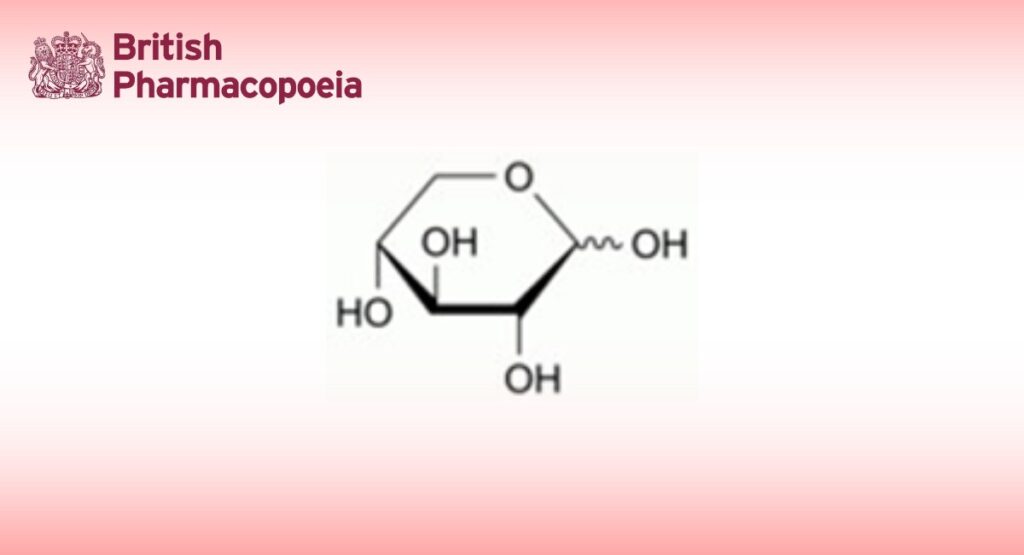
D-Xylopyranose.
CHARACTERS
Appearance
White or almost white, crystalline powder or colourless needles.
Solubility
Freely soluble in water, soluble in hot ethanol (96 per cent).
IDENTIFICATION
First identification: A.
Second identification: B, C.
A. Infrared absorption spectrophotometry (2.2.24).
Preparation Discs.
Comparison xylose CRS.
B. Thin-layer chromatography (2.2.27).
Solvent mixture water R, methanol R (2:3 V/V).
Test solution Dissolve 10 mg of the substance to be examined in the solvent mixture and dilute to 20 mL with the solvent mixture.
Reference solution (a) Dissolve 10 mg of xylose CRS in the solvent mixture and dilute to 20 mL with the solvent mixture.
Reference solution (b) Dissolve 10 mg of fructose R, 10 mg of glucose R and 10 mg of xylose R in the solvent mixture and dilute to 20 mL with the solvent mixture.
Plate TLC silica gel plate R.
Mobile phase water R, methanol R, anhydrous acetic acid R, methylene chloride R (10:15:25:50 V/V/V/V); measure the volumes accurately since a slight excess of water produces cloudiness.
Application 2 µL; thoroughly dry the points of application.
Development Over a path of 15 cm.
Drying In a current of warm air.
Detection Spray with a 5 g/L solution of thymol R in a mixture of 5 volumes of sulfuric acid R and 95 volumes of ethanol (96 per cent) R. Heat in an oven at 130 °C for 10 min.
System suitability Reference solution (b):
— the chromatogram shows 3 clearly separated spots.
Results The principal spot in the chromatogram obtained with the test solution is similar in position, colour and size to the principal spot in the chromatogram obtained with reference solution (a).
C. Dissolve 0.1 g in 10 mL of water R. Add 3 mL of cupri-tartaric solution R and heat. An orange or red precipitate is formed.
TESTS
Solution S
Dissolve 10.0 g in carbon dioxide-free water R and dilute to 100 mL with the same solvent.
Appearance of solution
Solution S is clear (2.2.1) and colourless (2.2.2, Method II).
Acidity or alkalinity
To 50 mL of solution S add 0.3 mL of phenolphthalein solution R1. The solution is colourless. Not more than 0.2 mL of 0.1 M sodium hydroxide is required to change the colour of the indicator to pink.
Specific optical rotation (2.2.7)
+ 18.5 to + 19.5 (dried substance).
Dissolve 10.0 g in 80 mL of water R, add 1 mL of dilute ammonia R2 and dilute to 100.0 mL with water R. Allow to stand for 30 min.
Chlorides (2.4.4)
Maximum 330 ppm.
Dilute 1.5 mL of solution S to 15 mL with water R.
Loss on drying (2.2.32)
Maximum 0.5 per cent, determined on 1.000 g by drying in vacuo at 105 °C for 4 h.
Sulfated ash (2.4.14)
Maximum 0.1 per cent, determined on 1.0 g.