Edition: BP 2025 (Ph. Eur. 11.6 update)
Action and use
Vitamin K epoxide reductase inhibitor; oral anticoagulant (coumarin).
Preparations
Warfarin Oral Suspension
Warfarin Tablets
DEFINITION
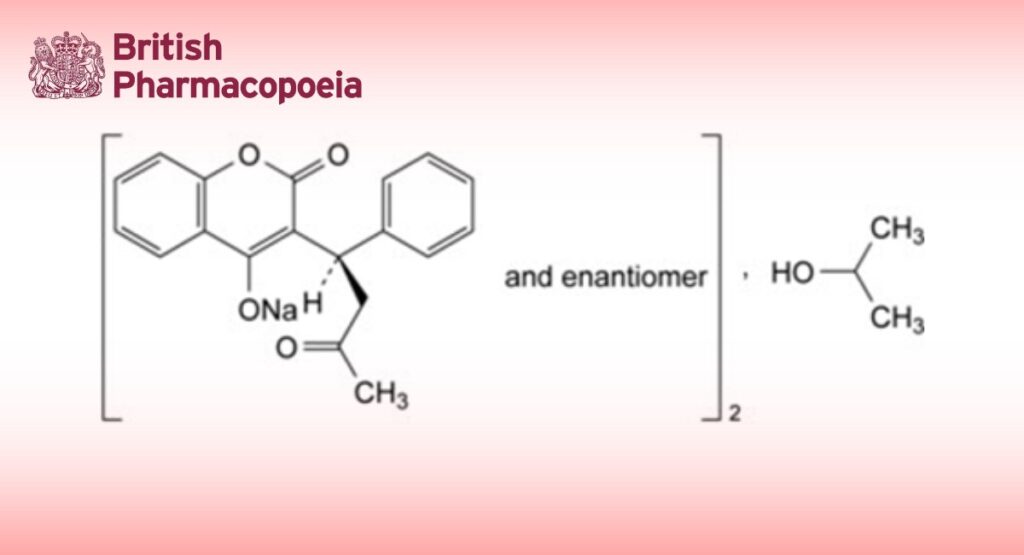
Sodium 2-oxo-3-[(1RS)-3-oxo-1-phenylbutyl]-2H-1-benzopyran-4-olate.
Content
98.0 per cent to 102.0 per cent (anhydrous substance).
CHARACTERS
Appearance
White or almost white, hygroscopic, amorphous powder.
Solubility
Very soluble in water and in ethanol (96 per cent), soluble in acetone, very slightly soluble in methylene chloride.
IDENTIFICATION
A. Infrared absorption spectrophotometry (2.2.24).
Comparison warfarin sodium CRS.
B. Propan-2-ol (see Tests).
C. It gives reaction (b) of sodium (2.3.1).
TESTS
Appearance of solution
The solution is clear (2.2.1) and colourless (2.2.2, Method II). Dissolve 1.0 g in water R and dilute to 20 mL with the same solvent.
pH (2.2.3)
7.6 to 8.6.
Dissolve 1.0 g in carbon dioxide-free water R and dilute to 100 mL with the same solvent.
Related substances
Liquid chromatography (2.2.29).
Solvent mixture methanol R, water R (25:75 V/V).
Test solution Dissolve 40.0 mg of the substance to be examined in the solvent mixture and dilute to 50.0 mL with the solvent mixture.
Reference solution (a) Dissolve 2 mg of 4-hydroxycoumarin R (impurity B) and 2 mg of benzalacetone R (impurity C) in 25 mL of methanol R and dilute to 100 mL with water R.
Reference solution (b) Dilute 1.0 mL of the test solution to 100.0 mL with the solvent mixture. Dilute 1.0 mL of this solution to 10.0 mL with the solvent mixture.
Column:
— size: l = 0.25 m, Ø = 4.0 mm;
— stationary phase: cyanosilyl silica gel for chromatography R (5 µm);
— temperature: 30 °C.
Mobile phase glacial acetic acid R, acetonitrile R, water R (1:25:75 V/V/V). Flow rate 1.5 mL/min.
Detection Spectrophotometer at 260 nm.
Injection 20 µL.
Run time Twice the retention time of warfarin.
Identification of impurities Use the chromatogram obtained with reference solution (a) to identify the peaks due to impurities B and C.
Relative retention With reference to warfarin (retention time = about 9 min): impurity B = about 0.4; impurity C = about 0.6.
System suitability Reference solution (a):
— resolution: minimum 2.0 between the peaks due to impurities B and C.
Limits:
— correction factors: for the calculation of content, multiply the peak areas of the following impurities by the corresponding correction factor: impurity B = 0.5; impurity C = 0.4;
— impurities B, C: for each impurity, not more than 1.5 times the area of the principal peak in the chromatogram obtained with reference solution (b) (0.15 per cent);
— unspecified impurities: for each impurity, not more than the area of the principal peak in the chromatogram obtained with reference solution (b) (0.10 per cent);
— total: not more than 3 times the area of the principal peak in the chromatogram obtained with reference solution (b) (0.3 per cent);
— disregard limit: 0.5 times the area of the principal peak in the chromatogram obtained with reference solution (b) (0.05 per cent).
Phenolic ketones
Dissolve 1.25 g in a 20 g/L solution of sodium hydroxide R and dilute to 10.0 mL with the same solvent. The absorbance (2.2.25) is maximum 0.20 measured at 385 nm within 15 min of preparing the solution.
Propan-2-ol (2.4.24, System A) Maximum 0.5 per cent.
Water (2.5.12)
Maximum 4.0 per cent, determined on 0.750 g.
ASSAY
Dissolve 0.100 g in 0.01 M sodium hydroxide and dilute to 100.0 mL with the same solvent. Dilute 10.0 mL of the solution to 100.0 mL with 0.01 M sodium hydroxide.
Dilute 10.0 mL of this solution to 100.0 mL with 0.01 M sodium hydroxide.
Measure the absorbance (2.2.25) at the absorption maximum at 308 nm.
Calculate the percentage content of C19H15NaO4 taking the specific absorbance to be 431.
STORAGE
In an airtight container, protected from light.
IMPURITIES
Specified impurities B, C.
Other detectable impurities (the following substances would, if present at a sufficient level, be detected by one or other of the tests in the monograph. They are limited by the general acceptance criterion for other/unspecified impurities and/or by the general monograph Substances for pharmaceutical use (2034). It is therefore not necessary to identify these impurities for demonstration of compliance. See also 5.10. Control of impurities in substances for pharmaceutical use) A.
A. (5RS)-3-(2-hydroxyphenyl)-5-phenylcyclohex-2-enone,
B. 4-hydroxy-2H-1-benzopyran-2-one (4-hydroxycoumarin),
C. (3E)-4-phenylbut-3-en-2-one (benzalacetone).