



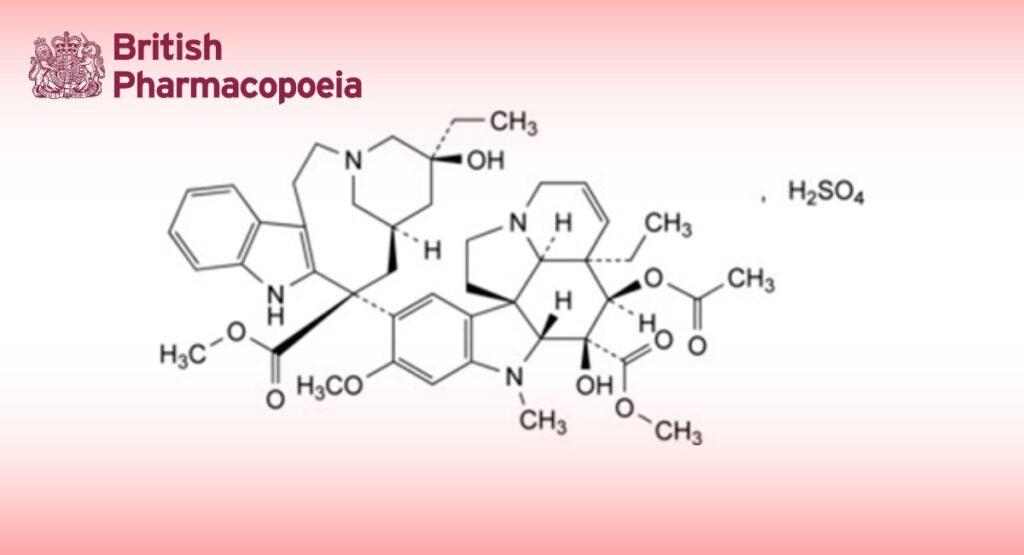
Edition: BP 2025 (Ph. Eur. 11.6 update)
Action and use
Vinca alkaloid cytotoxic.
Preparation
Vinblastine Injection
DEFINITION
Vinblastine sulfate contains not less than 95.0 per cent and not more than the equivalent of 104.0 per cent of methyl (3aR,4R,5S,5aR,10bR,13aR)-4-(acetyloxy)-3a-ethyl-9-[(5S,7R,9S)5-ethyl-5-hydroxy-9-(methoxycarbonyl)-1,4,5,6,7,8,9,10- octahydro-2H-3,7-methanoazacycloundecino[5,4-b]indol-9-yl]-5-hydroxy-8-methoxy-6-methyl-3a,4,5,5a,6,11,12,13a- octahydro-1H-indolizino[8,1-cd]carbazole-5-carboxylate sulfate, calculated with reference to the dried substance.
CHARACTERS
A white or slightly yellowish, crystalline powder, very hygroscopic, freely soluble in water, practically insoluble in ethanol (96 per cent).
IDENTIFICATION
A. Examine by infrared absorption spectrophotometry (2.2.24), comparing with the Ph. Eur. reference spectrum of vinblastine sulfate.
B. Examine the chromatograms obtained in the assay. The principal peak in the chromatogram obtained with the test solution is similar in position and approximate size to the principal peak in the chromatogram obtained with reference solution (a).
TESTS
Solution S
Dissolve 50.0 mg in carbon dioxide-free water R and dilute to 10.0 mL with the same solvent.
Appearance of solution
Solution S is clear (2.2.1) and not more intensely coloured than reference solution Y7 (2.2.2, Method I).
pH (2.2.3)
Dilute 3 mL of solution S to 10 mL with carbon dioxide-free water R. The pH of this solution is 3.5 to 5.0.
Related substances
Examine the chromatograms obtained in the assay. In the chromatogram obtained with the test solution, the area of any peak apart from the principal peak is not greater than the area of the principal peak in the chromatogram obtained with reference solution (c) (2.0 per cent) and the sum of the areas of any such peaks is not greater than 2.5 times the area of the principal peak in the chromatogram obtained with reference solution (c) (5.0 per cent). Disregard any peak with an area less than that of the peak in the chromatogram obtained with reference solution (d).
Loss on drying
Not more than 15.0 per cent, determined on 3 mg by thermogravimetry (2.2.34). Heat to 200 °C at a rate of 5 °C/min, under a stream of nitrogen for chromatography R, at a flow rate of 40 mL/min.
ASSAY
Examine by liquid chromatography (2.2.29).
Keep the solutions in iced water before use.
Test solution Dilute 1.0 mL of solution S (see Tests) to 5.0 mL with water R.
Reference solution (a) Dissolve the contents of a vial of vinblastine sulfate CRS in 5.0 mL of water R to obtain a concentration of 1.0 mg/mL.
Reference solution (b) Dissolve 1.0 mg of vincristine sulfate CRS in 1.0 mL of reference solution (a).
Reference solution (c) Dilute 1.0 mL of reference solution (a) to 50.0 mL with water R. Reference solution (d) Dilute 1.0 mL of reference solution (c) to 20.0 mL with water R. The chromatographic procedure may be carried out using:
— a stainless steel column 0.25 m long and 4.6 mm in internal diameter packed with octylsilyl silica gel for chromatography R (5 µm). Place between the injector and the column a precolumn packed with suitable silica gel,
— as mobile phase at a flow rate of 1.0 mL/min a mixture of 38 volumes of a 1.5 per cent V/V solution of diethylamine R adjusted to pH 7.5 with phosphoric acid R, 12 volumes of acetonitrile R and 50 volumes of methanol R,
— as detector a spectrophotometer set at 262 nm,
— a loop injector.
Inject 10 µL of each solution and record the chromatograms for 3 times the retention time of the peak due to vinblastine. The assay is not valid unless: in the chromatogram obtained with reference solution (b) the resolution between the peaks due to vincristine and vinblastine is not less than 4; the peak in the chromatogram obtained with reference solution (d) has a signal-to-noise ratio not less than 5. Calculate the percentage content of C46H60N4O13S from the area of the principal peak in each of the chromatograms obtained with the test solution and reference solution (a) and from the declared content of vinblastine sulfate CRS.
STORAGE
Store in an airtight, glass container, protected from light, at a temperature not exceeding -20 °C. If the substance is sterile, store in a sterile, airtight, tamper-evident glass container.


