



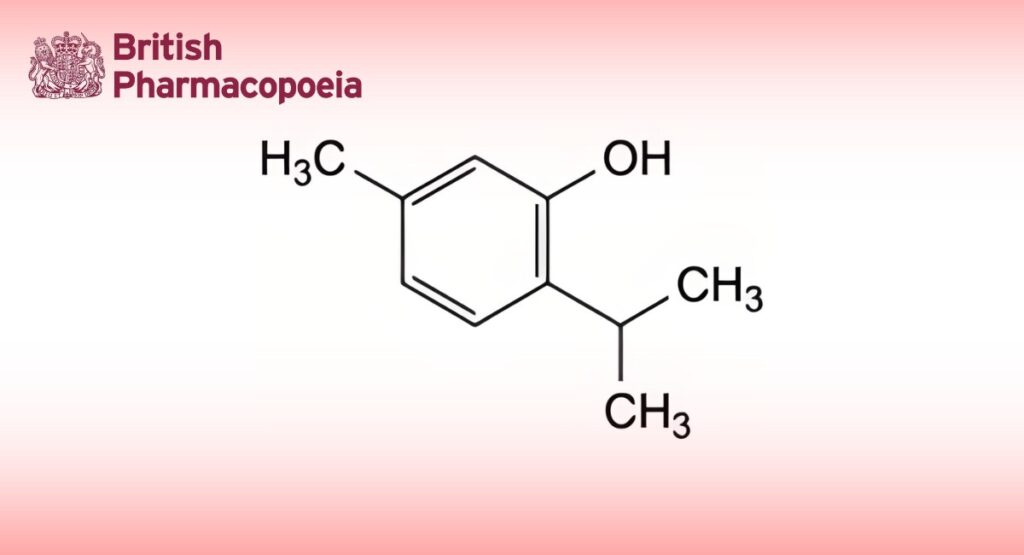
(Ph. Eur. monograph 0791)
C10H14O 150.2 89-83-8
DEFINITION
5-Methyl-2-(methylethyl)phenol.
CHARACTERS
Appearance
Colourless crystals.
Solubility
Very slightly soluble in water, very soluble in ethanol (96 per cent), freely soluble in essential oils and in fatty oils, sparingly soluble in glycerol. It dissolves in dilute solutions of alkali hydroxides.
IDENTIFICATION
First identification: B.
Second identification: A, C, D.
A. Melting point (2.2.14): 48 °C to 52 °C.
B. Infrared absorption spectrophotometry (2.2.24).
Comparison thymol CRS.
C. Dissolve 0.2 g with heating in 2 mL of dilute sodium hydroxide solution R and add 0.2 mL of chloroform R. Heat on a water-bath. A violet colour develops.
D. Dissolve about 2 mg in 1 mL of anhydrous acetic acid R. Add 0.15 mL of sulfuric acid R and 0.05 mL of nitric acid R. A bluish-green colour develops.
TESTS
Appearance of solution
The solution is not more opalescent than reference suspension IV (2.2.1) and not more intensely coloured than reference solution R6 (2.2.2, Method II).
Dissolve 1.0 g in 10 mL of dilute sodium hydroxide solution R.
Acidity
To 1.0 g in a 100 mL glass-stoppered conical flask add 20 mL of water R. Boil until dissolution is complete, cool and stopper the flask. Shake vigorously for 1 min. Add a few crystals of the substance to be examined to initiate crystallisation. Shake vigorously for 1 min and filter. To 5 mL of the filtrate add 0.05 mL of methyl red solution R and 0.05 mL of 0.01 M sodium hydroxide. The solution is yellow.
Related substances
Gas chromatography (2.2.28).
Test solution Dissolve 0.100 g of the substance to be examined in ethanol (96 per cent) R and dilute to 10.0 mL with the same solvent.
Reference solution (a) Dilute 1 mL of the test solution to 100 mL with ethanol (96 per cent) R.
Reference solution (b) Dilute 1 mL of reference solution (a) to 10 mL with ethanol (96 per cent) R.
Reference solution (c) Dilute 5 mL of reference solution (b) to 10 mL with ethanol (96 per cent) R.
Column:
— material: glass or steel;
— size: l = 4 m, Ø = 2 mm;
— stationary phase: diatomaceous earth for gas chromatography R, impregnated with a mixture suitable for the separation of free fatty acids.
Carrier gas nitrogen for chromatography R.
Flow rate 30 mL/min.
Temperature:
| Time (min) | Temperature (°C) | |
| Column | 0-2
2-22 22-37 |
80
80 → 240 240 |
| Injection port | 250 | |
| Detector | 300 |
Detector 300
Detection Flame ionisation.
Injection 1 μL.
System suitability Reference solution (b):
— signal-to-noise ratio: minimum 5 for the principal peak.
Limits:
— total: not more than the area of the principal peak in the chromatogram obtained with reference solution (a) (1.0 per cent);
— disregard limit: the area of the principal peak in the chromatogram obtained with reference solution (c) (0.05 per cent).
Residue on evaporation
Maximum 0.05 per cent.
Evaporate 2.00 g on a water-bath and heat in an oven at 100-105 °C for 1 h. The residue weighs not more than 1.0 mg.
STORAGE
Protected from light.


