



Edition: BP 2025 (Ph. Eur. 11.6 update)
(Ph. Eur. monograph 0644)
H—Ser—Tyr—Ser—Met—Glu—His—Phe—Arg—Trp—Gly—
Lys—Pro—Val—Gly—Lys—Lys—Arg—Arg—Pro —Val—
Lys—Val—Tyr—Pro—OH
C136H210N40O31S 2933 16960-16-0
Action and use
Corticotropic peptide.
Preparations
Tetracosactide Injection
Tetracosactide Zinc Injection
Ph Eur
DEFINITION
Synthetic human corticotropin-(1-24)-peptide. It increases the rate at which corticoid hormones are secreted by the adrenal glands. It is available as an acetate.
Content
90 per cent to 102 per cent (anhydrous and acetic acid-free substance). By convention, 1 μg of tetracosactide is equivalent to 1 IU of tetracosactide.
CHARACTERS
Appearance
White or yellow, amorphous powder.
Solubility
Sparingly soluble in water.
IDENTIFICATION
A. Examine the chromatograms obtained in the assay.
Results The principal peak in the chromatogram obtained with the test solution is similar in retention time and size to the principal peak in the chromatogram obtained with reference solution (b).
B. Amino acid analysis (2.2.56). For hydrolysis use Method 1 and for analysis use Method 1 or Method 4.
Express the content of each amino acid in moles. Calculate the relative proportions of the amino acids, taking that of valine to be equivalent to 3. The values fall within the following limits: lysine 3.5 to 4.7; histidine 0.9 to 1.1; arginine 2.7 to 3.3; serine 1.1 to 2.2; glutamic acid 0.9 to 1.1; proline 2.5 to 3.5; glycine 1.8 to 2.2; methionine 0.9 to 1.1; tyrosine 1.7 to 2.2; phenylalanine 0.9 to 1.1. Not more than traces of other amino acids are present.
TESTS
Specific optical rotation (2.2.7)
-109 to -99 (anhydrous and acetic acid-free substance).
Dissolve 10.0 mg in 1.0 mL of a mixture of 1 volume of glacial acetic acid R and 99 volumes of water R.
Absorbance (2.2.25)
0.51 to 0.61 (anhydrous and acetic acid-free substance), determined at the absorption maximum between 240 nm and 280 nm, at 276 nm. The ratio of the absorbance at the maximum at 276 nm to the absorbance at 248 nm is 2.4 to 2.9.
Dissolve 1.0 mg in 0.1 M hydrochloric acid and dilute to 5.0 mL with the same acid.
Related peptides
Liquid chromatography (2.2.29): use the normalisation procedure.
Test solution Dissolve an accurately weighed quantity of the substance to be examined in water R to obtain a concentration of 0.2 mg/mL.
Reference solution (a) Dissolve the contents of a vial of tetracosactide for peak identification CRS (containing impurities A, C, D, E, F, G, H, I and J) in water R to obtain a concentration of about 0.2 mg/mL.
Reference solution (b) Dissolve the contents of a vial of tetracosactide CRS in water R to obtain a concentration of about 0.2 mg/mL.
Reference solution (c) Dilute 1.0 mL of reference solution (b) to 100.0 mL with water R. Dilute 1.0 mL of this solution to 10.0 mL with water R.
Column:
– size: l = 0.15 m, Ø = 4.6 mm;
– stationary phase: end-capped ethylene-bridged phenylsilyl silica gel for chromatography (hybrid material) R (3.5 μm);
– temperature: 60 °C.
Mobile phase:
– mobile phase A: a 0.1 per cent (V/V) solution of methanesulfonic acid R in water for chromatography R;
– mobile phase B: a 0.1 per cent (V/V) solution of methanesulfonic acid R in a mixture of 50 volumes of water for chromatography R and 50 volumes of acetonitrile for chromatography R;
| Time (min) | Mobile phase A (per cent V/V) | Mobile phase B (per cent V/V) |
|---|---|---|
| 0 – 8 | 80 → 75 | 20 → 25 |
| 8 – 13 | 75 → 73 | 25 → 27 |
| 13 – 33 | 73 → 71 | 27 → 29 |
| 33 – 38 | 71 → 69 | 29 → 31 |
| 38 – 45 | 69 → 62 | 31 → 38 |
Flow rate 0.6 mL/min.
Detection Spectrophotometer at 220 nm.
Autosampler Set at 5 °C.
Injection 16 μL of the test solution and reference solutions (a) and (c).
Identification of impurities Use the chromatogram supplied with tetracosactide for peak identification CRS and the chromatogram obtained with reference solution (a) to identify the peaks due to impurities A, C + D + E, F + G, H, and I + J.
Relative retention With reference to tetracosactide (retention time = about 19 min): impurity A = about 0.67; impurities C, D and E = about 0.97; impurities F and G = about 1.07; impurity H = about 1.09; impurities J and I = about 1.15. Partial separation of the peaks due to impurities F and G as well as due to impurities J and I can be observed.
System suitability Reference solution (a):
– peak-to-valley ratio: minimum 3.0, where Hp = height above the baseline of the peak due to impurities C + D + E and Hv = height above the baseline of the lowest point of the curve separating this peak from the peak due to tetracosactide;
– symmetry factor: maximum 2.5 for the peak due to tetracosactide.
Limits:
– impurity A: maximum 2.0 per cent;
– sum of impurities C, D and E: maximum 1.0 per cent;
– sum of impurities F and G: maximum 1.0 per cent;
– impurity H: maximum 1.0 per cent;
– sum of impurities I and J: maximum 1.0 per cent;
– unspecified impurities: for each impurity, maximum 0.5 per cent;
– total: maximum 5.0 per cent;
– reporting threshold: 0.1 per cent (peak due to tetracosactide in the chromatogram obtained with reference solution (c)).
Acetic acid (2.5.34)
8.0 per cent to 13.0 per cent.
Test solution Dissolve 10.0 mg of the substance to be examined in a mixture of 5 volumes of mobile phase B and 95 volumes of mobile phase A and dilute to 10.0 mL with the same mixture of mobile phases.
Water (2.5.32)
Maximum 14.0 per cent, determined on 20.0-50.0 mg.
Bacterial endotoxins (2.6.14)
Less than 10 IU/mg, if intended for use in the manufacture of parenteral preparations without a further appropriate procedure for the removal of bacterial endotoxins.
ASSAY
Liquid chromatography (2.2.29) as described in the test for related peptides with the following modifications.
Injection Test solution and reference solution (b).
Calculate the content of C136H210N40O31S using the chromatogram obtained with reference solution (b) and taking into account the assigned content of tetracosactide CRS.
STORAGE
Protected from light, at a temperature of 2 °C to 8 °C.
LABELLING
The label states:
– the mass of peptide in the container;
– where applicable, that the substance is suitable for use in the manufacture of parenteral preparations.
IMPURITIES
Specified impurities A, C, D, E, F, G, H, I, J.
H—Ser—Tyr—Ser—MetO—Glu—His—Phe—Arg—Trp—Gly—
Lys—Pro— Val—Gly— Lys—Lys —Arg—Arg— Pro—Val—
Lys—Val—Tyr—Pro—OH
A. [4-(L-methionine S-oxide)]tetracosactide,
H— Tyr— Ser— Met —Glu —His— Phe—Arg —Trp—Gly—
Lys—Pro—Val—Gly—Lys—Lys—Arg—Arg—Pro—Val—
Lys—Val—Tyr—Pro—OH
C. des-1-serine-tetracosactide,
H—Tyr— Met—Glu— His— Phe— Arg— Trp — Gly—Lys—
Pro—Val—Gly—Lys—Lys—Arg—Arg—Pro—Val—Lys—
Val—Tyr—Pro—OH
D. des-3-serine-tetracosactide,
H—Ser—Tyr—Met—Glu—His—Phe—Arg—Trp—Gly—Lys—
Pro—Val—Gly—Lys—Lys—Arg—Arg— Pro—Val— Lys—
Val—Tyr—Pro—OH
E. [4-D-methionine]tetracosactide,
H—Ser—Tyr—Ser—D-Met—Glu—His—Phe—Arg—Trp—Gly—
Lys —Pro —Val— Gly— Lys— Lys—Arg—Arg— Pro—Val—
Lys—Val—Tyr—Pro—OH
F. endo-4a-(glutamic acid)-tetracosactide,
H—Ser—Tyr— Ser— Met— Glu— His— Phe— Arg— Trp—
Gly—Lys—Pro—Val—Gly—Lys—Lys—Arg—Arg—Pro—
Val—Lys—Val—Tyr—Pro—OH
G. unknown structure,
H—Ser—Tyr—Ser—Met—Glu—His—Phe—Arg—Trp—Gly—
Lys— Pro —Val — Gly — Lys— Lys— Arg—Arg — Pro —
Val—Lys—Val—Tyr—Pro—OH
H. endo-13a-glycine-tetracosactide,
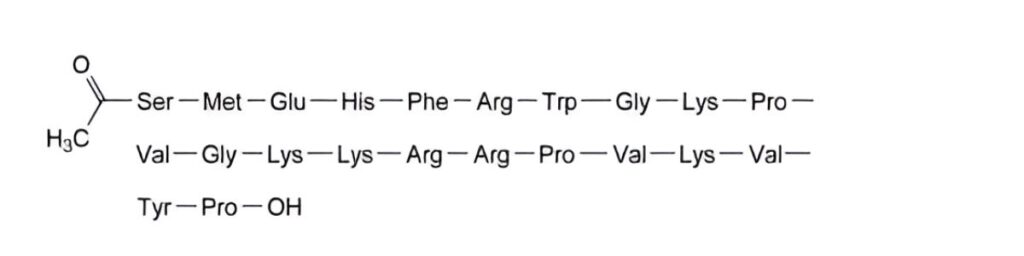
I. acetyltetracosactide-(3-24)-peptide,
H—Ser—Tyr—Ser—Met—His—Phe— Arg— Trp—Gly— Lys—
Pro—Val—Gly—Lys—Lys—Arg—Arg—Pro—Val—Lys—Val—
Tyr—Pro—OH
J. des-5-(glutamic acid)-tetracosactide.
Ph Eur


