



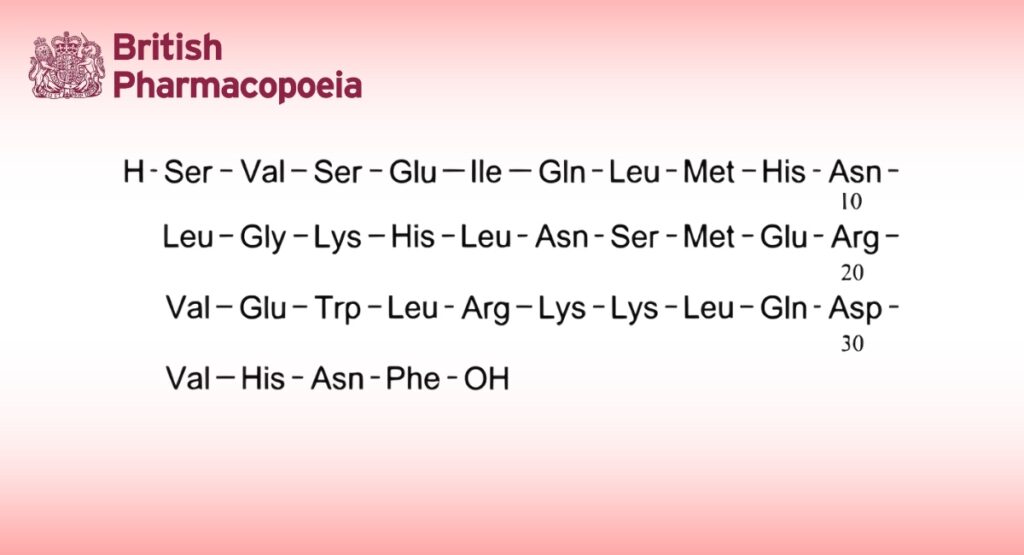
(Ph. Eur. monograph 2829)
C181H291N55O51S2 4118 52232-67-4
Action and use
Parathyroid hormone analogue; treatment of osteoporosis.
DEFINITION
Tetratriacontapeptide in which the sequence of amino acids is the same as that of the 1-34 N-terminal fragment of endogeneous human parathyroid hormone (rhPTH).
Content
95.0 per cent to 105.0 per cent (anhydrous, acetic acid- and chloride-free substance).
PRODUCTION
Teriparatide is produced by a method based on recombinant DNA (rDNA) technology. During the course of product development it must be demonstrated that the manufacturing process produces a biologically active protein using a suitable bioassay as approved by the competent authority.
Prior to release, the following tests are carried out on each batch of teriparatide, unless exemption has been granted by the competent authority.
Host-cell-derived proteins
The limit is approved by the competent authority.
Host-cell- and vector-derived DNA
The limit is approved by the competent authority.
CHARACTERS
Appearance
White or almost white, very hygroscopic powder.
Solubility
Freely soluble in water and in methanol, practically insoluble in acetonitrile.
IDENTIFICATION
A. Peptide mapping (2.2.55).
SELECTIVE CLEAVAGE OF THE PEPTIDE BONDS
Solution A Dissolve 230 mg of anhydrous disodium hydrogen phosphate R and 60 mg of sodium dihydrogen phosphate monohydrate R in 100 mL of water R and adjust to pH 7.8 with sodium hydroxide solution R.
Test solution Dissolve the substance to be examined in solution A to obtain a concentration of 1.5 mg/mL and transfer 150 μL of the solution to a clean tube. Add 90 μL of a 0.25 mg/mL solution of glutamyl endopeptidase for peptide mapping R in solution A. Mix and incubate at 37 °C for 18-24 h. Stop the reaction by adding 660 μL of mobile phase A to reach a final digested protein concentration of about 0.25 mg/mL.
NOTE: if a teriparatide concentration of 1.5 mg/mL is not obtainable, a similar ratio of micrograms of endopeptidase per milligram of teriparatide may be used.
Reference solution Prepare at the same time and in the same manner as for the test solution but using teriparatide CRS instead of the substance to be examined.
Blank solution Prepare at the same time and in the same manner as for the test solution but omitting the substance to be examined.
CHROMATOGRAPHIC SEPARATION
Liquid chromatography (2.2.29). Store the solutions at 2-8 °C and use them within 72 h.
Column:
— size: l = 0.15 m, Ø = 4.6 mm;
— stationary phase: octadecylsilyl silica gel for chromatography R (3.5 μm) with a pore size of 30 nm;
— temperature: 40 °C.
Mobile phase:
— mobile phase A: mix 1 mL of trifluoroacetic acid R and 1000 mL of water R; filter and degas;
— mobile phase B: mix 1 mL of trifluoroacetic acid R, 400 mL of water R and 600 mL of acetonitrile for chromatography R; filter and degas;
| Time (min) | Mobile phase A (per cent V/V) | Mobile phase B (per cent V/V) |
| 0 – 6 | 96 | 4 |
| 6 – 20 | 96 → 45 | 4 → 55 |
| 20 – 25 | 45 → 0 | 55 → 100 |
Flow rate 1 mL/min.
Detection Spectrophotometer at 214 nm.
Autosampler Set at 2-8 °C.
Injection 20 μL.
System suitability:
— the chromatogram obtained with the reference solution is qualitatively similar to the chromatogram of teriparatide digest supplied with teriparatide CRS;
— in the chromatogram obtained with the reference solution, identify the peaks due to digest fragments I, II, III, IV and V:
symmetry factor Maximum 2.3 for the peak due to fragment IV;
resolution Minimum 1.5 between the peaks due to fragments I and III.
Results The profile of the chromatogram obtained with the test solution corresponds to that of the chromatogram obtained with the reference solution.
B. Examine the chromatograms obtained in the assay.
Results The principal peak in the chromatogram obtained with the test solution is similar in retention time to the principal peak in the chromatogram obtained with the reference solution.
TESTS
Impurities with molecular masses greater than that of teriparatide
Size-exclusion chromatography (2.2.30): use the normalisation procedure. Store the solutions at 2-8 °C and use them within 72 h.
Test solution Dissolve the substance to be examined in water R to obtain a concentration of 1 mg/mL.
Reference solution Dissolve the contents of a vial of teriparatide CRS in water R to obtain a concentration of 1 mg/mL.
Blank solution water R.
Resolution solution Incubate a vial of teriparatide CRS at 75 °C for 16-24 h. After incubation, dissolve the contents of the vial in water R to obtain a concentration of 1 mg/mL of degraded teriparatide.
Column:
— size: l = 0.30 m, Ø = 7.8 mm;
— stationary phase: hydrophilic silica gel for chromatography R (5-10 μm) with a pore size of 12.5 nm, of a grade suitable for fractionation of globular proteins of relative molecular mass up to 150 000.
Mobile phase Add 1 mL of trifluoroacetic acid R to 750 mL of water R, mix with 250 mL of acetonitrile for chromatography R and degas.
Flow rate 0.5 mL/min.
Detection Spectrophotometer at 214 nm.
Autosampler Set at 2-8 °C.
Injection 20 μL.
Run time 1.5 times the retention time of teriparatide monomer.
Retention time Teriparatide monomer = about 17 min.
System suitability:
— the chromatogram obtained with the reference solution is similar to the chromatogram supplied with teriparatide CRS;
— resolution: minimum 2.0 between the peaks due to teriparatide dimer and monomer in the chromatogram obtained with the resolution solution.
Limit:
— sum of the peaks eluted before the principal peak: maximum 0.3 per cent; disregard any peak with a retention time greater than that of the peak due to teriparatide monomer.
Related proteins
Liquid chromatography (2.2.29): use the normalisation procedure. Store the solutions at 2-8 °C and use them within 48 h.
Buffer solution Dissolve 28.4 g of anhydrous sodium sulfate R in 900 mL of water R and adjust to pH 2.3 with phosphoric acid R. Dilute to 1000 mL with water for chromatography R and filter.
Test solution Dissolve the substance to be examined in mobile phase A to obtain a concentration of 0.7 mg/mL.
Reference solution Dissolve the contents of a vial of teriparatide CRS in mobile phase A to obtain a concentration of 0.7 mg/mL.
Blank solution Mobile phase A.
Resolution solution Dissolve the contents of a vial of teriparatide for system suitability CRS in mobile phase A to obtain a concentration of 1 mg/mL.
Column:
— size: l = 0.15 m, Ø = 4.6 mm;
— stationary phase: octadecylsilyl silica gel for chromatography R (3.5 μm) with a pore size of 30 nm;
— temperature: 40 °C.
Mobile phase:
— mobile phase A: mix 10 volumes of acetonitrile for chromatography R and 90 volumes of the buffer solution and degas; apply mild heating at 20 25 °C while stirring continuously during analysis;
— mobile phase B: mix equal volumes of acetonitrile for chromatography R and the buffer solution and degas; apply mild heating at 20-25 °C while stirring continuously during analysis;
| Time (min) | Mobile phase A (per cent V/V) | Mobile phase B (per cent V/V) |
| 0 – 5 | 100 → 65 | 0 → 35 |
| 5 – 35 | 65 → 60 | 35 → 40 |
| 35 – 45 | 60 → 0 | 40 → 100 |
Flow rate 1.0 mL/min.
Detection Spectrophotometer at 214 nm.
Autosampler Set at 2-8 °C.
Injection 20 μL.
Relative retention With reference to teriparatide (retention time = 20-25 min): related protein A ([MetO ,MetO]teriparatide) = about 0.40; related protein B ([MetO ]teriparatide) = about 0.49; related protein C ([MetO]teriparatide) = about 0.57; related protein D = about 1.06; related protein E = about 1.14.
System suitability Resolution solution:
— the chromatogram obtained is similar to the chromatogram supplied with teriparatide for system suitability CRS;
— resolution: minimum 1.5 between the peaks due to teriparatide and related protein D;
— symmetry factor: 0.8 to 2.0 for the peak due to teriparatide;
Results:
— the profile of the chromatogram obtained with the test solution corresponds to that of the chromatogram obtained with the reference solution.
Limits:
— sum of related proteins A, B and C: maximum 0.5 per cent;
— any other related protein: maximum 0.5 per cent;
— total: maximum 2.0 per cent;
— reporting threshold: 0.05 per cent.
Water (2.5.32)
Maximum 7.0 per cent, determined on 10 mg using the evaporation technique:
— temperature: 100 °C;
— heating time: 8 min.
Bacterial endotoxins (2.6.14)
Less than 50 IU/mg.
ASSAY
Acetate
Liquid chromatography (2.2.29): use the normalisation procedure. Store the solutions at 2-8 °C and use them within 72 h.
Test solution Dissolve the substance to be examined in the mobile phase to obtain a concentration of 5 mg/mL.
Reference solutions Dissolve separately 100 mg, 200 mg and 300 mg of anhydrous sodium acetate R in the mobile phase and dilute to 100 mL with the mobile phase. Further dilute 1.0 mL of each solution to 10.0 mL with the mobile phase to prepare a standard curve with acetate concentrations in the range of 0.072-0.216 mg/mL.
Plot peak areas versus injected acetate content and perform linear regression to create a standard curve.
Column:
— size: l = 0.25 m, Ø = 9.0 mm;
— stationary phase: ion-exclusion resin for chromatography R (7.5 μm).
Mobile phase 0.5 per cent V/V solution of dilute sulfuric acid R.
Flow rate 1.0 mL/min.
Detection Spectrophotometer at 210 nm.
Autosampler Set at 2-8 °C.
Injection 100 μL.
Run time 1.5 times the retention time of acetate.
Retention time Acetate = about 10 min.
System suitability:
— repeatability: maximum relative standard deviation of 1.25 per cent for the area of the principal peak, determined on 3 injections of the middle reference solution;
— the correlation coefficient (r) calculated for the standard curve is not less than 0.999.
Calculate the acetate content using the standard curve and the area of the peak due to acetate in the chromatogram obtained with the test solution.
Chloride
Liquid chromatography (2.2.29): use the normalisation procedure. Use the solutions within 72 h.
Test solution Dissolve the substance to be examined in water R to obtain a concentration of 1 mg/mL.
Reference solution (a) Dissolve 165.9 mg of sodium chloride R, previously dried at 105 °C for 30 min, in water R and dilute to 100 mL with the same solvent.
Reference solution (b) Dissolve 150 mg of sodium nitrite R in water R and dilute to 100 mL with the same solvent. Mix 1.0 mL of the solution and 2.5 mL of reference solution (a) and dilute to 100 mL with water R.
Reference solutions Dilute reference solution (a) with water R to prepare a standard curve with at least 4 concentrations in the range of 10-40 μg/mL.
Plot peak areas versus injected chloride content and perform linear regression to create a standard curve.
Precolumn:
— size: l = 0.05 m, Ø = 4.0 mm;
— stationary phase: strongly basic anion-exchange resin for chromatography R (15 μm).
Column:
— size: l = 0.25 m, Ø = 4.0 mm;
— stationary phase: strongly basic anion-exchange resin for chromatography R (15 μm).
Mobile phase Dissolve 285.7 mg of sodium hydrogen carbonate R and 381.6 mg of anhydrous sodium carbonate R in water R and dilute to 2000 mL with the same solvent.
Flow rate 2.0 mL/min.
Detection Conductivity detector; use a self-regenerating anion suppressor at 100 mA.
Injection 50 μL.
Run time 6 times the retention time of chloride.
Retention time Chloride = about 1.6 min; nitrite = about 1.8 min.
System suitability Reference solution (b):
— resolution: minimum 1.5 between the peaks due to chloride and nitrite;
— symmetry factor: maximum 2.0 for the peaks due to chloride and nitrite;
— repeatability: maximum relative standard deviation of 2.0 per cent for the areas of the peaks due to chloride and nitrite, determined on 5 injections;
— the correlation coefficient (r) calculated for the standard curve is not less than 0.999.
Calculate the chloride content using the standard curve and the area of the peak due to chloride in the chromatogram obtained with the test solution.
Content
Liquid chromatography (2.2.29) as described in the test for related proteins with the following modifications.
Test solution Dissolve the substance to be examined in the mobile phase to obtain a concentration of 0.25 mg/mL.
Reference solution Dissolve the contents of a vial of teriparatide CRS in the mobile phase to obtain a concentration of 0.25 mg/mL.
Mobile phase Mobile phase A, mobile phase B (63:37 V/V); apply mild heating at 20-25 °C while stirring continuously during analysis.
Run time 1.5 times the retention time of teriparatide.
Retention time Teriparatide = about 10 min.
System suitability Reference solution:
— symmetry factor: 0.8 to 1.5 for the peak due to teriparatide;
— repeatability: maximum relative standard deviation of 1.25 per cent for the area of the peak due to teriparatide, determined on 3 injections.
Calculate the percentage content of teriparatide (C181H291N55O51S2) taking into account the assigned content of teriparatide CRS.
STORAGE
In an airtight container, protected from light, at -10 °C or below.


