(Strands, Sterile Non-absorbable, in Distributor for Veterinary Use, Ph. Eur. monograph 0605)
DEFINITION
The statements in this monograph are intended to be read in conjunction with the individual monographs on sterile non- absorbable strands in distributor for veterinary use in the Pharmacopoeia. The requirements do not necessarily apply to sterile non-absorbable strands which are not the subject of such monographs.
Sterile non-absorbable strands in distributor for veterinary use are strands which, when introduced into a living organism, are not metabolised by that organism. Sterile non- absorbable strands vary in origin, which may be animal, vegetable or synthetic. They occur as cylindrical monofilaments or as multifilament strands. Multifilament strands consist of elementary fibres which are assembled by twisting, cabling or braiding. Such strands may be sheathed. Sterile non- absorbable strands may be treated to render them non-capillary, and they may be coloured with colouring matter or pigments authorised by the competent authority. The strands are sterilised.
They are presented in a suitable distributor that allows the withdrawal and use of all or part of the strand in aseptic conditions. The design of the distributor is such that with suitable handling the sterility of the content is maintained even when part of the strand has been removed. They may be stored dry or in a preserving liquid to which an antimicrobial preservative but not an antibiotic may be added.
TESTS
Remove the strand from the distributor and measure promptly and in succession the length, diameter and minimum breaking load.
Length
Measure the length in the condition in which the strand is presented and without applying more tension than is necessary to keep it straight. The length of the strand is not less than 95 per cent of the length stated on the label.
Diameter
Unless otherwise prescribed, measure the diameter by the following method using the strand in the condition in which it is presented. Use a suitable instrument capable of measuring with an accuracy of at least 0.002 mm and having a circular
pressor foot 10 mm to 15 mm in diameter. The pressor foot and the moving parts attached to it are weighted so as to apply a total load of 100 ± 10 g to the strand being tested. When making the measurements, lower the pressor foot slowly to avoid crushing the strand. Make not fewer than one measurement per 2 m of length and in any case not fewer than 12 measurements at points evenly spaced along the strand. During the measurement submit monofilament strands to a tension not greater than that required to keep them straight. Submit multifilament strands to a tension not greater than one-fifth of the minimum breaking load shown in column C of Table 0605.-1 appropriate to the gauge number and type of material concerned or 10 N whichever is less. For multifilament strands of gauge number above 1.5 make two measurements at each point, the second measurement being made after rotating the strand through 90°. The diameter of that point is the average of the two measurements. The average of the measurements carried out on the strand being
Sterile Non-absorbable Strands in Distributor tested and not less than two-thirds of the individual measurements are within the limits given in the columns under A in
Table 0605.-1 for the gauge number concerned. None of the measurements is outside the limits given in the columns under B in Table 0605.-1 for the gauge number concerned.
Table 0605.-1. – Diameters and minimum breaking loads
| Gauge number |
Diameter (millimetres) |
Minimum breaking load (newtons) |
||||||
| A | B | Linen thread | All other non- absorbable strands |
|||||
| min. | max. | min. | max. | C | D | C | D | |
| 0.5 | 0.050 | 0.069 | 0.045 | 0.085 | – | – | 1.0 | 0.35 |
| 0.7 | 0.070 | 0.099 | 0.060 | 0.125 | 1.0 | 0.3 | 1.5 | 0.60 |
| 1 | 0.100 | 0.149 | 0.085 | 0.175 | 2.5 | 0.6 | 3.0 | 1.0 |
| 1.5 | 0.150 | 0.199 | 0.125 | 0.225 | 5.0 | 1.0 | 5.0 | 1.5 |
| 2 | 0.200 | 0.249 | 0.175 | 0.275 | 8.0 | 2.5 | 9.0 | 3.0 |
| 2.5 | 0.250 | 0.299 | 0.225 | 0.325 | 9.0 | 5.0 | 13.0 | 5.0 |
| 3 | 0.300 | 0.349 | 0.275 | 0.375 | 11.0 | 8.0 | 15.0 | 9.0 |
| 3.5 | 0.350 | 0.399 | 0.325 | 0.450 | 15.0 | 9.0 | 22.0 | 13.0 |
| 4 | 0.400 | 0.499 | 0.375 | 0.550 | 18.0 | 11.0 | 27.0 | 15.0 |
| 5 | 0.500 | 0.599 | 0.450 | 0.650 | 26.0 | 15.0 | 35.0 | 22.0 |
| 6 | 0.600 | 0.699 | 0.550 | 0.750 | 37.0 | 18.0 | 50.0 | 27.0 |
| 7 | 0.700 | 0.799 | 0.650 | 0.850 | 50.0 | 26.0 | 62.0 | 35.0 |
| 8 | 0.800 | 0.899 | 0.750 | 0.950 | 65.0 | 37.0 | 73.0 | 50.0 |
Minimum breaking load
Unless otherwise prescribed, determine the minimum breaking load by the following method using the strand in the condition in which it is presented. The minimum breaking load is determined over a simple knot formed by placing one end of a strand held in the right hand over the other end held in the left hand, passing one end over the strand and through the loop so formed (see Figure 0605.-1) and pulling the knot tight.
Make not fewer than one measurement per 2 m of length at points evenly spaced along the strand. Determine the breaking load using a suitable tensilometer. The apparatus has two clamps for holding the strand, one of which is mobile and is driven at a constant rate of 30 cm per minute. The clamps are designed so that the strand being tested can be attached with-out any possibility of slipping. At the beginning of the test the length of strand between the clamps is 12.5 cm to 20 cm and the knot is midway between the clamps. Set the mobile clamp in motion and note the force required to break the strand. If the strand breaks in a clamp or within 1 cm of it, the result is discarded and the test repeated on another part of the strand. The average of all the results, excluding those legitimately dis-carded, is equal to or greater than the value in column C and no value is less than that given in column D in Table 0605.-1 for the gauge number and type of material concerned.
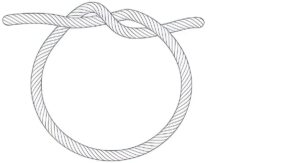
Figure 0605.-1. – Simple knot
Sterility (2.6.1)
They comply with the test for sterility as applied to catgut and other surgical sutures. Carry out the test on three sections each 30 cm long, cut off respectively from the beginning, the centre and the end of the strand.
Extractable colour
Strands that are dyed and intended to remain so during use comply with the test for extractable colour. Place 0.25 g of the strand to be examined in a conical flask, add 25.0 mL of water R and cover the mouth of the flask with a short-stemmed funnel. Boil for 15 min, cool and adjust to the original volume with water R. Depending on the colour of the strand, prepare the appropriate reference solution as described in Table 0605.-2 using the primary colour solutions (2.2.2).
Table 0605.-2. – Colour reference solutions
| Colour of strand | Composition of reference solution (parts by volume) |
|||
| Red primary solution |
Yellow primary solution |
Blue primary solution |
Water | |
| Yellow – brown | 0.2 | 1.2 | – | 8.6 |
| Pink – red | 1.0 | – | – | 9.0 |
| Green – blue | – | – | 2.0 | 8.0 |
| Violet | 1.6 | – | 8.4 | – |
The test solution is not more intensely coloured than the appropriate reference solution.
STORAGE
Store protected from light and heat.
LABELLING
The label states:
— the gauge number,
— the length in centimetres or in metres,
— where appropriate, that the strand is coloured and intended to remain so during use.