(Catgut, Sterile, in Distributor for Veterinary Use, Ph. Eur. monograph 0660)
DEFINITION
Sterile catgut in distributor for veterinary use consists of strands prepared from collagen taken from the intestinal membranes of mammals. After cleaning, the membranes are split longitudinally into strips of varying width, which, when assembled in small numbers, according to the diameter required, are twisted under tension, dried, polished, selected and sterilised. The strands may be treated with chemical substances such as chromium salts to prolong absorption and glycerol to make them supple, provided such substances do not reduce tissue acceptability.
The strand is presented in a distributor that allows the withdrawal and use of all or part of it in aseptic conditions. The design of the distributor is such that with suitable handling the sterility of the content is maintained even when part of the strand has been withdrawn. It may be stored dry or in a preserving liquid to which an antimicrobial preservative but not an antibiotic may be added.
TESTS
If stored in a preserving liquid, remove the strand from the distributor and measure promptly and in succession the length, diameter and breaking load. If stored in the dry state, immerse the strand in alcohol R Or a 90 per cent V/V solution of 2-propanol R for 24 h and proceed with the measurements as indicated above.
Length
Measure the length without applying to the strand more tension than is necessary to keep it straight. The length is not less than 95 per cent of the length stated on the label. If the strand consists of several sections joined by knots, the length of
each section is not less than 2.5 m.
Diameter
Carry out the test using a suitable instrument capable of measuring with an accuracy of at least 0.002 mm and having a circular pressor foot 10 mm to 15 mm in diameter. The pressor foot and the moving parts attached to it are weighted so as to apply a total load of 100 ± 10 g to the strand being tested. When making the measurements, lower the pressor foot slowly to avoid crushing the strand. Make not fewer than one measurement per 2 m of length. If the strand consists of several sections joined by knots, make not fewer than three measurements per section. In any case make not fewer than twelve measurements. Make the measurements at points evenly spaced along the strand or along each section. The strand is not subjected to more tension than is necessary to keep it straight during measurement. The average of the measurements carried out on the strand being tested and not less than two-thirds of the individual measurements are within the limits given in the column under A in Table 0660.-1 for the gauge number concerned. None of the measurements is outside the limits given in the columns under B in Table 0660.-1 for the gauge number concerned.
Minimum breaking load
The minimum breaking load is determined over a simple knot formed by placing one end of a strand held in the right hand over the other end held in the left hand, passing one end over the strand and through the loop so formed (see Figure 0660.-1) and pulling the knot tight.
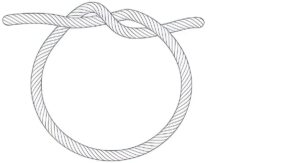
Figure 0660.-1. – Simple knot
Make not fewer than one measurement per 2 m of length. If the strand consists of several sections joined by knots, make not fewer than three measurements per section and, in any case, not fewer than one measurement per 2 m of length at points evenly spaced along the strand or along each section. Determine the breaking load using a suitable tensilometer. The apparatus has two clamps for holding the strand, one of which is mobile and is driven at a constant rate of 30 cm per minute. The clamps are designed so that the strand being tested can be attached without any possibility of slipping. At the beginning of the test the length of strand between the clamps is 12.5 cm to 20 cm and the knot is midway between the clamps. Set the mobile clamp in motion and note the force required to break the strand. If the strand breaks in a clamp or within 1 cm of it, the result is discarded and the test repeated on another part of the strand. The average of all the results, excluding those legitimately discarded, is equal to or greater than the value in column C and no value is less than that given in column D in Table 0660.-1 for the gauge number concerned.
Table 0660.-1. – Diameters and breaking loads
| Gauge number | Diameter (millimetres) |
Breaking load (newtons) |
||||
| A | B | C | D | |||
| min. | max. | min. | max. | |||
| 1 | 0.100 | 0.149 | 0.085 | 0.175 | 1.8 | 0.4 |
| 1.5 | 0.150 | 0.199 | 0.125 | 0.225 | 3.8 | 0.7 |
| 2 | 0.200 | 0.249 | 0.175 | 0.275 | 7.5 | 1.8 |
| 2.5 | 0.250 | 0.299 | 0.225 | 0.325 | 10 | 3.8 |
| 3 | 0.300 | 0.349 | 0.275 | 0.375 | 12.5 | 7.5 |
| 3.5 | 0.350 | 0.399 | 0.325 | 0.450 | 20 | 10 |
| 4 | 0.400 | 0.499 | 0.375 | 0.550 | 27.5 | 12.5 |
| 5 | 0.500 | 0.599 | 0.450 | 0.650 | 38.4 | 20.0 |
| 6 | 0.600 | 0.699 | 0.550 | 0.750 | 45.0 | 27.5 |
| 7 | 0.700 | 0.799 | 0.650 | 0.850 | 60.0 | 38.0 |
| 8 | 0.800 | 0.899 | 0.750 | 0.950 | 70.0 | 45.0 |
Soluble chromium compounds
Place 0.25 g in a conical flask containing 1 mL of water R per 10 mg of catgut. Stopper the flask, allow to stand at 37 ± 0.5 °C for 24 h, cool and decant the liquid. Transfer 5 mL to a small test tube and add 2 mL of a 10 g/L solution of diphenylcarbazide R in alcohol R and 2 mL of dilute sulfuric acid R. The solution is not more intensely coloured than a standard prepared at the same time using 5 mL of a solution containing 2.83 μg of potassium dichromate R per millilitre, 2 mL of dilute sulfuric acid R and 2 mL of a 10 g/L solution of diphenylcarbazide R in alcohol R (1 ppm of Cr).
Sterility (2.6.1)
It complies with the test for sterility as applied to catgut and other surgical sutures. Carry out the test on three sections, each 30 cm long, cut off respectively from the beginning, the centre and the end of the strand.
STORAGE
Store protected from light and heat.
LABELLING
The label states:
— the gauge number,
— the length in centimetres or in metres.