Action and use
Muscarinic M3 receptor antagonist; anticholinergic.
DEFINITION
Solifenacin Oral Suspension contains Solifenacin Succinate.
The oral suspension complies with the requirements stated under Oral Liquids and with the following requirements.
Content of solifenacin succinate, C27H32N2O6
95.0 to 105.0% of the stated amount.
IDENTIFICATION
Mix a volume of the oral suspension containing 20 mg of Solifenacin Succinate in 30 mL of a mixture of 2 volumes of acetonitrile and 3 volumes of 0.1M hydrochloric acid. Shake to disperse and centrifuge the mixture. To the supernatant add 5 mL of 5M sodium hydroxide. Extract with three 30-mL quantities of dichloromethane, shake the combined extracts with anhydrous sodium sulfate, filter and evaporate the filtrate to dryness. The infrared absorption spectrum of the residue, Appendix II A, is concordant with the reference spectrum of solifenacin (RS 508).
TESTS
Dissolution
Complies with the dissolution test for tablets and capsules, Appendix XII B1.
TEST CONDITIONS
(a) Use Apparatus 2, rotating the paddle at 50 revolutions per minute.
(b) Use 900 mL of 0.1M hydrochloric acid, at a temperature of 37°, as the medium.
PROCEDURE
Carry out the method for liquid chromatography, Appendix III D, using the following freshly prepared solutions.
(1) Shake the container containing the oral suspension being examined for 30 seconds and accurately place a volume equivalent to one dose into each dissolution vessel. After 15 minutes withdraw a sample of the medium and filter (0.45-μm PTFE is suitable). Dilute the filtrate, if necessary, to produce a solution containing the equivalent of 0.00056% w/v of Solifenacin Succinate.
(2) 0.00056% w/v of solifenacin succinate BPCRS in 0.1M hydrochloric acid.
Solifenacin Oral Suspension
CHROMATOGRAPHIC CONDITIONS
(a) Use a stainless steel column (15 cm × 4.6 mm) packed with end-capped octadecylsilyl amorphous organosilica polymer for chromatography (3.5 μm) (Waters XTerra MS C18 is suitable).
(b) Use isocratic elution and the mobile phase described below.
(c) Use a flow rate of 1 mL per minute.
(d) Use a column temperature of 40°.
(e) Use an autosampler temperature of 5°.
(f) Use a detection wavelength of 210 nm.
(g) Inject 25 μL of each solution.
MOBILE PHASE
30 volumes of acetonitrile R1 and 70 volumes of a 0.05M ammonium dihydrogen orthophosphate solution previously adjusted to pH 2.4 with orthophosphoric acid.
When the chromatograms are recorded under the prescribed conditions the retention time of the solifenacin is about 11 minutes.
DETERMINATION OF CONTENT
Calculate the total content of solifenacin succinate, C27H32N2O6, in the medium from the chromatograms obtained and using the declared content of C27H32N2O6 in solifenacin succinate BPCRS.
LIMITS
The amount of solifenacin succinate released is not less than 75% (Q) of the stated amount.
Related substances
Carry out the method for liquid chromatography, Appendix III D, using the following freshly prepared solutions.
Solution A 20 volumes of acetonitrile R1 and 30 volumes of 0.1M hydrochloric acid.
(1) To a quantity of the oral suspension containing 6 mg of Solifenacin Succinate, add 30 mL of solution A and shake. Dilute to 50 mL with solution A, centrifuge and use the supernatant liquid.
(2) Dilute 1 volume of solution (1) to 100 volumes with solution A. Further dilute 1 volume of this solution to 5 volumes with solution A.
(3) To 10 mg of solifenacin succinate BPCRS add 1 mL of hydrogen peroxide (30%), 5 mL of 0.1M sodium hydroxide, 10 mL of water and 5 mL of acetonitrile. Stir uncovered for 10 minutes (generation of impurity I). Add 1 volume of this solution
to 2.5 volumes of solution (1) and dilute to 25 volumes with solution A.
(4) 0.1% w/v of solifenacin succinate impurity standard BPCRS (containing impurities A and 1) in solution A.
CHROMATOGRAPHIC CONDITIONS
(a) Use a stainless steel column (15 cm × 4.6 mm) packed with end-capped octadecylsilyl amorphous organosilica polymer for chromatography (3.5 μm) (Waters XTerra MS C18 is suitable).
(b) Use gradient elution and the mobile phase described below.
(c) Use a flow rate of 1 mL per minute.
(d) Use a column temperature of 40°.
(e) Use an autosampler temperature of 5°.
(f) Use a detection wavelength of 210 nm.
(g) Inject 15 μL of each solution.
MOBILE PHASE
Mobile phase A: 20 volumes of acetonitrile R1 and 80 volumes of a 0.05M ammonium dihydrogen orthophosphate solution previously adjusted to pH 2.4 with orthophosphoric acid.
Mobile phase B: Acetonitrile R1.
| Time (Minutes) | Mobile phase A (% v/v) | Mobile phase B (% v/v) | Comment |
| 0-25 | 95-90 | 5-10 | linear gradient |
| 25-40 | 90-75 | 10-25 | linear gradient |
| 40-41 | 75-50 | 25-50 | linear gradient |
| 41-65 | 50 | 50 | isocratic |
| 65-66 | 50-95 | 50-5 | linear gradient |
| 66-75 | 95 | 5 | re-equilibration |
SYSTEM SUITABILITY
The test is not valid unless, in the chromatogram obtained with solution (3), the resolution between the peaks due to solifenacin and impurity I is at least 2.0.
CALCULATION OF IMPURITIES
For each impurity, use the concentration of solifenacin succinate in solution (2).
For the reporting threshold, use the concentration of solifenacin succinate in solution (2).
For peak identification, use solutions (3) and (4).
Solifenacin succinate retention time: about 26 minutes.
Relative retention: impurity A, about 0.2; impurity 1, about 0.5; impurity I, about 1.1.
Correction factor: impurity A, multiply by 0.7.
LIMITS
— unspecified impurities: for each impurity, not more than 0.2%;
— total impurities: not more than 0.5%;
— reporting threshold: 0.1%.
ASSAY
Carry out the method for liquid chromatography, Appendix III D, using the following solutions freshly prepared in solution A.
(1) To a weighed volume of the oral suspension containing 6 mg of Solifenacin Succinate, add 30 mL, shake to disperse and dilute to produce 50 mL. Centrifuge and dilute 1 volume of the supernatant liquid to 10 volumes.
(2) 0.0012% w/v of solifenacin succinate BPCRS.
(3) 0.0012% w/v of solifenacin succinate BPCRS and 0.00024% w/v of propyl 4-hydroxybenzoate.
CHROMATOGRAPHIC CONDITIONS
The chromatographic conditions described under Dissolution may be used.
SYSTEM SUITABILITY
The test is not valid unless, in the chromatogram obtained with solution (3), the resolution between the peaks due to solifenacin and propyl 4-hydroxybenzoate is at least 1.5.
DETERMINATION OF CONTENT
Determine the weight per mL of the oral suspension, Appendix V G, and calculate the content of C27H32N2O6, weight in volume, using the declared content of C27H32N2O6 in solifenacin succinate BPCRS.
Supporting information for Dissolution and Assay
In developing the Dissolution and Assay methods, geometric scaling of column dimensions and chromatographic parameters to the validated method conditions have been explored in order to reduce the solvent needed and the environmental impact. The “More resources” tab, available in the BP online monograph, provides additional information on the investigations carried out. Visit https://www.pharmacopoeia.com/guidance/environmentalhub for more information.
IMPURITIES
The impurities limited by the requirements of this monograph include impurity I listed under Solifenacin Succinate and:
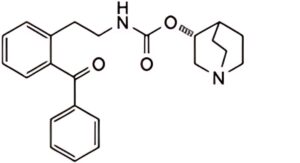
1. (+)-(R)-quinuclidin-3-yl [2-(2-benzoylphenyl)ethyl]carbamate