



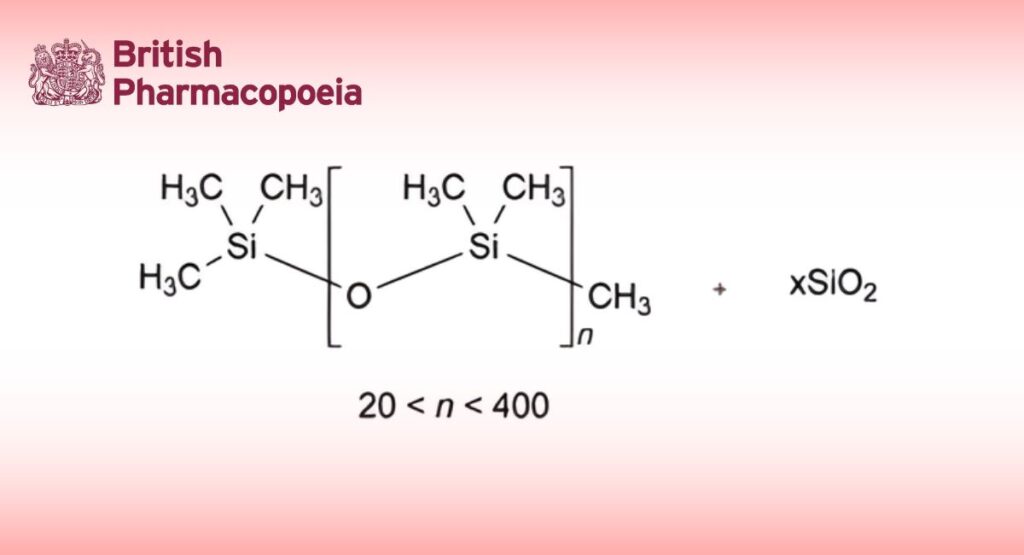
(Ph. Eur. monograph 1470)
8050-81-5
Action and use
Silicon dioxide analogue; defoaming agent.
DEFINITION
Mixture of α-trimethylsilyl-ω-methylpoly[oxy(dimethylsilanediyl)] and silicon dioxide.
Simeticone is prepared by incorporation of 4 per cent to 7 per cent silica into poly(dimethylsiloxane) with a degree of polymerisation between 20 and 400.
Content
90.5 per cent to 99.0 per cent of poly(dimethylsiloxane).
PRODUCTION
Poly(dimethylsiloxane) is obtained by hydrolysis and polycondensation of dichlorodimethylsilane and chlorotrimethylsilane and the silica is modified at the surface by incorporation of methylsilyl groups.
CHARACTERS
Appearance
Viscous, greyish-white, opalescent liquid.
Solubility
Practically insoluble in water, very slightly soluble or practically insoluble in anhydrous ethanol, practically insoluble in methanol, partly miscible with ethyl acetate, with methylene chloride, with methyl ethyl ketone and with toluene.
IDENTIFICATION
A. Infrared absorption spectrophotometry (2.2.24).
Preparation: Thin films between plates of sodium chloride R.
Absorption maxima: At 2964 cm-1 , 2905 cm-1 , 1412 cm-1 , 1260 cm-1 and 1020 cm-1.
B. Heat 0.5 g in a test-tube over a small flame until white fumes begin to appear. Invert the tube over a 2nd tube containing 1 mL of a 1 g/L solution of chromotropic acid, sodium salt R in sulfuric acid R so that the fumes reach the solution. Shake the 2nd tube for about 10 s and heat on a water-bath for 5 min. The solution is violet.
C. The residue obtained in the test for silica under Assay gives the reaction of silicates (2.3.1).
TESTS
Acidity
To 2.0 g add 25 mL of a mixture of equal volumes of anhydrous ethanol R and ether R, previously neutralised to 0.2 mL of bromothymol blue solution R1, and shake. Not more than 3.0 mL of 0.01 M sodium hydroxide is required to change the colour of the solution to blue.
Defoaming activity
Foaming solution: Dissolve 5.0 g of docusate sodium R in 1 L of water R, warm to 50 °C if necessary.
Defoaming solution: To 50 mL of methyl ethyl ketone R add 0.250 g of the substance to be examined, warm to not more than 50 °C with shaking.
Into a 250 mL cylindrical tube about 5 cm in diameter introduce 100 mL of foaming solution and 1 mL of defoaming solution. Close tightly and fix the tube on a suitable oscillating shaker that complies with the following conditions:
— 250-300 oscillations per minute;
— angle of oscillation of about 10°;
— oscillation radius of about 10 cm.
Shake for 10 s and record the time between the end of the shaking and the instant the 1st portion of foam-free liquid surface appears.
This duration is not longer than 15 s.
Mineral oils
Place 2.0 g in a test-tube and examine in ultraviolet light at 365 nm. The fluorescence is not more intense than that of a solution containing 0.1 ppm of quinine sulfate R in 0.005 M sulfuric acid examined in the same conditions.
Phenylated compounds
The corrected absorbance (2.2.25) is not greater than 0.2.
Test solution: Dissolve 5.0 g with shaking in 10.0 mL of cyclohexane R.
Spectral range: 200-350 nm.
Calculate the corrected absorbance using the following expression:
B − C
B = absorbance at the absorption maximum between 250 nm and 270 nm;
C = absorbance at 300 nm.
Volatile matter
Maximum 1.0 per cent, determined on 1.00 g by heating in an oven at 150 °C for 2 h. Carry out the test using a dish 60 mm in diameter and 10 mm deep.
ASSAY
Silica
Heat not less than 20.0 mg to 800 °C increasing the temperature by 20 °C/min under a current of nitrogen R at a flow rate of 200 mL/min and weigh the residue (silica).
Poly(dimethylsiloxane)
Infrared absorption spectrophotometry (2.2.24).
Test solution: Place about 50 mg (E) in a screw-capped 125 mL cylindrical tube, add 25.0 mL of toluene R, swirl manually to disperse and add 50 mL of dilute hydrochloric acid R, close the tube and place on a vortex mixer; shake for 5 min. Transfer the contents of the tube to a separating funnel, allow to settle and transfer 5 mL of the upper layer to a screw-capped test-tube containing 0.5 g of anhydrous sodium sulfate R. Cap and shake vigorously manually. Centrifuge to obtain a clear solution.
Reference solution: Introduce about 0.20 g of dimeticone CRS (poly(dimethylsiloxane)) into 100.0 mL of toluene R. Prepare the reference solution in the same way as for the test solution, using 25.0 mL of the dimeticone solution obtained above.
Blank solution: Shake 10 mL of toluene R with 1 g of anhydrous sodium sulfate R. Centrifuge the resulting suspension.
Record the infrared absorption spectra for the test solution and the reference solution in 0.5 mm cells, from 1330 cm-1 to 1180 cm-1 . Determine the absorbance of the band at 1260 cm-1 .
Calculate the percentage content of poly(dimethylsiloxane) using the following expression:
25×C×AM×100 / AE×E
AM = absorbance of the test solution;
AE = absorbance of the reference solution;
C = concentration of the reference solution, in milligrams per millilitre;
E = mass of the substance to be examined, in milligrams.
FUNCTIONALITY-RELATED CHARACTERISTICS
This section provides information on characteristics that are recognised as being relevant control parameters for one or more functions of the substance when used as an excipient (see chapter 5.15). Some of the characteristics described in the Functionality-related characteristics section may also be present in the mandatory part of the monograph since they also represent mandatory quality criteria. In such cases, a cross-reference to the tests described in the mandatory part is included in the Functionality-related characteristics section. Control of the characteristics can contribute to the quality of a medicinal product by improving the consistency of the manufacturing process and the performance of the medicinal product during use. Where control methods are cited, they are recognised as being suitable for the purpose, but other methods can also be used. Wherever results for a particular characteristic are reported, the control method must be indicated.
The following characteristic may be relevant for simeticone used as defoaming agent.
Defoaming activity
(see Tests).


