



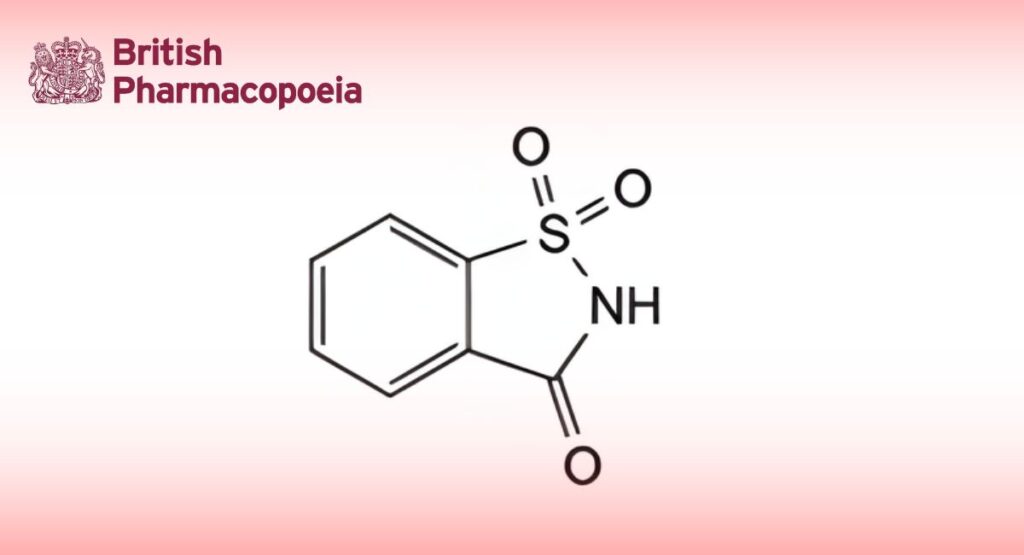
(Ph. Eur. monograph 0947)
C7H5NO3S 183.2 81-07-2
Action and use
Sweetening agent.
DEFINITION
1,2-Benzisothiazol-3(2H)-one 1,1-dioxide.
Content
99.0 per cent to 101.0 per cent (dried substance).
CHARACTERS
Appearance
White or almost white, crystalline powder or colourless crystals.
Solubility
Sparingly soluble in boiling water and in ethanol (96 per cent), slightly soluble in cold water. It dissolves in dilute solutions of alkali hydroxides and carbonates.
IDENTIFICATION
First identification: C.
Second identification: A, B, D, E.
A. A saturated solution, prepared without heating, turns blue litmus paper R red.
B. Melting point (2.2.14): 226 °C to 230 °C.
C. Infrared absorption spectrophotometry (2.2.24).
Preparation: Discs.
Comparison: saccharin CRS.
D. Mix about 10 mg with about 10 mg of resorcinol R, add 0.25 mL of sulfuric acid R and carefully heat the mixture over a naked flame until a dark green colour is produced. Allow to cool, add 10 mL of water R and dilute sodium hydroxide solution R until an alkaline reaction is produced. An intense green fluorescence develops.
E. To 0.2 g add 1.5 mL of dilute sodium hydroxide solution R, evaporate to dryness and heat the residue carefully until it melts, avoiding carbonisation. Allow to cool, dissolve the mass in about 5 mL of water R, add dilute hydrochloric acid R until a weak acid reaction is produced and filter, if necessary. To the filtrate add 0.2 mL of ferric chloride solution R2. A violet colour develops.
TESTS
Solution S
Dissolve 5.0 g in 20 mL of a 200 g/L solution of sodium acetate R and dilute to 25 mL with the same solution.
Appearance of solution
Solution S is clear (2.2.1) and colourless (2.2.2, Method II).
o- and p-Toluenesulfonamide
Gas chromatography (2.2.28).
Internal standard solution: Dissolve 25 mg of caffeine R in methylene chloride R and dilute to 100 mL with the same solvent.
Test solution: Suspend 10.0 g of the substance to be examined in 20 mL of water R and dissolve using 5-6 mL of strong sodium hydroxide solution R. If necessary adjust the solution to pH 7-8 with 1 M sodium hydroxide or 1 M hydrochloric acid and dilute to 50 mL with water R. Shake the solution with 4 quantities, each of 50 mL, of methylene chloride R. Combine the lower layers, dry over anhydrous sodium sulfate R and filter. Wash the filter and the sodium sulfate with 10 mL of methylene chloride R. Combine the solution and the washings and evaporate almost to dryness in a water-bath at a temperature not exceeding 40 °C. Using a small quantity of methylene chloride R, quantitatively transfer the residue into a suitable 10 mL tube, evaporate to dryness in a current of nitrogen and dissolve the residue in 1.0 mL of the internal
standard solution.
Blank solution: Evaporate 200 mL of methylene chloride R to dryness in a water-bath at a temperature not exceeding 40 °C. Dissolve the residue in 1 mL of methylene chloride R.
Reference solution: Dissolve 20.0 mg of o-toluenesulfonamide R and 20.0 mg of toluenesulfonamide R in methylene chloride R and dilute to 100.0 mL with the same solvent. Dilute 5.0 mL of the solution to 50.0 mL with methylene chloride R. Evaporate 5.0 mL of the final solution to dryness in a current of nitrogen. Dissolve the residue in 1.0 mL of the internal standard solution.
Column:
— material: fused silica;
— size: l = 10 m, Ø = 0.53 mm;
— stationary phase: phenyl(50)methyl(50)polysiloxane R (film thickness 2 μm).
Carrier gas nitrogen for chromatography R.
Flow rate 10 mL/min.
Split ratio 1:2.
Temperature:
— column: 180 °C;
— injection port and detector: 250 °C.
Detection: Flame ionisation.
Injection: 1 μL.
Order of elution o-toluenesulfonamide, p-toluenesulfonamide, caffeine.
System suitability:
— resolution: minimum 1.5 between the peaks due to o-toluenesulfonamide and p-toluenesulfonamide in the chromatogram obtained with the reference solution;
— the chromatogram obtained with the blank solution does not show any peak with the same retention times as the internal standard, o-toluenesulfonamide and p-toluenesulfonamide.
Limits:
— o-toluenesulfonamide: the ratio of its area to that of the internal standard is not greater than the corresponding ratio in the chromatogram obtained with the reference solution (10 ppm);
— p-toluenesulfonamide: the ratio of its area to that of the internal standard is not greater than the corresponding ratio in the chromatogram obtained with the reference solution (10 ppm).
Readily carbonisable substances
Dissolve 0.20 g in 5 mL of sulfuric acid R and keep at 48-50 °C for 10 min. When viewed against a white background, the solution is not more intensely coloured than a solution prepared by mixing 0.1 mL of red primary solution, 0.1 mL of blue primary solution and 0.4 mL of yellow primary solution (2.2.2) with 4.4 mL of water R.
Loss on drying (2.2.32)
Maximum 1.0 per cent, determined on 1.000 g by drying in an oven at 105 °C for 2 h.
Sulfated ash (2.4.14)
Maximum 0.2 per cent, determined on 1.0 g.
ASSAY
Dissolve 0.500 g in 40 mL of ethanol (96 per cent) R. Add 40 mL of water R. Titrate with 0.1 M sodium hydroxide, using a 10 g/L solution of phenolphthalein R in ethanol (96 per cent) R as indicator. Carry out a blank titration.
1 mL of 0.1 M sodium hydroxide is equivalent to 18.32 mg of C7H5NO3S.


