(Ph. Eur. monograph 3021)
Action and use
Factor Xa inhibitor; anticoagulant.
DEFINITION
Tablets containing Rivaroxaban (2932), for human use.
They comply with the monograph Tablets (0478) and the following additional requirements.
Content
95.0 per cent to 105.0 per cent of the content of rivaroxaban (C19H18ClN3O5S) stated on the label.
IDENTIFICATION
A. Record the UV spectrum of the principal peak in the chromatograms obtained with the solutions used in the assay, with a diode array detector in the range of 210-400 nm.
Results: The UV spectrum of the principal peak in the chromatogram obtained with the test solution is similar to the UV spectrum of the principal peak in the chromatogram obtained with reference solution (a).
B. Examine the chromatograms obtained in the assay.
Results: The principal peak in the chromatogram obtained with the test solution is similar in retention time and size to the principal peak in the chromatogram obtained with reference solution (a).
TESTS
Related substances
Liquid chromatography (2.2.29).
Solution A: Dilute 0.67 mL of phosphoric acid R to 1000 mL with water for chromatography R.
Solvent mixture: Solution A, acetonitrile R (40:60 V/V).
Test solution: To at least 4 whole tablets add a volume of the solvent mixture equivalent to about 2/3 of the final volume. Sonicate for at least 15 min, until the tablets have disintegrated completely. Dilute with the solvent mixture to obtain a
concentration of rivaroxaban of 0.2 mg/mL and filter.
Reference solution (a): Dissolve 20.0 mg of rivaroxaban CRS in the solvent mixture using sonication and dilute to 100.0 mL with the solvent mixture.
Reference solution (b): Dilute 2.0 mL of the test solution to 100.0 mL with the solvent mixture. Dilute 1.0 mL of this solution to 10.0 mL with the solvent mixture.
Reference solution (c): Dissolve 2 mg of rivaroxaban for system suitability CRS (containing impurity G) in the solvent mixture using sonication and dilute to 10 mL with the solvent mixture.
Column:
— size: l = 0.055 m, Ø = 4.0 mm;
— stationary phase: end-capped octadecylsilyl silica gel for chromatography R1 (3 μm);
— temperature: 45 °C.
Mobile phase:
— mobile phase A: acetonitrile R, solution A (8:92 V/V);
— mobile phase B: acetonitrile R;
| Time (min) |
Mobile phase A (per cent V/V) |
Mobile phase B (per cent V/V) |
| 0 – 2 | 100 | 0 |
| 2 – 15 | 100 → 53 | 0 → 47 |
Flow rate: 1.0 mL/min.
Detection: Spectrophotometer at 250 nm.
Injection: 5 μL of the test solution and reference solutions (b) and (c).
Identification of impurities: Use the chromatogram supplied with rivaroxaban for system suitability CRS and the chromatogram obtained with reference solution (c) to identify the peak due to impurity G.
Relative retention: With reference to rivaroxaban (retention time = about 9.5 min): impurity G = about 0.9.
System suitability: Reference solution (c):
— resolution: minimum 5.0 between the peaks due to impurity G and rivaroxaban.
Calculation of percentage contents:
— for each impurity, use the concentration of rivaroxaban in reference solution (b).
Limits:
— unspecified impurities: for each impurity, maximum 0.2 per cent;
— total: maximum 0.3 per cent;
— reporting threshold: 0.1 per cent.
Dissolution1 (2.9.3, Apparatus 2).
Dissolution medium (2.5 mg tablets): Dissolve 29.9 g of sodium acetate R and 16.6 mL of glacial acetic acid R in water R and dilute to 10 L with the same solvent. Adjust to pH 4.5 with sodium hydroxide solution R or glacial acetic acid R. Use
900 mL of the medium.
Dissolution medium (10 mg tablets): Dissolve 29.9 g of sodium acetate R, 16.6 mL of glacial acetic acid R and 20 g of sodium dodecyl sulfate R in water R and dilute to 10 L with the same solvent. Adjust to pH 4.5 with sodium hydroxide solution R or glacial acetic acid R. Use 900 mL of the medium.
Dissolution medium (15 mg and 20 mg tablets): Dissolve 29.9 g of sodium acetate R, 16.6 mL of glacial acetic acid R and 40 g of sodium dodecyl sulfate R in water R and dilute to 10 L with the same solvent. Adjust to pH 4.5 with sodium hydroxide solution R or glacial acetic acid R. Use 900 mL of the medium.
Rotation speed: 75 r/min.
Time: 30 min.
Analysis: Liquid chromatography (2.2.29). Prepare the solutions immediately before use.
Test solutions: Samples withdrawn from the dissolution vessel and filtered.
Reference solution: Dissolve 28.0 mg of rivaroxaban CRS in acetonitrile R and dilute to 50.0 mL with the same solvent. Dilute a suitable volume of the solution with the dissolution medium to obtain a concentration of rivaroxaban corresponding to the theoretical concentration of rivaroxaban in the test solution, based on the labelled content of the tablets.
Column:
— size: l = 0.06 m, Ø = 4.0 mm;
— stationary phase: end-capped octadecylsilyl silica gel for chromatography R (3 μm);
— temperature: 40 °C.
Mobile phase: acetonitrile R, water for chromatography R (40:60 V/V).
Flow rate: 1.0 mL/min.
Detection: Spectrophotometer at 250 nm.
Autosampler: Set at 10 °C.
Injection: 10 μL.
Run time: 3 times the retention time of rivaroxaban.
System suitability: Reference solution:
— repeatability: maximum relative standard deviation of 1.0 per cent determined on 6 injections.
Calculate the amount of dissolved rivaroxaban (C19H18ClN3O5S), expressed as a percentage of the content stated on the label, taking into account the assigned content of rivaroxaban CRS.
Acceptance criterion:
— Q = 80 per cent after 30 min.
ASSAY
Liquid chromatography (2.2.29) as described in the test for related substances with the following modifications.
Injection Test solution and reference solution (a).
System suitability Reference solution (a):
— repeatability: maximum relative standard deviation of 1.0 per cent determined on 6 injections.
Calculate the percentage content of rivaroxaban (C19H18ClN3O5S) taking into account the assigned content of rivaroxaban CRS.
IMPURITIES
Other detectable impurities (the following substances would, if present at a sufficient level, be detected by one or other of the tests in the monograph): B, D, E, G, H, I, J.
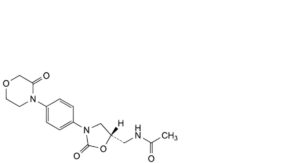
B. N-[[(5S)-2-oxo-3-[4-(3-oxomorpholin-4-yl)phenyl]-1,3-oxazolidin-5-yl]methyl]acetamide,
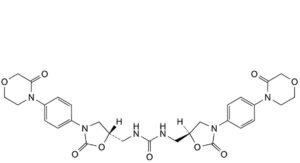
D. N,N′-bis[[(5S)-2-oxo-3-[4-(3-oxomorpholin-4-yl)phenyl]-1,3-oxazolidin-5-yl]methyl]urea,
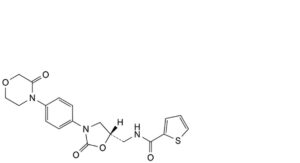
E. N-[[(5S)-2-oxo-3-[4-(3-oxomorpholin-4-yl)phenyl]-1,3-oxazolidin-5-yl]methyl]thiophene-2-carboxamide,
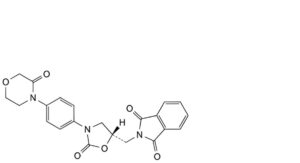
G. 2-[[(5S)-2-oxo-3-[4-(3-oxomorpholin-4-yl)phenyl]-1,3-oxazolidin-5-yl]methyl]-2H-isoindole-1,3-dione,
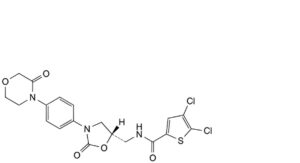
H. 4,5-dichloro-N-[[(5S)-2-oxo-3-[4-(3-oxomorpholin-4-yl)phenyl]-1,3-oxazolidin-5-yl]methyl]thiophene-2-carboxamide,
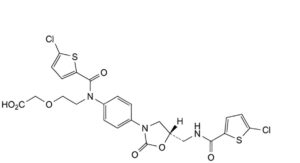
I. [2-[(5 S)-1 ,9 -dichloro-2,5 ,8-trioxo-3,7-diaza-5(3,5)-1,3-oxazolidina-1,9(2)-dithiophena-4(1,4)-benzenanonaphan-3- yl]ethoxy]acetic acid,
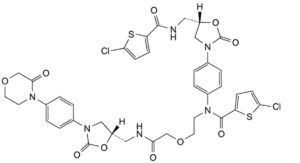
J. 5-chloro-N-[4-[(5S)-5-[(5-chlorothiophene-2-carboxamido)methyl]-2-oxo-1,3-oxazolidin-3-yl]phenyl]-N-[2-[2-oxo-2- [[[(5S)-2-oxo-3-[4-(3-oxomorpholin-4-yl)phenyl]-1,3-oxazolidin-5-yl]methyl]amino]ethoxy]ethyl]thiophene-2-carboxamide.
1The test approved in the marketing authorisation is to be used for routine quality control to confirm batch-to-batch consistency. For more information please consult Ph. Eur. 1. General Notices.