



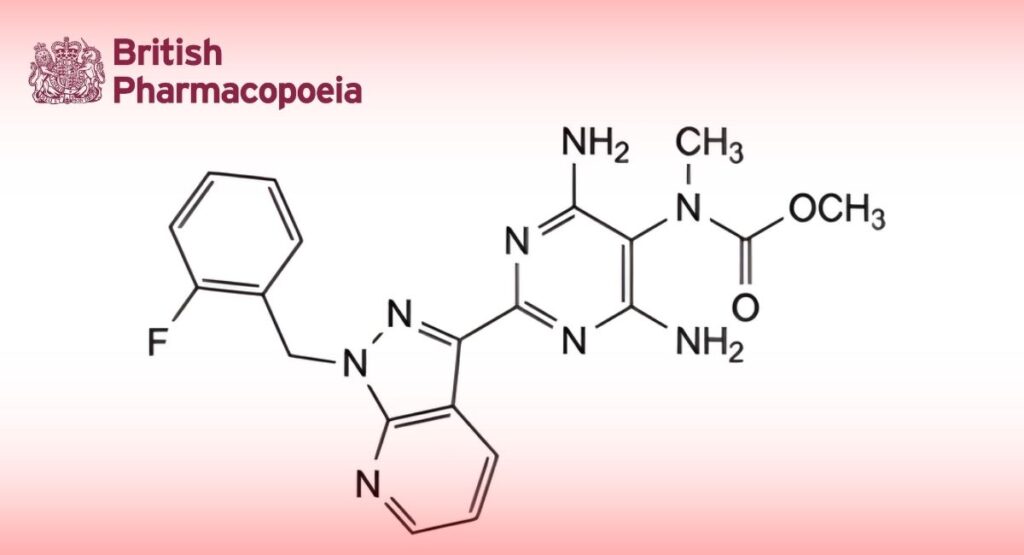
(Ph. Eur. monograph 3078)
C20H19FN8O2 422.4 625115-55-1
Action and use
Guanylate cyclase stimulator; treatment of pulmonary hypertension.
Preparation
Riociguat Tablets
DEFINITION
Methyl [4,6-diamino-2-[1-[(2-fluorophenyl)methyl]-1H-pyrazolo[3,4-b]pyridin-3-yl]pyrimidin-5-yl](methyl)carbamate.
Content
98.0 per cent to 102.0 per cent (anhydrous substance).
CHARACTERS
Appearance
White or yellowish powder.
Solubility
Practically insoluble in water, very slightly soluble in anhydrous ethanol, practically insoluble in heptane.
It shows polymorphism (5.9).
IDENTIFICATION
Infrared absorption spectrophotometry (2.2.24).
Comparison: riociguat CRS.
If the spectra obtained in the solid state show differences, dissolve the substance to be examined and the reference substance separately in methanol R, evaporate to dryness and record new spectra using the residues.
TESTS
Protect the solutions from light throughout the tests.
Related substances
Liquid chromatography (2.2.29).
Solvent mixture: Mobile phase A, acetonitrile R (20:80 V/V).
Test solution: Dissolve 20.0 mg of the substance to be examined in the solvent mixture using sonication and dilute to 50.0 mL with the solvent mixture.
Reference solution (a): Dilute 1.0 mL of the test solution to 100.0 mL with the solvent mixture. Dilute 1.0 mL of this solution to 10.0 mL with the solvent mixture.
Reference solution (b): Dissolve 4 mg of riociguat for system suitability CRS (containing impurities B and C) in the solvent mixture using sonication and dilute to 10 mL with the solvent mixture.
Reference solution (c): Dissolve 20.0 mg of riociguat CRS in the solvent mixture using sonication and dilute to 50.0 mL with the solvent mixture.
Column:
— size: l = 0.25 m, Ø = 4.6 mm;
— stationary phase: end-capped octadecylsilyl silica gel for chromatography R (5 μm);
— temperature: 40 °C.
Mobile phase:
— mobile phase A: perchloric acid R, water for chromatography R (0.4:100 V/V);
— mobile phase B: acetonitrile R1;
| Time (min) |
Mobile phase A (per cent V/V) |
Mobile phase B (per cent V/V) |
| 0 – 2 | 75 | 25 |
| 2 – 27 | 75 → 65 | 25 → 35 |
| 27 – 42 | 65 → 32 | 35 → 68 |
| 42 – 43 | 32 → 10 | 68 → 90 |
| 43 – 52 | 10 | 90 |
Flow rate: 1.0 mL/min.
Detection: Spectrophotometer at 210 nm.
Autosampler: Set at 15 °C.
Injection: 5 μL of the test solution and reference solutions (a) and (b).
Identification of impurities: Use the chromatogram supplied with riociguat for system suitability CRS and the chromatogram obtained with reference solution (b) to identify the peaks due to impurities B and C.
Relative retention: With reference to riociguat (retention time = about 22 min): impurity B = about 0.97; impurity C = about 1.4.
System suitability: Reference solution (b):
— resolution: minimum 1.5 between the peaks due to impurity B and riociguat.
Calculation of percentage contents:
— for each impurity, use the concentration of riociguat in reference solution (a).
Limits:
— impurity C: maximum 0.20 per cent;
— unspecified impurities: for each impurity, maximum 0.10 per cent;
— total: maximum 0.3 per cent;
— reporting threshold: 0.05 per cent.
Impurity E
Head-space gas chromatography (2.2.28).
Test solution: Dissolve 50 mg of the substance to be examined in 1.0 mL of dimethyl sulfoxide R in a head-space vial.
Reference solution: Dilute 50 μL of benzene R (impurity E) to 10.0 mL with dimethyl sulfoxide R. Dilute 11.5 μL of the solution to 10.0 mL with dimethyl sulfoxide R. Transfer 20 μL of this solution into a head-space vial and add 1.0 mL of dimethyl sulfoxide R.
Column:
— material: fused silica;
— size: l = 60 m, Ø = 0.32 mm;
— stationary phase: macrogol 20 000 R (film thickness 0.5 μm).
Carrier: gas helium for chromatography R.
Flow rate: 3.3 mL/min.
Split ratio: 1:20.
Static head-space conditions that may be used:
— equilibration temperature: 100 °C;
— equilibration time: 30 min;
— transfer-line temperature: 120 °C;
— pressurisation time: 30 s;
— injection volume: 1.0 mL;
— injection time: 1 min.
Temperature:
| Time (min) |
Temperature (°C) |
|
| Column | 0 – 10 | 40 → 60 |
| 10 – 15 | 60 | |
| 15 – 18.2 | 60 → 140 | |
| 18.2 – 35 | 140 | |
| Injection port | 120 | |
| Detector | 250 |
Detection: Flame ionisation.
Identification of impurities: Use the chromatogram obtained with the reference solution to identify the peak due to impurity E.
Retention time: Impurity E = about 7.1 min.
System suitability: Reference solution:
— signal-to-noise ratio: minimum 15 for the peak due to impurity E.
Limit:
— impurity E: not more than the area of the corresponding peak in the chromatogram obtained with the reference solution (2 ppm).
Water (2.5.32)
Maximum 0.2 per cent, determined on 0.250 g using the evaporation technique at 150 °C.
Sulfated ash (2.4.14)
Maximum 0.1 per cent, determined on 1.0 g in a platinum crucible.
ASSAY
Liquid chromatography (2.2.29) as described in the test for related substances with the following modification.
Injection: Test solution and reference solution (c).
Calculate the percentage content of C20H19FN8O2 taking into account the assigned content of riociguat CRS.
IMPURITIES
Specified impurities C, E.
Other detectable impurities (the following substances would, if present at a sufficient level, be detected by one or other of the tests in the monograph. They are limited by the general acceptance criterion for other/unspecified impurities and/or by the general monograph Substances for pharmaceutical use (2034). It is therefore not necessary to identify these impurities for demonstration of compliance. See also 5.10. Control of impurities in substances for pharmaceutical use) A, B, D.
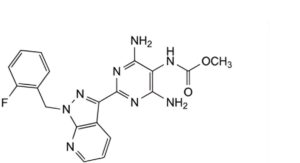
A. methyl [4,6-diamino-2-[1-[(2-fluorophenyl)methyl]-1H-pyrazolo[3,4-b]pyridin-3-yl]pyrimidin-5-yl]carbamate,
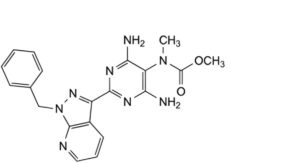
B. methyl [4,6-diamino-2-(1-benzyl-1H-pyrazolo[3,4-b]pyridin-3-yl)pyrimidin-5-yl](methyl)carbamate,
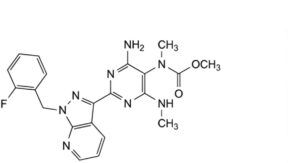
C. methyl [4-amino-2-[1-[(2-fluorophenyl)methyl]-1H-pyrazolo[3,4-b]pyridin-3-yl]-6-(methylamino)pyrimidin-5-yl] (methyl)carbamate,
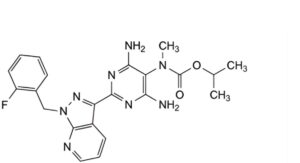
D. propan-2-yl [4,6-diamino-2-[1-[(2-fluorophenyl)methyl]-1H-pyrazolo[3,4-b]pyridin-3-yl]pyrimidin-5-yl](methyl)carbamate,
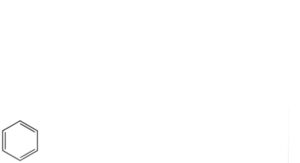
E. benzene.


