



Edition: BP 2025 (Ph. Eur. 11.6 update)
Action and use
Opioid receptor agonist; analgesic.
DEFINITION
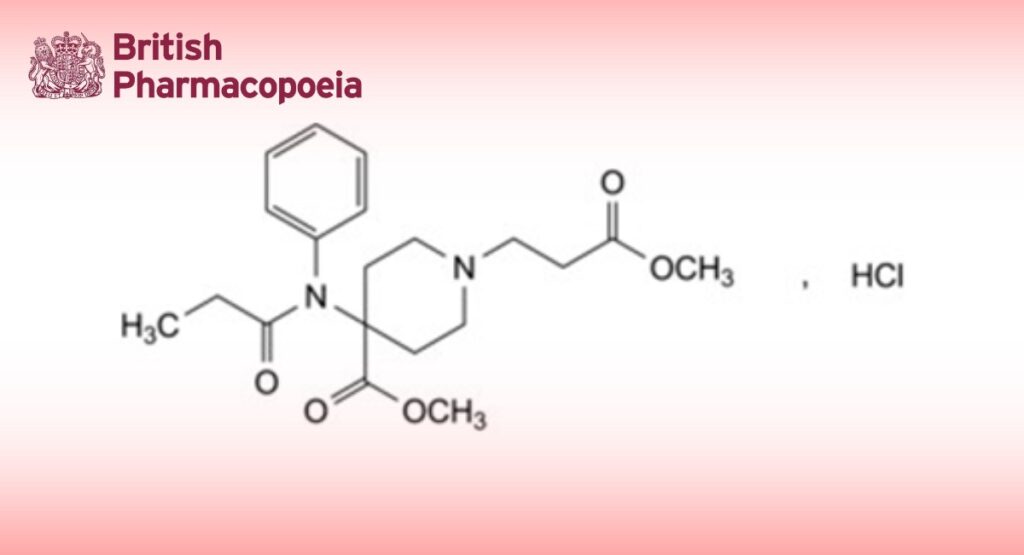
Methyl 1-(3-methoxy-3-oxopropyl)-4-[phenyl(propanoyl)amino]piperidine-4-carboxylate hydrochloride.
Content
97.0 per cent to 102.0 per cent (dried substance).
CHARACTERS
Appearance
White or almost white, crystalline powder.
Solubility
Freely soluble in water, soluble in acetonitrile and in methanol, sparingly soluble in ethanol (96 per cent).
IDENTIFICATION
A. Infrared absorption spectrophotometry (2.2.24).
Comparison remifentanil hydrochloride CRS.
B. It gives reaction (a) of chlorides (2.3.1).
TESTS
Appearance of solution
The solution is clear (2.2.1) and colourless (2.2.2, Method II). Dissolve 0.5 g in water R and dilute to 50.0 mL with the same solvent.
Related substances
Liquid chromatography (2.2.29). Prepare the solutions immediately before use and keep them at not more than 5 °C.
Buffer solution Dissolve 6.0 g of anhydrous sodium dihydrogen phosphate R in 950 mL of water for chromatography R, adjust to pH 3.0 with phosphoric acid R and dilute to 1000 mL with water for chromatography R.
Test solution (a) Dissolve 30.0 mg of the substance to be examined in mobile phase B and dilute to 20.0 mL with mobile phase B.
Test solution (b) Dilute 1.0 mL of test solution (a) to 20.0 mL with mobile phase B.
Reference solution (a) Dissolve 3 mg of remifentanil impurity mixture CRS (containing impurities A, B, C, E, L, N and O) in mobile phase B and dilute to 2 mL with mobile phase B.
Reference solution (b) Dilute 1.0 mL of test solution (a) to 100.0 mL with mobile phase B. Dilute 1.0 mL of this solution to 10.0 mL with mobile phase B.
Reference solution (c) Dissolve 30.0 mg of remifentanil hydrochloride CRS in mobile phase B and dilute to 20.0 mL with mobile phase B. Dilute 1.0 mL of the solution to 20.0 mL with mobile phase B.
Column:
— size: l = 0.10 m, Ø = 2.1 mm;
— stationary phase: end-capped octadecylphenylsilyl silica gel for chromatography R (2 µm);
— temperature: 40 °C.
Mobile phase:
— mobile phase A: acetonitrile R1, methanol R2, buffer solution (1:9:90 V/V/V);
— mobile phase B: acetonitrile R1, buffer solution, methanol R2 (12:40:48 V/V/V);
| Time (min) | Mobile phase A (per cent V/V) | Mobile phase B (per cent V/V) |
| 0 – 8 | 85 | 15 |
| 8 – 40 | 85 → 45 | 15 → 55 |
Flow rate 0.65 mL/min.
Detection Spectrophotometer at 210 nm.
Injection 5.0 µL of test solution (a) and reference solutions (a) and (b).
Identification of impurities Use the chromatogram supplied with remifentanil impurity mixture CRS and the chromatogram obtained with reference solution (a) to identify the peaks due to impurities A, B, C, E, L, N and O.
Relative retention With reference to remifentanil (retention time = about 10 min): impurity L = about 0.2; impurity O = about 0.40; impurity B = about 0.44; impurity A = about 0.7; impurity C = about 0.80; impurity N = about 0.85; impurity E = about 1.4.
System suitability Reference solution (a):
— resolution: minimum 1.5 between the peaks due to impurities O and B; minimum 2.0 between the peaks due to impurities C and N.
Calculation of percentage contents:
— correction factor: multiply the peak area of impurity L by 1.5;
— for each impurity, use the concentration of remifentanil hydrochloride in reference solution (b).
Limits:
— impurity C: maximum 0.5 per cent;
— impurity A: maximum 0.2 per cent;
— impurities B, E, L: for each impurity, maximum 0.15 per cent;
— unspecified impurities: for each impurity, maximum 0.10 per cent;
— total: maximum 1.0 per cent;
— reporting threshold: 0.05 per cent.
Methyl acrylate
Head-space gas chromatography (2.2.28).
Internal standard solution Dilute 25.0 µL of propanol R to 100.0 mL with water for chromatography R. Dilute 50.0 mL of the solution to 1000.0 mL with water for chromatography R.
Test solution Dissolve 0.100 g of the substance to be examined in the internal standard solution and dilute to 5.0 mL with the internal standard solution.
Reference solution Dilute 75.0 µL of methyl acrylate R to 100.0 mL with the internal standard solution. Dilute 10.0 mL of the solution to 100.0 mL with the internal standard solution. Dilute 7.0 mL of this solution to 100.0 mL with the internal standard solution.
Precolumn:
— material: deactivated fused silica;
— size: l = 5 m, Ø = 0.25 mm.
Column:
— material: fused silica;
— size: l = 60 m, Ø = 0.53 mm;
— stationary phase: cyanopropyl(7)phenyl(7)methyl(86)polysiloxane R (film thickness 3 µm).
Carrier gas helium for chromatography R. Flow rate 8.3 mL/min.
Pressure 68.9 kPa.
Split ratio 1:10.
Static head-space conditions that may be used:
— equilibration temperature: 90 °C;
— equilibration time: 5 min;
— transfer-line temperature: 180 °C;
— pressurisation time: 2 min;
— injection: 6 s or 1 mL;
— withdrawal time: 12 s;
— shaker: on.
Temperature:
| Time (min) | Temperature (°C) | |
| Column | 0 – 35 | 35 |
| 35 – 40 | 35 → 210 | |
| 40 – 50 | 210 | |
| Injection port | 180 | |
| Detector | 250 | |
Detection Flame ionisation.
Retention time Propanol = about 25 min; methyl acrylate = about 27 min.
System suitability Reference solution:
— resolution: minimum 5.0 between the peaks due to propanol and methyl acrylate. Calculate the content of methyl acrylate, taking its relative density to be 0.955 at 20 °C. Limit:
— methyl acrylate: maximum 250 ppm.
Loss on drying (2.2.32)
Maximum 0.5 per cent, determined on 1.000 g by drying in an oven at 105 °C for 3 h.
Sulfated ash (2.4.14)
Maximum 0.1 per cent, determined on 1.0 g.
ASSAY
Liquid chromatography (2.2.29) as described in the test for related substances with the following modifications.
Mobile phase:
| Time (min) | Mobile phase A (per cent V/V) | Mobile phase B (per cent V/V) |
| 0 – 8 | 85 | 15 |
| 8 – 12 | 85 → 83 | 15 → 17 |
| 12 – 15 | 83 → 15 | 17 → 85 |
| 15 – 25 | 15 | 85 |
Injection Test solution (b) and reference solution (c).
Retention time Remifentanil = about 11 min.
System suitability Reference solution (c):
— symmetry factor: maximum 2.2 for the peak due to remifentanil.
Calculate the percentage content of C20H29ClN2O5 taking into account the assigned content of remifentanil hydrochloride CRS.
IMPURITIES
Specified impurities A, B, C, E, L.
Other detectable impurities (the following substances would, if present at a sufficient level, be detected by one or other of the tests in the monograph. They are limited by the general acceptance criterion for other/unspecified impurities and/or by the general monograph Substances for pharmaceutical use (2034). It is therefore not necessary to identify these impurities for demonstration of compliance. See also 5.10. Control of impurities in substances for pharmaceutical use) D, G, H, I, J, K, M, N, O.
A. methyl 4-[phenyl(propanoyl)amino]piperidine-4-carboxylate,
B. methyl 4-[acetyl(phenyl)amino]-1-(3-methoxy-3-oxopropyl)piperidine-4-carboxylate,
C. 3-[4-(methoxycarbonyl)-4-[phenyl(propanoyl)amino]piperidin-1-yl]propanoic acid,
D. methyl 4-[butanoyl(phenyl)amino]-1-(3-methoxy-3-oxopropyl)piperidine-4-carboxylate,
E. methyl 1-(3-methoxy-3-oxopropyl)-4-[(2-methyl-3-oxopentanoyl)(phenyl)amino]piperidine-4-carboxylate,
G. methyl 1-benzyl-4-[phenyl(propanoyl)amino]piperidine-4-carboxylate,
H. 1-benzyl-4-(phenylamino)piperidine-4-carbonitrile,
I. 1-benzyl-4-(phenylamino)piperidine-4-carboxamide,
J. methyl 1-benzyl-4-(phenylamino)piperidine-4-carboxylate,
K. methyl 1-methyl-4-[phenyl(propanoyl)amino]piperidine-4-carboxylate,
L. methyl 3-(2-ethyl-4-oxo-1-phenyl-1,3,8-triazaspiro[4.5]dec-2-en-8-yl)propanoate,
M. methyl 3-[4-cyano-4-(phenylamino)piperidin-1-yl]propanoate,
N. methyl 3-[4-cyano-4-[phenyl(propanoyl)amino]piperidin-1-yl]propanoate,
O. N-phenylpropanamide.


