Edition: BP 2025 (Ph. Eur. 11.6 update)
Action and use
Insecticide.
DEFINITION
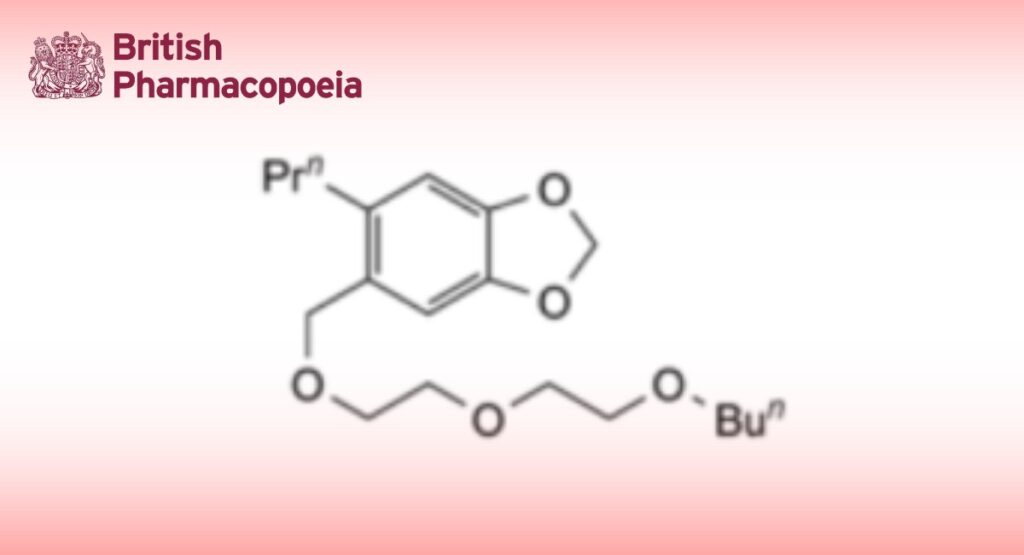
Piperonyl Butoxide is 5-[2-(2-butoxyethoxy)ethoxymethyl]-6-propyl-1,3-benzodioxole. It contains not less than 94.0% and not more than 102.0% of C19H30O5.
CHARACTERISTICS
A colourless to light yellow, oily liquid.
Very slightly soluble in water; miscible with ethanol (96%) with ether and with petroleum oils.
IDENTIFICATION
The infrared absorption spectrum, Appendix II A, is concordant with the reference spectrum of Piperonyl Butoxide (RS 478).
TESTS
Refractive index
1.494 to 1.504, Appendix V E.
Weight per mL
1.050 to 1.065 g, Appendix V G.
Sulfated ash
Not more than 0.2%, Appendix IX A, Method II.
Related substances
Carry out the method for gas chromatography, Appendix III B, using the following solutions in n-hexane.
(1) 1.2% w/v of the substance being examined.
(2) Dilute 1 volume of solution (1) to 100 volumes and dilute 1 volume of the resulting solution to 10 volumes.
(3) Dilute 1 volume of solution (2) to 20 volumes.
(4) 0.16% w/v of piperonyl butoxide impurity standard BPCRS.
CHROMATOGRAPHIC CONDITIONS
(a) Use a fused silica capillary column (25 m × 0.32 mm) bonded with a 0.52-µm layer of 100% dimethylpolysiloxane (DB1 is suitable).
(b) Use helium as the carrier gas at 1 mL per minute.
(c) Use the temperature gradient described below.
(d) Use an inlet temperature of 250°.
(e) Use a flame ionisation detector at a temperature of 300°.
(f) Use a split ratio of 1:10.
(g) Inject 1 µL of each solution.
| Time(Minutes) | Temperature °C | Comment |
| 0-2 | 70 | isothermal |
| 2-45 | 70→285 | linear gradient |
| 45-60 | 285 | isothermal |
SYSTEM SUITABILITY
The test is not valid unless:
the chromatogram obtained with solution (4) closely resembles the reference chromatogram supplied with piperonyl butoxide impurity standard BPCRS;
in the chromatogram obtained with solution (3), the signal-to-noise ratio of the principal peak is at least 10; the resolution between piperonyl butoxide and dipiperonyl methane is at least 2.
LIMITS
In the chromatogram obtained with solution (1):
determine the amount of each secondary peak by normalisation.
the area of any peak corresponding to dipiperonyl methane is not greater than 2.0%;
the area of any peak corresponding to diethylene glycol butyl ether is not greater than 2.0%; the area of any peak corresponding to dipiperonyl ether is not greater than 1.5%;
the area of any peak corresponding to dihydrosafrole is not greater than 50 ppm; the area of any other secondary peak is not greater than 0.5%;
the sum of the areas of any other secondary peaks is not greater than 2.5%.
Disregard any peak with an area less than principal peak in solution (2) (0.1%) with the exception of dihydrosafrole.
ASSAY
Carry out the method for gas chromatography, Appendix III B, using the following solutions in hexane.
(1) 0.16% w/v of the substance being examined.
(2) 0.16% w/v of piperonyl butoxide BPCRS.
(3) 0.16% w/v of piperonyl butoxide impurity standard BPCRS.
CHROMATOGRAPHIC CONDITIONS
The chromatographic conditions described under Related substances may be used.
SYSTEM SUITABILITY
The test is not valid unless the chromatogram obtained with solution (3) closely resembles the reference chromatogram supplied with piperonyl butoxide impurity standard BPCRS and the resolution between piperonyl butoxide and dipiperonyl methane is at least 2.0.
Calculate the content of C19H30O5 using the declared content of C19H30O5 in piperonyl butoxide BPCRS.
IMPURITIES
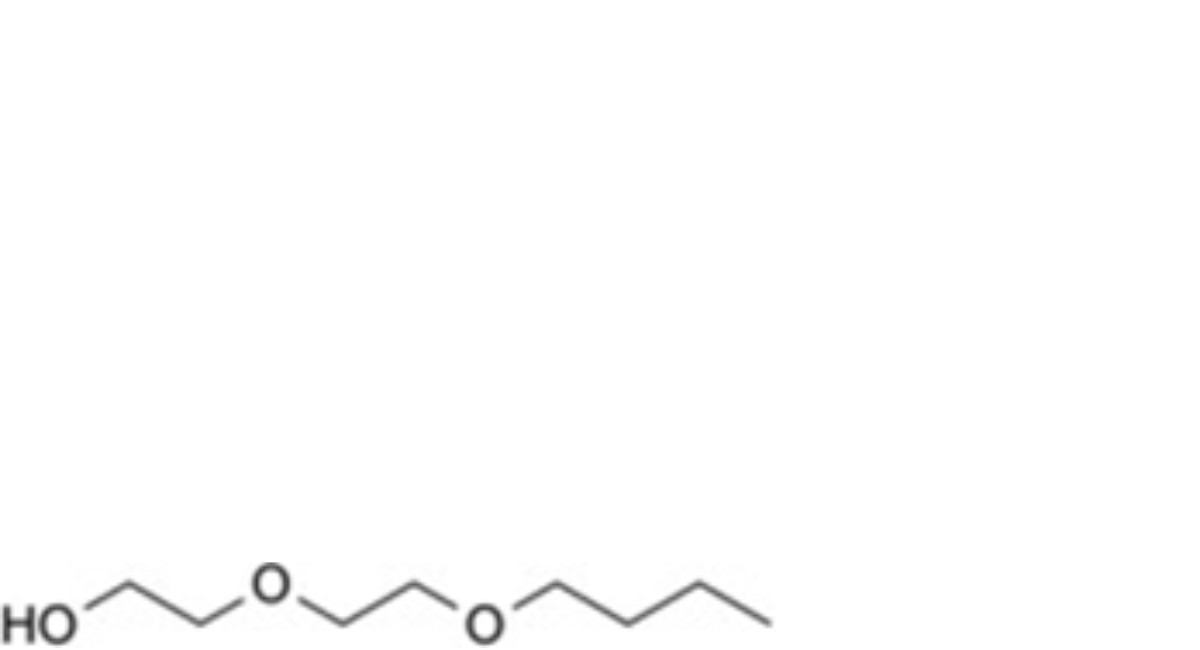
A. 2-(2-butoxyethoxy)ethanol, (diethylene glycol butyl ether);
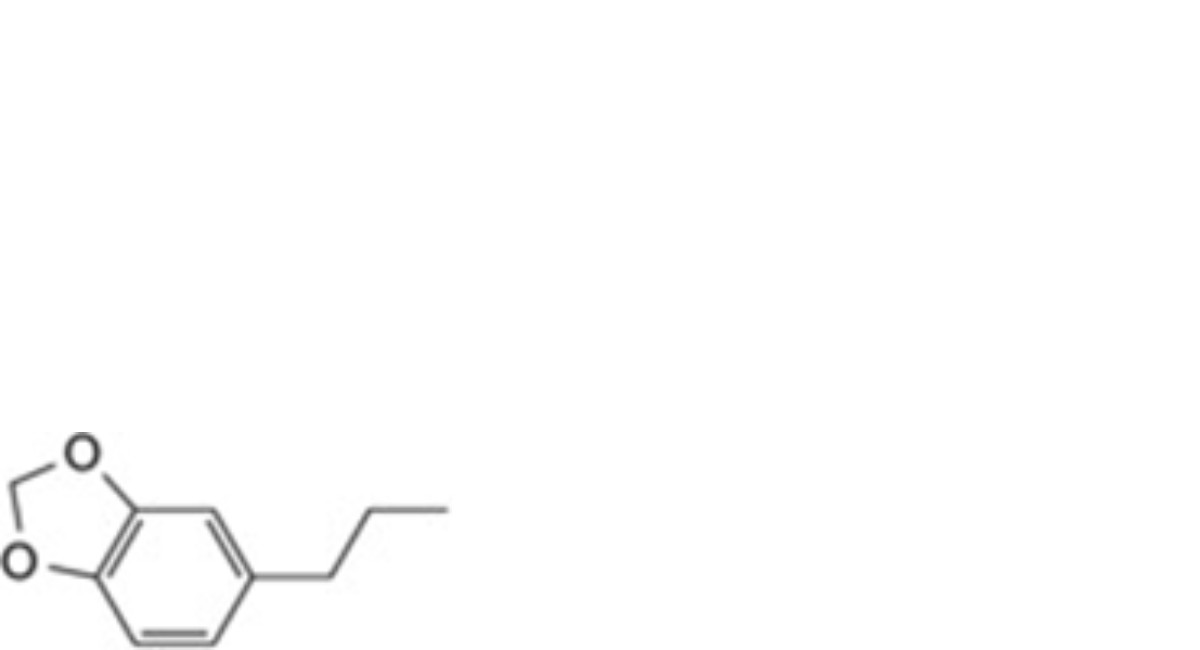
B. 5-propyl-1,3-benzodioxole, 1,2-methylendioxy-4-propylbenzene, (dihydrosafrole);
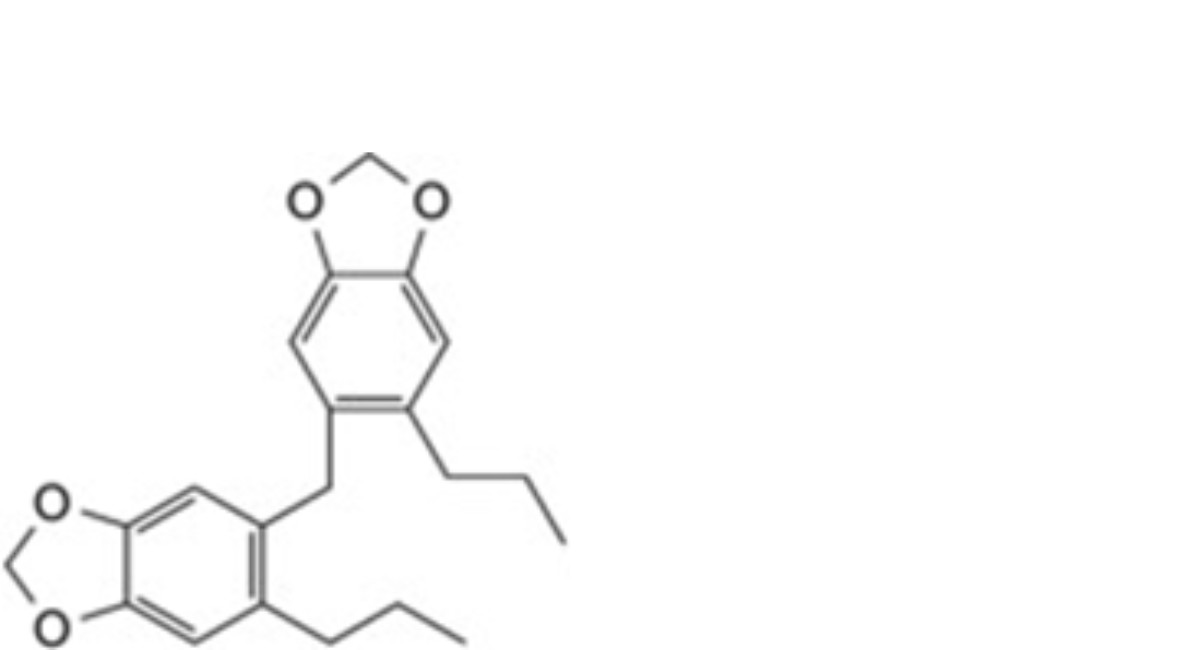
C. [1,1’- di-(6-propyl-benzo-[1,3]-dioxol-5-yl)methane], (dipiperonyl methane);
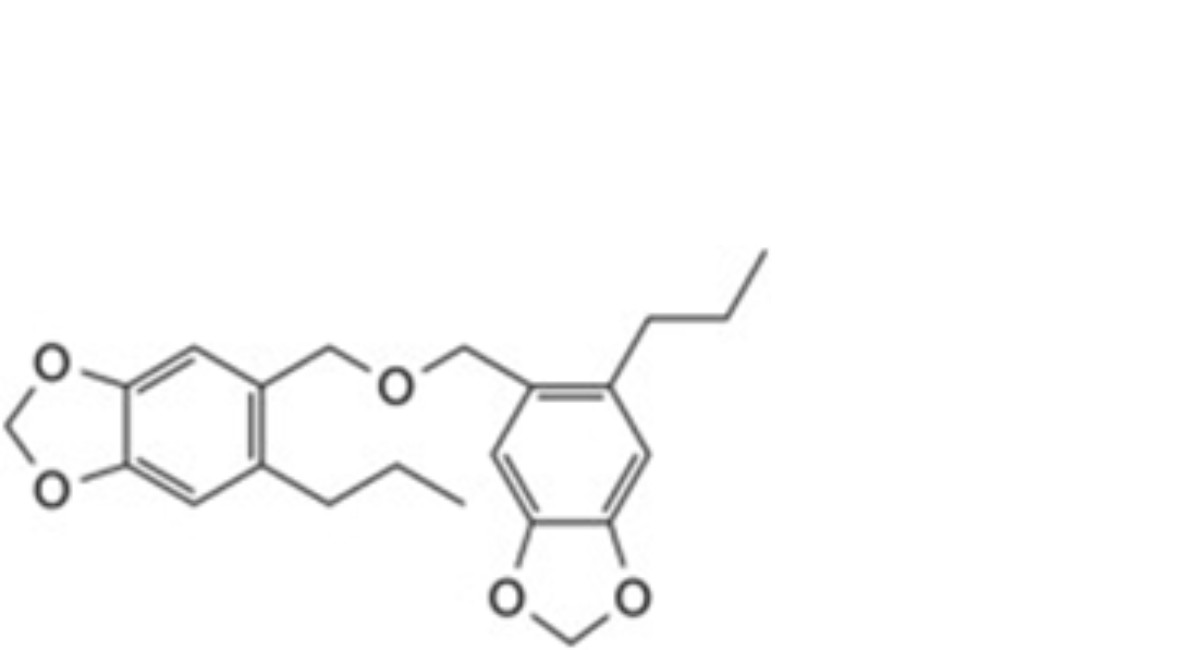
D. [di-((6-propyl-benzo-[1,3]dioxol-5-yl)methyl)ether] (dipiperonyl ether).