



Edition: BP 2025 (Ph. Eur. 11.6 update)
Action and use
Anthelminthic.
Ph Eur
DEFINITION
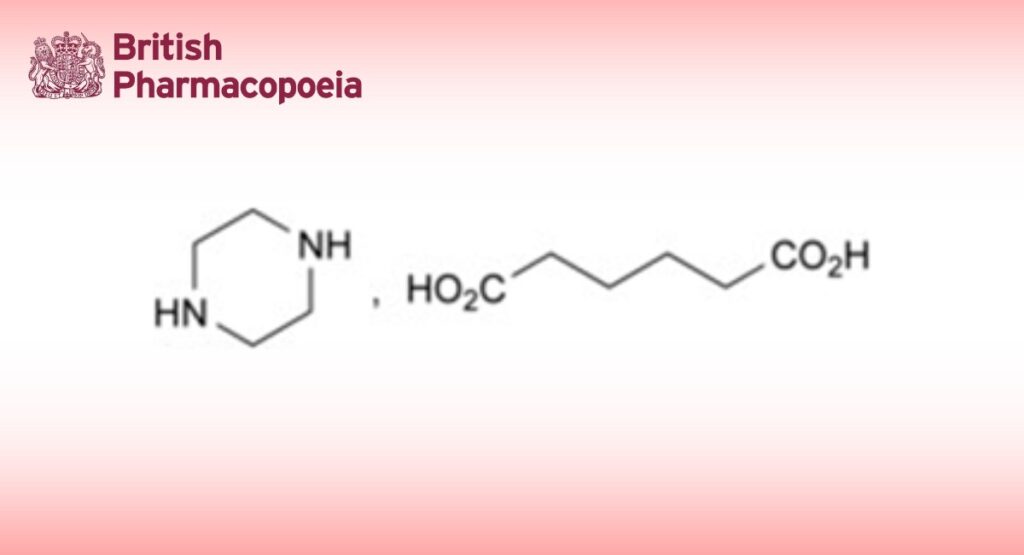
Piperazine adipate contains not less than 98.0 per cent and not more than the equivalent of 101.0 per cent of piperazine hexanedioate, calculated with reference to the anhydrous substance.
CHARACTERS
A white or almost white crystalline powder, soluble in water, practically insoluble in ethanol (96 per cent). It melts at about 250 °C, with decomposition.
IDENTIFICATION
First identification: A. Second identification: B, C.
A. Examine by infrared absorption spectrophotometry (2.2.24), comparing with the spectrum obtained with piperazine adipate CRS. Examine the substances prepared as discs.
B. Examine the chromatograms obtained in the test for related substances after spraying with the ninhydrin solutions. The principal spot in the chromatogram obtained with test solution (b) is similar in position, colour and size to the principal spot in the chromatogram obtained with reference solution (a).
C. To 10 mL of solution S (see Tests) add 5 mL of hydrochloric acid R and shake with three quantities, each of 10 mL, of ether R. Evaporate the combined ether layers to dryness. The residue, washed with 5 mL of water R and dried at 100 °C to 105 °C, melts (2.2.14) at 150 °C to 154 °C.
TESTS
Solution S
Dissolve 2.5 g in water R and dilute to 50 mL with the same solvent.
Appearance of solution
Solution S is clear (2.2.1) and not more intensely coloured than reference solution B8 (2.2.2, Method II).
Related substances
Examine by thin-layer chromatography (2.2.27), using a suitable silica gel as the coating substance.
Test solution (a) Dissolve 1.0 g of the substance to be examined in 6 mL of concentrated ammonia R and dilute to 10 mL with ethanol R.
Test solution (b) Dilute 1 mL of test solution (a) to 10 mL with a mixture of 2 volumes of ethanol R and 3 volumes of concentrated ammonia R.
Reference solution (a) Dissolve 0.1 g of piperazine adipate CRS in a mixture of 2 volumes of ethanol R and 3 volumes of concentrated ammonia R and dilute to 10 mL with the same mixture of solvents.
Reference solution (b) Dissolve 25 mg of ethylenediamine R in a mixture of 2 volumes of ethanol R and 3 volumes of concentrated ammonia R and dilute to 100 mL with the same mixture of solvents.
Reference solution (c) Dissolve 25 mg of triethylenediamine R in a mixture of 2 volumes of ethanol R and 3 volumes of concentrated ammonia R and dilute to 100 mL with the same mixture of solvents.
Reference solution (d) Dissolve 12.5 mg of triethylenediamine R in 5.0 mL of test solution (a) and dilute to 50 mL with a mixture of 2 volumes of ethanol R and 3 volumes of concentrated ammonia R.
Apply separately to the plate 5 µL of each solution. Develop over a path of 15 cm using a freshly prepared mixture of 20 volumes of concentrated ammonia R and 80 volumes of acetone R. Dry the plate at 105 °C and spray successively with a 3 g/L solution of ninhydrin R in a mixture of 3 volumes of anhydrous acetic acid R and 100 volumes of butanol R and a 1.5 g/L solution of ninhydrin R in ethanol R. Dry the plate at 105 °C for 10 min. Any spot in the chromatogram obtained with test solution (a), apart from the principal spot, is not more intense than the spot in the chromatogram obtained with reference solution (b) (0.25 per cent). Spray the plate with 0.05 M iodine and allow to stand for about 10 min. Any spot corresponding to triethylenediamine in the chromatogram obtained with test solution (a) is not more intense than the spot in the chromatogram obtained with reference solution (c) (0.25 per cent). The test is not valid unless the chromatogram obtained with reference solution (d) shows two clearly separated spots. Disregard any spots remaining on the line of application.
Water (2.5.12)
Not more than 0.5 per cent, determined on 1.00 g by the semi-micro determination of water.
Sulfated ash (2.4.14)
Not more than 0.1 per cent, determined on 1.0 g.
ASSAY
Dissolve 0.100 g in 10 mL of anhydrous acetic acid R with gentle heating and dilute to 70 mL with the same acid. Titrate with 0.1 M perchloric acid using 0.25 mL of naphtholbenzein solution R as indicator until the colour changes from
brownish-yellow to green.
1 mL of 0.1 M perchloric acid is equivalent to 11.61 mg of C10H20N2O4.
Ph Eur


