



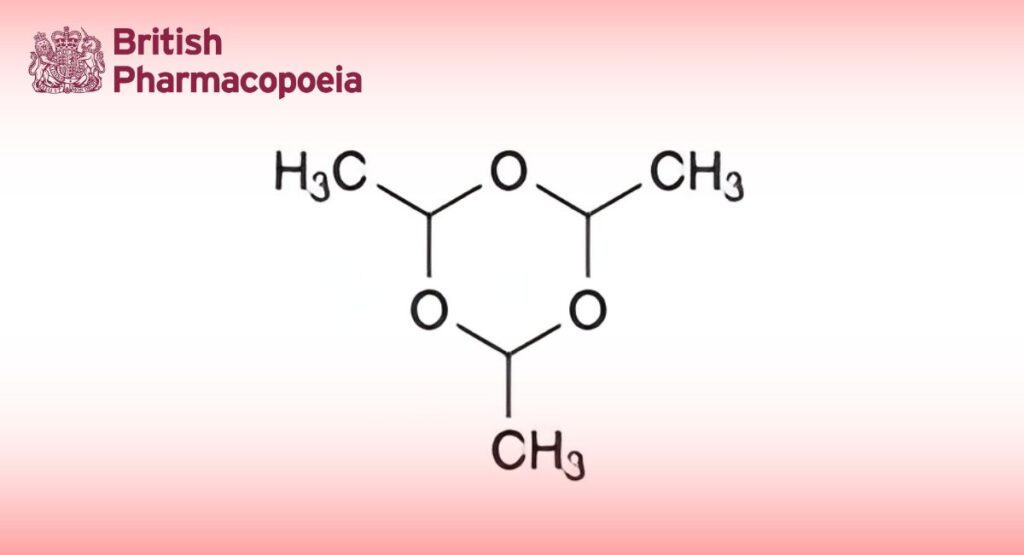
(Ph. Eur. monograph 0351)
C6H12O3 132.2 123-63-7
Action and use
Anticonvulsant.
DEFINITION
2,4,6-Trimethyl-1,3,5-trioxane (cyclic trimer of acetaldehyde).
It may contain a suitable quantity of an antioxidant.
CHARACTERS
Appearance
Colourless or slightly yellow, transparent liquid. It solidifies on cooling to form a crystalline mass.
Solubility
Soluble in water, but less soluble in boiling water, miscible with ethanol (96 per cent) and with essential oils.
IDENTIFICATION
A. Solution S (see Tests) is clear (2.2.1) but becomes turbid on warming.
B. To 5 mL add 0.1 mL of dilute sulfuric acid R and heat. Acetaldehyde, recognisable by its odour, is evolved.
C. To 5 mL of solution S in a test-tube add 5 mL of ammoniacal silver nitrate solution R and heat in a water-bath. Silver is deposited as a mirror on the wall of the tube.
TESTS
Solution S
Dissolve 20.0 mL in carbon dioxide-free water R and dilute to 200.0 mL with the same solvent.
Acidity
To 50.0 mL of solution S add 0.05 mL of phenolphthalein solution R. Not more than 1.5 mL of 0.1 M sodium hydroxide is required to change the colour of the indicator.
Refractive index (2.2.6)
1.403 to 1.406.
Relative density (2.2.5)
0.991 to 0.996.
Distillation range (2.2.11)
A maximum of 10 per cent distils below 123 °C and a minimum of 95 per cent distils below 126 °C.
Freezing point (2.2.18)
10 °C to 13 °C.
Acetaldehyde
To 5.0 mL add a mixture of 0.2 mL of methyl orange solution R, 5 mL of ethanol (60 per cent V/V) R and 5 mL of alcoholic hydroxylamine solution R and shake. Not more than 0.8 mL of 0.5 M sodium hydroxide is required to change the colour of the indicator to pure yellow.
Peroxides
Place 50.0 mL of solution S in a ground-glass-stoppered flask, add 5 mL of dilute sulfuric acid R and 10 mL of potassium iodide solution R, close the flask and allow to stand protected from light for 15 min. Titrate with 0.1 M sodium thiosulfate using 1 mL of starch solution R as indicator. Allow to stand for 5 min and, if necessary complete the titration. Not more than 2.0 mL of 0.1 M sodium thiosulfate is required.
Non-volatile residue
Maximum 0.6 g/L.
Heat 5.0 mL in a tared evaporating dish on a water-bath and dry at 105 °C for 1 h. The residue weighs a maximum of 3 mg.
STORAGE
In a small, well-filled, airtight container, protected from light. If the substance has solidified the whole contents of the
container must be liquefied before use.


