Action and use
Anticholinergic.
DEFINITION
Oxybutynin Oral Solution contains Oxybutynin Hydrochloride in a suitable vehicle.
The oral solution complies with the requirements stated under Oral Liquids and with the following requirements
Content of oxybutynin hydrochloride, C22H31NO3, HCl
95.0 to 105.0% of the stated amount.
IDENTIFICATION
To a quantity of the oral solution containing 25 mg of Oxybutynin Hydrochloride add sufficient 2M sodium hydroxide to adjust to pH 12.0 and extract with four 20-mL quantities of hexane. Filter the collected hexane layers through anhydrous sodium sulfate (Whatman GF/C is suitable). Evaporate the filtrate to dryness under a current of nitrogen, to yield a clear, sticky liquid residue. The infrared absorption spectrum of the residue, Appendix II A, is concordant with the reference spectrum of oxybutynin (RS 442).
TESTS
Related substances
Carry out the method for liquid chromatography, Appendix III D, using the following solutions.
(1) Mix a quantity of the oral solution containing 25 mg of Oxybutynin Hydrochloride with 40 mL of 0.01M hydrochloric acid, add sufficient 0.01M hydrochloric acid to produce 100 mL, mix and filter.
(2) 0.000375% w/v of oxybutynin impurity A EPCRS in 0.01M hydrochloric acid.
(3) 0.00025% w/v of phenylcyclohexylglycolic acid BPCRS in 0.01M hydrochloric acid.
(4) Dilute 1 volume of solution (1) to 200 volumes with 0.01M hydrochloric acid.
(5) 0.0000125% w/v of oxybutynin impurity A EPCRS in solution (4).
CHROMATOGRAPHIC CONDITIONS
(a) Use a stainless steel column (15 cm × 4.6 mm) packed with octadecylsilyl silica gel for chromatography R1 (5 μm) (Symmetry C18 is suitable).
(b) Use gradient elution and the mobile phases described below.
(c) Use a flow rate of 1 mL per minute.
(d) Use an ambient column temperature.
(e) Use a detection wavelength of 210 nm.
(f) Inject 50 μL of each solution.
(g) When the chromatograms are recorded under the prescribed conditions the retention times are about 31 minutes for oxybutynin hydrochloride and about 47 minutes for oxybutynin impurity A.
MOBILE PHASE
Mobile phase A 0.34% w/v of potassium dihydrogen orthophosphate and 0.436% w/v of dipotassium hydrogen orthophosphate.
Mobile phase B acetonitrile R1.
| Time (Minutes) | Mobile phase A (% v/v) | Mobile phase B (% v/v) | Comment |
| 0-5 | 70 | 30 | isocratic |
| 5-6 | 70→45 | 30→55 | linear gradient |
| 6-50 | 45 | 55 | isocratic |
| 50-51 | 45→70 | 55→30 | linear gradient |
| 51-60 | 70 | 30 | re-equilibration |
SYSTEM SUITABILITY
The test is not valid unless, in the chromatogram obtained with solution (5), the resolution factor between the peaks due to oxybutynin hydrochloride and oxybutynin impurity A is at least 10.0.
LIMITS
In the chromatogram obtained with solution (1):
the area of any peak corresponding to oxybutynin impurity A is not greater than the area of the principal peak in the chromatogram obtained with solution (2) (1.5%);
the area of any peak corresponding to phenylcyclohexylglycolic acid is not greater than half the area of the principal peak in the chromatogram obtained with solution (3) (0.5%);
the area of any other secondary peak is not greater than 0.4 times the area of the principal peak in the chromatogram obtained with solution (4) (0.2%);
the sum of the areas of any such secondary peaks is not greater than the area of the principal peak in the chromatogram obtained with solution (4) (0.5%).
Disregard any peak with an area less than the area of the principal peak in the chromatogram obtained with solution (5) (0.05%).
ASSAY
Carry out the method for liquid chromatography, Appendix III D, using the following solutions.
(1) Mix a quantity of the oral solution containing 25 mg of Oxybutynin Hydrochloride with 400 mL of 0.01M hydrochloric acid, add sufficient 0.01M hydrochloric acid to produce 500 mL, mix and filter.
(2) 0.005% w/v of oxybutynin hydrochloride BPCRS in 0.01M hydrochloric acid.
CHROMATOGRAPHIC CONDITIONS
(a) Use a stainless steel column (15 cm × 4.6 mm) packed with nitrile silica gel for chromatography R1 (5 μm) (Spherisorb CN is suitable).
(b) Use isocratic elution and the mobile phase described below.
(c) Use a flow rate of 2 mL per minute.
(d) Use a column temperature of 40°.
(e) Use a detection wavelength of 200 nm.
(f) Inject 20 μL of each solution.
MOBILE PHASE
300 volumes of acetonitrile R1 and 700 volumes of a 0.48% w/v solution of anhydrous potassium dihydrogen orthophosphate previously adjusted to pH 3.0 to 3.5 with orthophosphoric acid.
DETERMINATION OF CONTENT
Calculate the content of C22H31NO3, HCl in the oral slution using the declared content of C22H31NO3, HCl in oxybutynin hydrochloride BPCRS.
IMPURITIES
The impurities limited by the requirements of this monograph include:
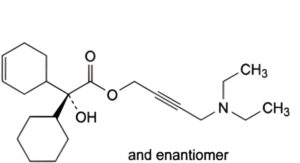
1. 4-(diethylamino)but-2-ynyl (RS)-2-(cyclohex-3-enyl)-2-cyclohexyl-2-hydroxyacetate (European Pharmacopoeia impurity A),
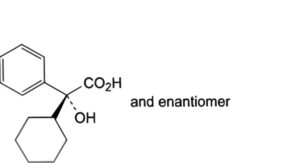
2. (RS)-2-cyclohexyl-2-hydroxy-2-phenylacetic acid (phenylcyclohexylglycolic acid) (European Pharmacopoeia impurity D)