Action and use
Proton pump inhibitor; treatment of peptic ulcer disease.
DEFINITION
Omeprazole for Injection is a sterile material consisting of Omeprazole Sodium with or without excipients. It is supplied in a sealed container.
The contents of the sealed container comply with the requirements for Powders for Injections or Infusions stated under Parenteral Preparations and with the following requirements.
Content of omeprazole, C17H19N3O3S
95.0 to 105.0% of the stated amount.
IDENTIFICATION
In the Assay, record the UV spectrum of the principal peak in the chromatograms obtained with solutions (1) and (2) with a diode array detector in the range of 210 to 400 nm.
The UV spectrum of the principal peak in the chromatogram obtained with solution (1) is concordant with that of the peak in the chromatogram obtained with solution (2); the retention time of the principal peak in the chromatogram obtained with solution (1) is similar to that of the peak in the chromatogram obtained with solution (2).
TESTS
Alkalinity
pH of a solution containing the equivalent of 0.8% w/v of omeprazole in 0.9% w/v of sodium chloride in water for injections, 9.0 to 11.0, Appendix V L.
Related substances
Carry out the method for liquid chromatography, Appendix III D, using the following solutions prepared in solution A. All solutions should be freshly prepared and injected within 15 minutes.
Solution A 0.068% w/v of trisodium orthophosphate and 0.062% w/v disodium hydrogen orthophosphate dihydrate.
(1) Dilute the volume of the injection containing the equivalent of 0.2 g of omeprazole in 100 mL and dilute to 1 volume to 20 volumes.
(2) Dilute 1 volume of solution (1) to 200 volumes.
(3) 0.0005% w/v each of omeprazole BPCRS and omeprazole impurity D EPCRS.
(4) 0.01% w/v of omeprazole impurity BPCRS.
(5) Dilute 1 volume of solution (2) to 5 volumes.
CHROMATOGRAPHIC CONDITIONS
(a) Use a stainless steel column (10 cm × 4.6 mm) packed with octadecylsilyl silica gel for chromatography (3 μm) (Microspher C18 is suitable).
(b) Use isocratic elution and the mobile phase described below.
(c) Use a flow rate of 1 mL per minute.
(d) Use an ambient column temperature.
(e) Use a detection wavelength of 280 nm.
(f) Inject 20 μL of each solution.
MOBILE PHASE
Solution B 0.017% w/v of sodium dihydrogen orthophosphate monohydrate and 0.053% w/v of disodium hydrogen orthophosphate dihydrate, adjusted to pH 7.4.
50 volumes of 0.02M tetrabutylammonium hydrogen sulfate, 260 volumes of acetonitrile and 690 volumes of solution B.
SYSTEM SUITABILITY
The test is not valid unless, in the chromatogram obtained with solution (3), the resolution between omeprazole and impurity D and is at least 3.0.
CALCULATION OF IMPURITIES
For each impurity, use the concentration of omeprazole in solution (2).
For the reporting threshold, use the concentration of omeprazole in solution (5).
For peak identification, use solutions (3) and (4).
Omeprazole retention time: about 7 minutes.
Relative retention: impurity 5, about 0.25; impurity 3, about 0.3; impurity A, about 0.35; impurity E, about 0.45; impurity D; about 1.25; impurity 2, about 1.45.
LIMITS
— impurities 2 and 5: not more than 0.6%;
— unspecified impurities: for each impurity, not more than 0.2%;
— total impurities: not more than 2.5%;
— reporting threshold: 0.1%.
ASSAY
Determine the weight of the contents of 10 containers as described in the test for uniformity of weight, Appendix XII C1, Powders for Parenteral Administration.
Carry out the method for liquid chromatography, Appendix III D, using the following solutions.
Solution C 11 volumes of 0.25M trisodium orthophosphate, 22 volumes of 0.5M disodium hydrogen orthophosphate and dilute to 100 volumes with water. Adjust to pH 11.0 with orthophosphoric acid or 10M sodium hydroxide.
(1) Dilute a quantity of the mixed contents of 10 containers containing the equivalent of 20 mg of omeprazole with 20 mL of ethanol, dilute to 100 mL with solution C and filter (a 0.45-μm glass fibre filter is suitable). Dilute 1 volume to 5 volumes with water.
(2) 0.02% w/v of omeprazole BPCRS in a mixture of 1 volume of ethanol and 4 volumes of solution C. Dilute 1 volume to 5 volumes with water.
(3) 0.1% w/v of omeprazole BPCRS and 0.0005% w/v omeprazole impurity D EPCRS, each prepared by dissolving the reference material in 1 volume of ethanol and diluting to 5 volumes with solution C. Mix 1 volume of each solution and dilute to 10 volumes with water.
CHROMATOGRAPHIC CONDITIONS
(a) Use a stainless steel column (15 cm × 4.6 mm) packed with end-capped extra-dense bonded octadecylsilyl silica gel for chromatography (5 μm) (Zorbax Eclipse XDB-C18 is suitable).
(b) Use isocratic elution and the mobile phase described below.
(c) Use a flow rate of 1 mL per minute.
(d) Use an ambient column temperature.
(e) Use a detection wavelength of 302 nm.
(f) Inject 20 μL of each solution.
MOBILE PHASE
Solution D 10.5 volumes of 1M sodium dihydrogen orthophosphate monohydrate, 60 volumes of 0.5M disodium hydrogen orthophosphate dihydrate and dilute to 100 volumes with water. Adjust to pH 7.3 with orthophosphoric acid or 10M sodium hydroxide.35 volumes of acetonitrile, 50 volumes of solution D and dilute to 100 volumes with water.
When the chromatograms are recorded under the prescribed conditions, the retention time of omeprazole is about 4 minutes.
SYSTEM SUITABILITY
The test is not valid unless, in the chromatogram obtained with solution (3), the resolution between impurity D and omeprazole is greater than 5.0.
DETERMINATION OF CONTENT
Calculate the content of C17H19N3O3S in the powder for injection using the declared content of C17H19N3O3S in omeprazole BPCRS.
LABELLING
The quantity of active ingredient is stated in terms of the equivalent amount of omeprazole.
IMPURITIES
The impurities limited by the requirements of this monograph include those listed under Omeprazole Sodium and:
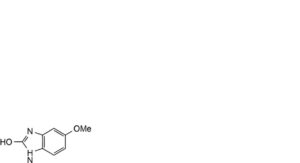
1. 2-hydroxy-5-methoxybenzimidazole (5-methoxy-2-benzimidazolinone),
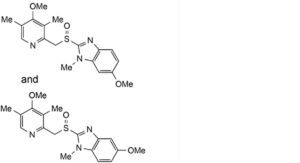
2. 5-methoxy-2-[[(4-methoxy-3,5-dimethyl-2-pyridinyl)-methyl]sulfinyl]-1-methyl-1H-benzimidazole and 6-methoxy-2-[[(4-methoxy-3,5-dimethyl-2-pyridinyl)-methyl]sulfinyl]-1-methyl-1H-benzimidazole, regioisomers
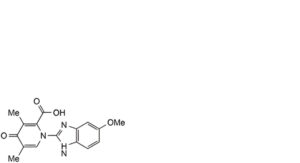
3. 1,4-dihydro-1-(5-methoxy-1H-benzimidazol-2-yl)-3,5-dimethyl-4-oxo-2-pyridinecarboxylic acid
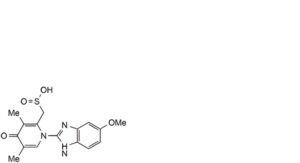
4. [1-(5-methoxy-1H-benzimidazol-2-yl)-3,5-dimethyl-4-oxo-1,4-dihydropyridin-2-yl] methanesulfinic acid
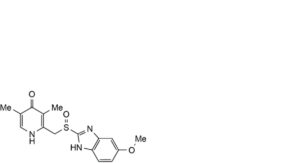
5. 2{[(5-methoxy-1H-benzimidazol-2-yl)sulfinyl]methyl}-3,5-dimethyl-4(1H)-pyridone