



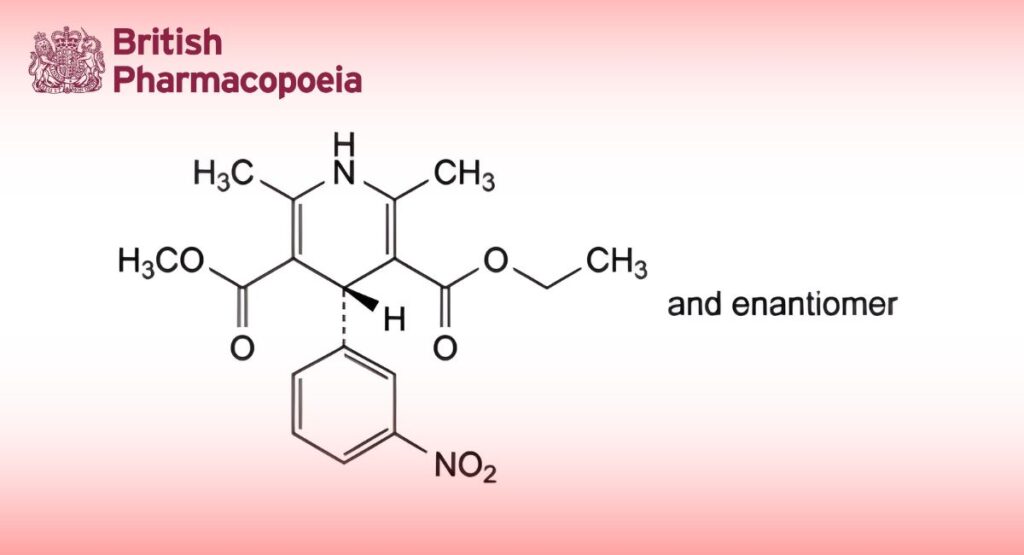
(Ph. Eur. monograph 1246)
C18H20N2O6 360.4 39562-70-4
Action and use
Calcium channel blocker.
DEFINITION
Ethyl methyl (4RS)-2,6-dimethyl-4-(3-nitrophenyl)-1,4-dihydropyridine-3,5-dicarboxylate.
Content
98.5 per cent to 101.5 per cent (dried substance).
CHARACTERS
Appearance
Yellow, crystalline powder.
Solubility
Practically insoluble in water, freely soluble in ethyl acetate, sparingly soluble in anhydrous ethanol and in methanol.
It shows polymorphism (5.9).
Exposure to ultraviolet light leads to the formation of a nitrophenylpyridine derivative.
Prepare solutions immediately before use either protected from light or under long-wavelength light (> 420 nm).
IDENTIFICATION
Infrared absorption spectrophotometry (2.2.24).
Comparison :nitrendipine CRS.
If the spectra obtained in the solid state show differences, record new spectra using 20 g/L solutions in methylene chloride R and a 0.2 mm cell.
TESTS
Related substances
Liquid chromatography (2.2.29).
Test solution: Dissolve 20 mg of the substance to be examined in 2.5 mL of tetrahydrofuran R and dilute to 10.0 mL with the mobile phase.
Reference solution (a): Dilute 1.0 mL of the test solution to 100.0 mL with the mobile phase. Dilute 1.0 mL of this solution to 10.0 mL with the mobile phase.
Reference solution (b): Dissolve 15.0 mg of nitrendipine impurity A CRS in 2.5 mL of tetrahydrofuran R and dilute to 10.0 mL with the mobile phase. Dilute 1.0 mL of this solution to 20.0 mL with the mobile phase.
Reference solution (c): Dilute 0.5 mL of the test solution to 20.0 mL with the mobile phase.
Reference solution (d): Mix 1.0 mL of reference solution (b) and 1.0 mL of reference solution (c), then dilute to 25.0 mL with the mobile phase.
Reference solution (e): Dissolve 2 mg of nitrendipine for peak identification CRS (containing impurities B and C) in 0.5 mL of tetrahydrofuran R and dilute to 1.0 mL with the mobile phase.
Column:
— size: l = 0.125 m, Ø = 4 mm;
— stationary phase: irregular octadecylsilyl silica gel for chromatography R (5 μm);
— temperature: 40 °C.
Mobile phase: acetonitrile R, tetrahydrofuran R, water R (14:22:64 V/V/V).
Flow rate: 1 mL/min.
Detection: Spectrophotometer at 235 nm.
Injection: 10 μL of the test solution and reference solutions (a), (d) and (e).
Run time: 5 times the retention time of nitrendipine.
Identification of impurities: Use the chromatogram supplied with nitrendipine for peak identification CRS and the chromatogram obtained with reference solution (e) to identify the peaks due to impurities B and C; use the chromatogram obtained with reference solution (d) to identify the peak due to impurity A.
Relative retention: With reference to nitrendipine (retention time = about 9 min): impurity B = about 0.7; impurity A = about 0.8; impurity C = about 1.4.
System suitability: Reference solution (d):
— resolution: minimum 2.0 between the peaks due to impurity A and nitrendipine.
Limits:
— impurities B, C: for each impurity, not more than 4 times the area of the principal peak in the chromatogram obtained with reference solution (a) (0.4 per cent);
— impurity A: not more than the area of the corresponding peak in the chromatogram obtained with reference solution (d) (0.15 per cent);
— unspecified impurities: for each impurity, not more than the area of the principal peak in the chromatogram obtained with reference solution (a) (0.10 per cent);
— total: maximum 0.7 per cent;
— disregard limit: 0.5 times the area of the principal peak in the chromatogram obtained with reference solution (a) (0.05 per cent).
Loss on drying (2.2.32)
Maximum 0.5 per cent, determined on 1.000 g by drying in an oven at 105 °C.
Sulfated ash (2.4.14)
Maximum 0.1 per cent, determined on 1.0 g.
ASSAY
Dissolve 0.160 g with gentle heating if necessary in a mixture of 25 mL of 2-methyl-2-propanol R and 25 mL of perchloric acid solution R. Titrate with 0.1 M cerium sulfate, using 0.1 mL of ferroin R as indicator. Titrate slowly towards the end of the titration. Carry out a blank titration.
1 mL of 0.1 M cerium sulfate is equivalent to 18.02 mg of C18H20N2O6.
STORAGE
Protected from light.
IMPURITIES
Specified impurities A, B, C.
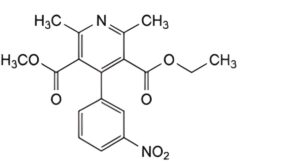
A. ethyl methyl 2,6-dimethyl-4-(3-nitrophenyl)pyridine-3,5-dicarboxylate,
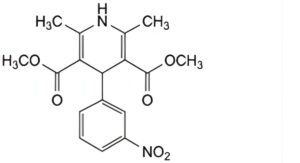
B. dimethyl 2,6-dimethyl-4-(3-nitrophenyl)-1,4-dihydropyridine-3,5-dicarboxylate,
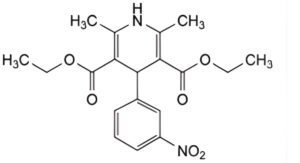
C. diethyl 2,6-dimethyl-4-(3-nitrophenyl)-1,4-dihydropyridine-3,5-dicarboxylate.


