



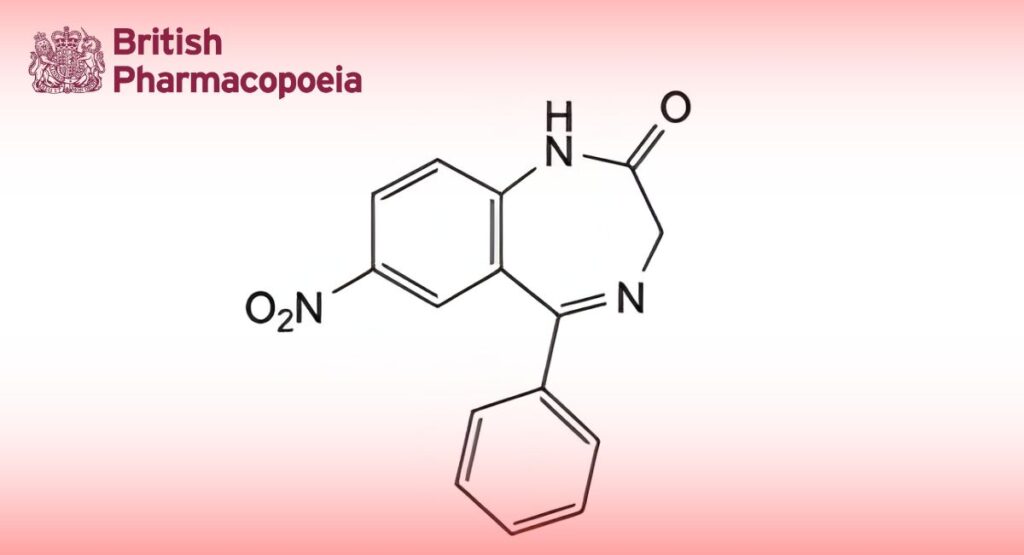
(Ph. Eur. monograph 0415)
C15H11N3O3 281.3 146-22-5
Action and use
Benzodiazepine.
Preparations
Nitrazepam Oral Suspension
Nitrazepam Tablets
DEFINITION
7-Nitro-5-phenyl-1,3-dihydro-2H-1,4-benzodiazepin-2-one.
Content
99.0 per cent to 101.0 per cent (dried substance).
CHARACTERS
Appearance
White or yellow, crystalline powder.
Solubility
Practically insoluble in water, slightly soluble in ethanol (96 per cent).
IDENTIFICATION
Infrared absorption spectrophotometry (2.2.24).
Comparison: nitrazepam CRS.
TESTS
Related substances
Liquid chromatography (2.2.29). Carry out the test protected from light.
Test solution: Dissolve 50 mg of the substance to be examined in acetonitrile R and dilute to 20.0 mL with the same solvent.
Reference solution (a): Dilute 1.0 mL of the test solution to 100.0 mL with acetonitrile R. Dilute 1.0 mL of this solution to 10.0 mL with acetonitrile R.
Reference solution (b): Dissolve 2 mg of clonazepam CRS in acetonitrile R and dilute to 100.0 mL with the same solvent. Dilute 1.0 mL of this solution to 10.0 mL with the test solution.
Column:
— size: l = 0.25 m, Ø = 4.0 mm;
— stationary phase: octylsilyl silica gel for chromatography R (5 μm);
— temperature: 40 °C.
Mobile phase:
— mobile phase A: 7.8 g/L solution of sodium dihydrogen phosphate R adjusted to pH 3.0 with phosphoric acid R;
— mobile phase B: acetonitrile R;
| Time (min) |
Mobile phase A (per cent V/V) |
Mobile phase B (per cent V/V) |
| 0 – 3 | 65 | 35 |
| 3 – 10 | 65 → 50 | 35 → 50 |
| 10 – 20 | 50 | 50 |
Flow rate: 1 mL/min.
Detection: Spectrophotometer at 270 nm.
Injection: 10 μL.
Relative retention: With reference to nitrazepam (retention time = about 9 min): clonazepam = about 1.1.
System suitability: Reference solution (b):
— peak-to-valley ratio: minimum 4.0, where Hp = height above the baseline of the peak due to clonazepam and Hv = height above the baseline of the lowest point of the curve separating this peak from the peak due to nitrazepam.
Limits:
— unspecified impurities: for each impurity, not more than the area of the principal peak in the chromatogram obtained with reference solution (a) (0.10 per cent);
— total: not more than twice the area of the principal peak in the chromatogram obtained with reference solution (a) (0.2 per cent);
— disregard limit: 0.5 times the area of the principal peak in the chromatogram obtained with reference solution (a) (0.05 per cent).
Loss on drying (2.2.32)
Maximum 0.5 per cent, determined on 1.000 g by drying in an oven at 105 °C for 4 h.
Sulfated ash (2.4.14)
Maximum 0.1 per cent, determined on 1.0 g.
ASSAY
Dissolve 0.250 g in 25 mL of acetic anhydride R. Titrate with 0.1 M perchloric acid, determining the end-point potentiometrically (2.2.20).
1 mL of 0.1 M perchloric acid is equivalent to 28.13 mg of C15H11N3O3.
STORAGE
Protected from light.
IMPURITIES
Other detectable impurities (the following substances would, if present at a sufficient level, be detected by one or other of the tests in the monograph. They are limited by the general acceptance criterion for other/unspecified impurities and/or by the general monograph Substances for pharmaceutical use (2034). It is therefore not necessary to identify these impurities for demonstration of compliance. See also 5.10. Control of impurities in substances for pharmaceutical use) A, B, C, D.
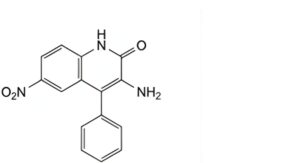
A. 3-amino-6-nitro-4-phenylquinolin-2(1H)-one,
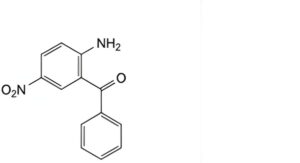
B. (2-amino-5-nitrophenyl)phenylmethanone,
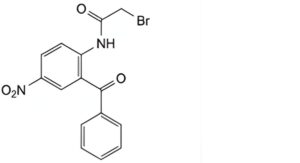
C. 2-bromo-N-[4-nitro-2-(phenylcarbonyl)phenyl]acetamide,
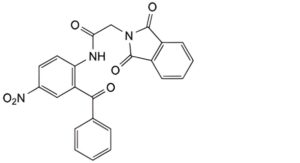
D. 2-(1,3-dioxo-1,3-dihydro-2H-isoindol-2-yl)-N-[4-nitro-2-(phenylcarbonyl)phenyl]acetamide.


