(Ph. Eur. 11.6 update)
Action and use
Thyroid hormone replacement.
DEFINITION
Levothyroxine Tablets contain Levothyroxine Sodium.
The tablets comply with the requirements stated under Tablets and with the following requirements.
PRODUCTION
Levothyroxine Sodium used in the formulation of Levothyroxine
Tablets exists primarily in its most stable form, a crystalline pentahydrate.
Care should be taken during manufacture to avoid exposure to higher temperatures (> 50°) or very low humidities.
Content of anhydrous levothyroxine sodium, C15H10I4NNaO4
90.0 to 105.0% of the stated amount.
IDENTIFICATION
In the test for Uniformity of content, record the UV spectrum of the principal peak in the chromatograms obtained with solutions (1) and (2) with a diode array detector in the range of 210 to 400 nm.
The UV spectrum of the principal peak in the chromatogram obtained with solution (1) is concordant with that of the peak in the chromatogram obtained with solution (2);
the retention time of the principal peak in the chromatogram obtained with solution (1) is similar to that of the peak in the chromatogram obtained with solution (2).
TESTS
Dissolution
Comply with the dissolution test for tablets and capsules, Appendix XII B1.
Plastic containers must not be used to prepare and store solutions.
TEST CONDITIONS
(a) Use Apparatus 2, rotating the paddle at 100 revolutions per minute.
(b) Use 500 mL of water, at a temperature of 37°, as the medium.
(c) For tablets containing the equivalent of 25 μg or less of anhydrous levothyroxine sodium, place two tablets in the dissolution vessel; for tablets containing more than the equivalent of 25 μg of anhydrous levothyroxine sodium, place one tablet in the dissolution vessel.
PROCEDURE
Carry out the method for liquid chromatography, Appendix III D, using the following solutions.
(1) After 45 minutes withdraw a 5-mL sample of the medium and centrifuge, dilute with sufficient of the dissolution medium, if necessary, to produce a solution expected to contain 0.00001% w/v of anhydrous levothyroxine sodium. To a 5-mL aliquot add 200 μL of 0.1M sodium hydroxide and 125 μL of a 2% v/v solution of diethylamine.
(2) To 5 mL of 0.00001% w/v levothyroxine sodium EPCRS in 0.001M sodium hydroxide add 200 μL of 0.1M sodium hydroxide and 125 μL of a 2% v/v solution of diethylamine and mix.
CHROMATOGRAPHIC CONDITIONS
(a) Use a stainless steel column (15 cm × 4.6 mm) packed with cyanosilyl silica gel for chromatography (5 μm) (Spherisorb S5 CN is suitable).
(b) Use isocratic elution and the mobile phase described below.
(c) Use a flow rate of 1 mL per minute.
(d) Use a column temperature of 40°.
(e) Use a detection wavelength of 225 nm.
(f) Inject 150 μL of each solution.
MOBILE PHASE
5 volumes of orthophosphoric acid, 300 volumes of acetonitrile R1 and 700 volumes of water.
DETERMINATION OF CONTENT
Calculate the total content of anhydrous levothyroxine sodium, C15H10I4NNaO4, in the medium from the chromatograms obtained and using the declared content of C15H10I4NNaO4 in levothyroxine sodium EPCRS.
LIMITS
The amount of anhydrous levothyroxine sodium released is not less than 75% (Q) of the stated amount.
Related substances
Carry out the method for liquid chromatography, Appendix III D, using the following solutions, prepared in solution A, protected from light.
Solution A: Equal volumes of methanol and 0.1M sodium hydroxide.
(1) Shake a quantity of powdered tablets containing the equivalent of 0.25 mg of anhydrous levothyroxine sodium with 2.5 mL of 0.1M sodium hydroxide. Dilute to 5 mL with methanol, shake and mix with the aid of ultrasound. Centrifuge and filter the supernatant liquid through a 0.7-μm glass microfibre filter (Whatman GMF is suitable).
(2) Dilute 1 volume of solution (1) to 50 volumes.
(3) 0.0005% w/v of levothyroxine sodium impurity standard BPCRS.
(4) Dilute 1 volume of solution (2) to 20 volumes.
CHROMATOGRAPHIC CONDITIONS
(a) Use a stainless steel column (15 cm × 3.0 mm) packed with end-capped octadecylsilyl silica gel for chromatography (3.5 μm) (Waters Sunfire C18 is suitable).
(b) Use gradient elution and the mobile phase described below.
(c) Use a flow rate of 0.6 mL per minute.
(d) Use a column temperature of 30°.
(e) Use a detection wavelength of 225 nm.
(f) Inject 6 μL of each solution.
MOBILE PHASE
Mobile phase A: 200 volumes of 0.098% w/v of orthophosphoric acid in acetonitrile and 800 volumes of 0.098% w/v of orthophosphoric acid in water.
Mobile phase B: 180 volumes of 0.098% w/v of orthophosphoric acid in water and 820 volumes of 0.098% w/v of orthophosphoric acid in acetonitrile.
| Time (Minutes) | Mobile phase A (% v/v) | Mobile phase B (% v/v) | Comment |
| 0-2 | 100→89 | 0→11 | linear gradient |
| 2-17 | 89→72 | 11→28 | linear gradient |
| 17-45 | 72→0 | 28→100 | linear gradient |
| 45-50 | 0 | 100 | isocratic |
| 50-52 | 0→100 | 100→0 | linear gradient |
| 52-60 | 100 | 0 | re-equilibration |
When the chromatograms are recorded under the prescribed conditions, the relative retentions with reference to levothyroxine (retention time about 14 minutes) are: impurity A, about 0.7; impurity 1, about 0.8 and impurity D, about 2.5.
SYSTEM SUITABILITY
The test is not valid unless, in the chromatogram obtained with solution (3):
the resolution between impurity A and levothyroxine is at least 10.0;
the signal-to-noise ratio of the principal peak in the chromatogram obtained with solution (4) is at least 20.
LIMITS
Identify any peak corresponding to impurity 1 in the chromatogram obtained with solution (1), using the chromatogram obtained with solution (3), and multiply the area of this peak by a correction factor of 1.8.
In the chromatogram obtained with solution (1):
the area of any peak corresponding to impurity 1 is not greater than 4 times the area of the principal peak in the chromatogram obtained with solution (2) (8%);
the area of any other secondary peak is not greater than half the area of the principal peak in the chromatogram obtained with solution (2) (1%);
the sum of the areas of any secondary peaks, excluding impurity 1, is not greater than 2.5 times the area of the principal peak in the chromatogram obtained with solution (2) (5%);
the sum of the areas of all secondary peaks, is not greater than 5 times the area of the principal peak in the chromatogram obtained with solution (2) (10%).
Disregard any peak with an area less than the area of the principal peak in the chromatogram obtained with solution (4) (0.1%).
Uniformity of content
Tablets containing less than 2 mg and/or less than 2% w/w of Levothyroxine Sodium comply with the requirements stated under Tablets using the following method of analysis. Carry out the method for liquid chromatography, Appendix III D, using the following solutions prepared in solution A, unless otherwise stated, protected from light.
Solution A: Equal volumes of methanol and 0.1M sodium hydroxide.
(1) Add sufficient 0.05M sodium hydroxide to one tablet to produce a solution containing the equivalent of about 6 μg per mL of anhydrous levothyroxine sodium, mix with the aid of ultrasound until the tablet is fully dispersed, cool and shake for 2 minutes. Add sufficient 0.05M sodium hydroxide to produce a solution containing the equivalent of 0.0005% w/v of anhydrous levothyroxine sodium, filter through glass microfibre filter (Whatman GF/C is suitable) and use the filtrate.
(2) 0.00055% w/v of levothyroxine sodium EPCRS in 0.05M sodium hydroxide.
(3) 0.0005% w/v of liothyronine sodium EPCRS and 0.0005% w/v of levothyroxine sodium EPCRS.
CHROMATOGRAPHIC CONDITIONS
(a) Use a stainless steel column (25 cm × 4.6 mm) packed with cyanosilyl silica gel for chromatography (5 μm) (Nucleosil 5 CN is suitable).
(b) Use isocratic elution and the mobile phase described below.
(c) Use a flow rate of 1 mL per minute.
(d) Use an ambient column temperature.
(e) Use a detection wavelength of 225 nm.
(f) Inject 20 μL of each solution.
MOBILE PHASE
5 volumes of orthophosphoric acid, 300 volumes of acetonitrile and 700 volumes of water.
SYSTEM SUITABILITY
The test is not valid unless, in the chromatogram obtained with solution (3), the resolution between the peaks due to liothyronine and levothyroxine is at least 4.0.
DETERMINATION OF CONTENT
Calculate the content of C15H10I4NNaO4 in each tablet using the declared content of C15H10I4NNaO4 in levothyroxine sodium EPCRS.
ASSAY
Use the average of the individual results determined in the test for Uniformity of content.
STORAGE
Levothyroxine Tablets should be protected from light.
LABELLING
The quantity of active ingredient is stated in terms of the equivalent amount of anhydrous levothyroxine sodium.
IMPURITIES
The impurities limited by the requirements of this monograph include impurities A, D, F and G listed under Levothyroxine Sodium and:
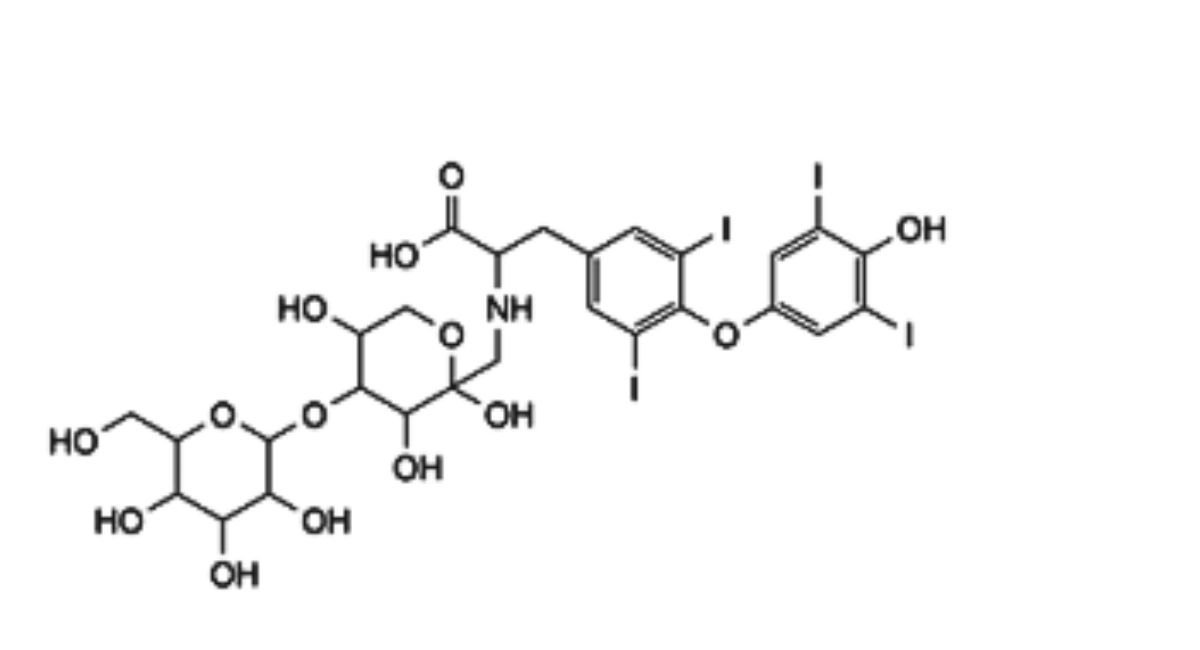
- 3-(4-(4-hydroxy-3,5-diiodophenoxy)-3,5-diiodophenyl)-2-(((4,5,6-trihydroxy-3-((3,4,5-trihydroxy-6-(hydroxymethyl)tetrahydro-2H-pyran-2-yl)oxy)tetrahydro-2H-pyran-2-yl)methyl)amino)propanoic acid (levothyroxine-lactose maillard impurity).