



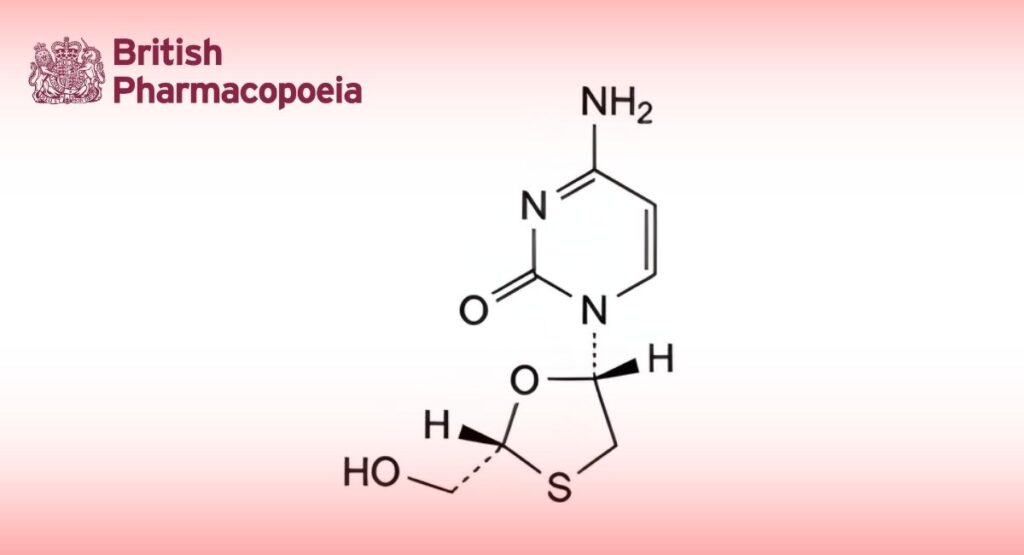
(Ph. Eur. monograph 2217)
C8H11N3O3S 229.3 134678-17-4
Action and use
Nucleoside reverse transcriptase inhibitor; antiviral (HIV).
Preparations
Lamivudine Tablets
Zidovudine and Lamivudine Tablets
Abacavir, Zidovudine and Lamivudine Tablets
Abacavir and Lamivudine Tablets
DEFINITION
4-Amino-1-[(2R,5S)-2-(hydroxymethyl)-1,3-oxathiolan-5-yl]pyrimidin-2(1H)-one.
Content
97.5 per cent to 102.0 per cent (dried substance).
CHARACTERS
Appearance
White or almost white powder.
Solubility
Soluble in water, sparingly soluble in methanol, slightly soluble in ethanol (96 per cent).
It shows polymorphism (5.9).
IDENTIFICATION
First identification: B, C.
Second identification: A, B.
A. Specific optical rotation (2.2.7): -99 to -97 (dried substance).
Dissolve 0.250 g in water R and dilute to 50.0 mL with the same solvent.
B. Infrared absorption spectrophotometry (2.2.24).
Comparison: lamivudine CRS.
If the spectra obtained in the solid state show differences, dissolve the substance to be examined and the reference substance separately in methanol R, evaporate to dryness and record new spectra using the residues.
C. Enantiomeric purity (see Tests).
TESTS
Absorbance (2.2.25)
Maximum 0.3 at 440 nm, using a path length of 4 cm.
Dissolve 1.00 g in water R, using sonication if necessary, and dilute to 20.0 mL with the same solvent.
Related substances
Liquid chromatography (2.2.29).
Test solution: Dissolve 50.0 mg of the substance to be examined in the mobile phase and dilute to 100.0 mL with the mobile phase.
Reference solution (a): Dilute 1.0 mL of the test solution to 100.0 mL with the mobile phase. Dilute 1.0 mL of this solution to 10.0 mL with the mobile phase.
Reference solution (b): Dissolve 5.0 mg of salicylic acid R in the mobile phase and dilute to 100.0 mL with the mobile phase. Dilute 1.0 mL of the solution to 100.0 mL with the mobile phase.
Reference solution (c): Dissolve 50.0 mg of lamivudine CRS in the mobile phase and dilute to 100.0 mL with the mobile phase.
Reference solution (d): Dissolve 5 mg of cytosine R and 5 mg of uracil R in the mobile phase and dilute to 100 mL with the mobile phase. Dilute 2 mL of the solution to 10 mL with the mobile phase.
Reference solution (e): Dissolve 5 mg of lamivudine for system suitability 1 CRS (containing impurities A and B) in 2 mL of the mobile phase. Add 1 mL of reference solution (d) and dilute to 10 mL with the mobile phase.
Column:
— size: l = 0.25 m, Ø = 4.6 mm;
— stationary phase: base-deactivated end-capped octadecylsilyl silica gel for chromatography R (5 μm);
— temperature: 35 °C.
Mobile phase: Mix 5 volumes of methanol R and 95 volumes of a 1.9 g/L solution of ammonium acetate R, previously adjusted to pH 3.8 with glacial acetic acid R.
Flow rate: 1.0 mL/min.
Detection: Spectrophotometer at 277 nm.
Injection: 10 μL.
Run time: 3 times the retention time of lamivudine.
Identification of impurities: Use the chromatograms obtained with reference solutions (b) and (e) to identify the peaks due to impurities A, B, C, E and F.
Relative retention: With reference to lamivudine (retention time = about 9 min): impurity E = about 0.28; impurity F = about 0.32; impurity A = about 0.36; impurity B = about 0.91; impurity J = about 1.45; impurity C = about 2.32.
System suitability Reference solution (e):
— resolution: minimum 1.5 between the peaks due to impurities F and A; minimum 1.5 between the peaks due to impurity B and lamivudine.
Limits:
— correction factors: for the calculation of content, multiply the peak areas of the following impurities by the corresponding correction factor: impurity E = 0.6; impurity F = 2.2; impurity J = 2.2;
— impurity A: not more than 3 times the area of the principal peak in the chromatogram obtained with reference solution (a) (0.3 per cent);
— impurity B: not more than twice the area of the principal peak in the chromatogram obtained with reference solution (a) (0.2 per cent);
— impurity C: not more than the area of the principal peak in the chromatogram obtained with reference solution (b) (0.1 per cent);
— any other impurity: for each impurity, not more than the area of the principal peak in the chromatogram obtained with reference solution (a) (0.1 per cent);
— total: not more than 6 times the area of the principal peak in the chromatogram obtained with reference solution (a) (0.6 per cent);
— disregard limit: 0.5 times the area of the principal peak in the chromatogram obtained with reference solution (a) (0.05 per cent).
Enantiomeric purity
Liquid chromatography (2.2.29): use the normalisation procedure.
Test solution: Dissolve 25.0 mg of the substance to be examined in water R and dilute to 100.0 mL with the same solvent.
Reference solution: Dissolve the contents of a vial of lamivudine for system suitability 2 CRS (containing impurity D) in 1.0 mL of water R.
Column:
— size: l = 0.25 m, Ø = 4.6 mm;
— stationary phase: beta-cyclodextrin derivative of silica gel for chiral separation R (5 μm);
— temperature: maintain at constant temperature between 15 °C and 30 °C; the temperature may be adjusted to optimise the resolution between lamivudine and impurity D; a lower temperature favours improved resolution.
Mobile phase: Mix 5 volumes of methanol R and 95 volumes of a 7.7 g/L solution of ammonium acetate R.
Flow rate: 1.0 mL/min.
Detection: Spectrophotometer at 270 nm.
Injection: 10 μL.
Run time: Twice the retention time of lamivudine.
Relative retention: With reference to lamivudine (retention time = about 8 min): impurity D = about 1.2; impurity B and enantiomer = about 1.3 and 1.5.
System suitability: Reference solution:
— peak-to-valley-ratio: minimum 15, where Hp = height above the baseline of the peak due to impurity D and Hv = height above the baseline of the lowest point of the curve separating this peak from the peak due to lamivudine.
Calculate the sum of the percentage contents of all impurity peaks with a relative retention from 1.2 to 1.5. Subtract the percentage content of impurity B as obtained in the test for related substances.
Limit:
— impurity D: maximum 0.3 per cent.
Loss on drying (2.2.32)
Maximum 0.5 per cent, determined on 1.000 g by drying in an oven at 105 °C.
Sulfated ash (2.4.14)
Maximum 0.1 per cent, determined on 1.0 g.
ASSAY
Liquid chromatography (2.2.29) as described in the test for related substances with the following modification.
Injection: Test solution and reference solution (c).
Calculate the percentage content of C8H11N3O3S using the chromatograms obtained with the test solution and reference solution (c) and the declared content of C8H11N3O3S in lamivudine CRS.
STORAGE
Protected from light.
IMPURITIES
Specified impurities A, B, C, D.
Other detectable impurities (the following substances would, if present at a sufficient level, be detected by one or other of the tests in the monograph. They are limited by the general acceptance criterion for other/unspecified impurities and/or by the general monograph Substances for pharmaceutical use (2034). It is therefore not necessary to identify these impurities for demonstration of compliance. See also 5.10. Control of impurities in substances for pharmaceutical use) E, F, G, H, I, J.
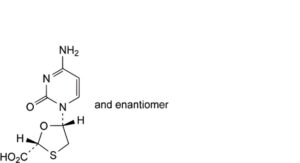
A. (2RS,5SR)-5-(4-amino-2-oxopyrimidin-1(2H)-yl)-1,3-oxathiolane-2-carboxylic acid,
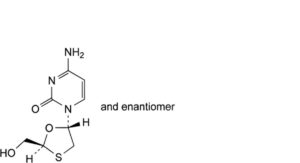
B. 4-amino-1-[(2RS,5RS)-2-(hydroxymethyl)-1,3-oxathiolan-5-yl]pyrimidin-2(1H)-one ((±)-trans-lamivudine),
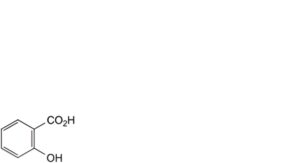
C. 2-hydroxybenzenecarboxylic acid (salicylic acid),
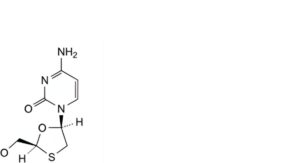
D. 4-amino-1-[(2S,5R)-2-(hydroxymethyl)-1,3-oxathiolan-5-yl]pyrimidin-2(1H)-one,
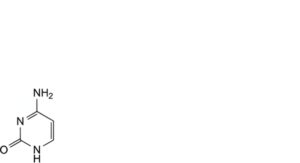
E. 4-aminopyrimidin-2(1H)-one (cytosine),
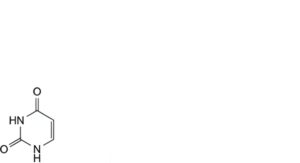
F. pyrimidine-2,4(1H,3H)-dione (uracil),
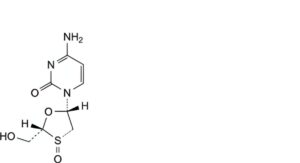
G. 4-amino-1-[(2R,3S,5S)-2-(hydroxymethyl)-1,3-oxathiolan-5-yl]pyrimidin-2(1H)-one S-oxide,
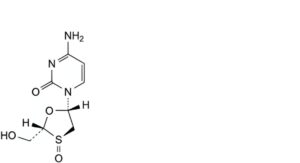
H. 4-amino-1-[(2R,3R,5S)-2-(hydroxymethyl)-1,3-oxathiolan-5-yl]pyrimidin-2(1H)-one S-oxide,
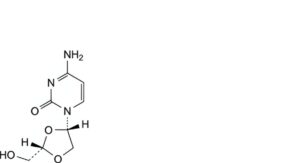
I. 4-amino-1-[(2S,4S)-2-(hydroxymethyl)-1,3-dioxolan-4-yl]pyrimidin-2(1H)-one,
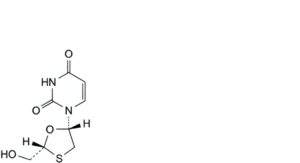
J. 1-[(2R,5S)-2-(hydroxymethyl)-1,3-oxathiolan-5-yl]pyrimidine-2,4(1H,3H)-dione.


