
Edition: BP 2025 (Ph. Eur. 11.6 update)
Action and use
Cyclo-oxygenase inhibitor; analgesic; anti-inflammatory.
DEFINITION
Ketoprofen Gel is a solution of Ketoprofen in a suitable water-miscible basis.
The gel complies with the requirements stated under Topical Semi-solid Preparations and with the following requirements.
Content of ketoprofen, C16H14O3
92.5 to 105.0% of the stated amount.
IDENTIFICATION
Shake a quantity of the gel containing 60 mg of Ketoprofen with 10 mL of dichloromethane and filter. Evaporate the filtrate to dryness under nitrogen. Dry the residue at 60° for 1 hour. The infrared absorption spectrum of the residue, Appendix II A, is concordant with the reference spectrum of ketoprofen (RS 484).
TESTS
Acidity or alkalinity
pH of a 1% w/v dispersion of the gel in carbon dioxide-free water, 5.0 to 7.5, Appendix V L.
Ketoprofen ethyl ester
In the Assay, in the chromatogram obtained with solution (1) the area of any peak corresponding to ketoprofen ethyl ester is not greater than the area of the principal peak in the chromatogram obtained with solution (3) (4.0%).
Related substances
Carry out the method for liquid chromatography, Appendix III D, using the following solutions prepared immediately before use.
(1) Dilute a quantity of the gel containing 10 mg of Ketoprofen with sufficient methanol to produce a solution containing 0.01% w/v of Ketoprofen.
(2) Dilute 1 volume of solution (1) to 100 volumes with methanol.
(3) 0.00002% w/v of ketoprofen impurity A EPCRS in the mobile phase.
(4) 0.00002% w/v of ketoprofen impurity C EPCRS in the mobile phase.
(5) 0.0005% w/v of ketoprofen BPCRS and 0.0001% w/v of ketoprofen impurity A EPCRS in methanol.
(6) Dilute 1 volume of solution (2) to 10 volumes with methanol.
CHROMATOGRAPHIC CONDITIONS
(a) Use a stainless steel column (15 cm × 4.6 mm) packed with octadecylsilyl silica gel for chromatography (5 μm) with a specific surface area of 350 m /g and a pore size of 10 nm (Nucleosil 100 C18 is suitable).
(b) Use isocratic elution and the mobile phase described below.
(c) Use a flow rate of 1 mL per minute.
(d) Use an ambient column temperature.
(e) Use a detection wavelength of 233 nm.
(f) Inject 20 μL of each solution.
(g) Allow the chromatography to proceed for 7 times the retention time of ketoprofen.
MOBILE PHASE
2 volumes of freshly prepared phosphate buffer solution pH 3.5, 43 volumes of acetonitrile and 55 volumes of water. When the chromatograms are recorded under the prescribed conditions, the relative retentions with reference to ketoprofen (retention time about 8 minutes) are: impurity C, about 0.3; impurity E, about 0.7; impurity B, about 0.8; impurity D, about 1.5; impurity A, about 1.6; impurity F, about 2.3.
SYSTEM SUITABILITY
The test is not valid unless, in the chromatogram obtained with solution (5), the resolution between the peaks due to ketoprofen and impurity A is at least 7.0.
LIMITS
Use the chromatogram obtained with solution (3) to identify the peak due to impurity A; use the chromatogram obtained with solution (4) to identify the peak due to impurity C.
In the chromatogram obtained with solution (1):
the area of any peak corresponding to impurity A is not greater than 2.5 times the area of the principal peak in the chromatogram obtained with solution (3) (0.5%);
the area of any peak corresponding to impurity C is not greater than 2.5 times the area of the principal peak in the chromatogram obtained with solution (4) (0.5%);
the area of any peak corresponding to impurity B, D, E or F is not greater than half the area of the principal peak in the chromatogram obtained with solution (2) (0.5%);
the area of any other secondary peak is not greater than 0.2 times the area of the principal peak in the chromatogram obtained with solution (2) (0.2%);
the sum of the areas of all the secondary peaks excluding impurities A and C is not greater than 2.5 times the area of the principal peak in the chromatogram obtained with solution (2) (2.5%).
Disregard any peak with an area less than the area of the principal peak in the chromatogram obtained with solution (6) (0.1%).
ASSAY
Carry out the method for liquid chromatography, Appendix III D, using the following solutions prepared with solution A. Solution A 270 mL of acetonitrile and 550 mL of a 0.5% w/v solution of ammonium acetate.
(1) Shake a weighed quantity of the gel containing 10 mg of Ketoprofen with 50 mL of methanol for 15 minutes, centrifuge the mixture for 5 minutes, and dilute 25 mL of the supernatant liquid with sufficient solution A to produce 100 mL.
(2) Add 19 mL of methanol to 5 mL of a 0.1% w/v solution of ketoprofen BPCRS in methanol, add sufficient solution A to produce 100 mL and mix.
(3) Add 19 mL of methanol to 5 mL of a 0.004% w/v solution of ketoprofen ethyl ester BPCRS in methanol, add sufficient solution A to produce 100 mL and mix.
CHROMATOGRAPHIC CONDITIONS
(a) Use a stainless steel column (25 cm × 4.6 mm) packed with octadecylsilyl silica gel for chromatography (5 μm) (Spherisorb ODS 1 is suitable).
(b) Use isocratic elution and the mobile phase described below.
(c) Use a flow rate of 2 mL per minute.
(d) Use an ambient column temperature.
(e) Use a detection wavelength of 254 nm.
(f) Inject 20 μL of each solution.
(g) Allow the chromatography to proceed for 8 times the retention time of ketoprofen.
MOBILE PHASE
450 volumes of a solution containing 40% v/v of methanol and 60% v/v of acetonitrile and 550 volumes of a 0.5% w/v solution of ammonium acetate, adjusted to pH 5.9 by the addition of 10% w/w nitric acid.
DETERMINATION OF CONTENT
Calculate the content of C16H14O3 in the gel using the declared content of C16H14O3 in ketoprofen BPCRS.
IMPURITIES
The impurities limited by the requirements of this monograph include those listed under Ketoprofen and:
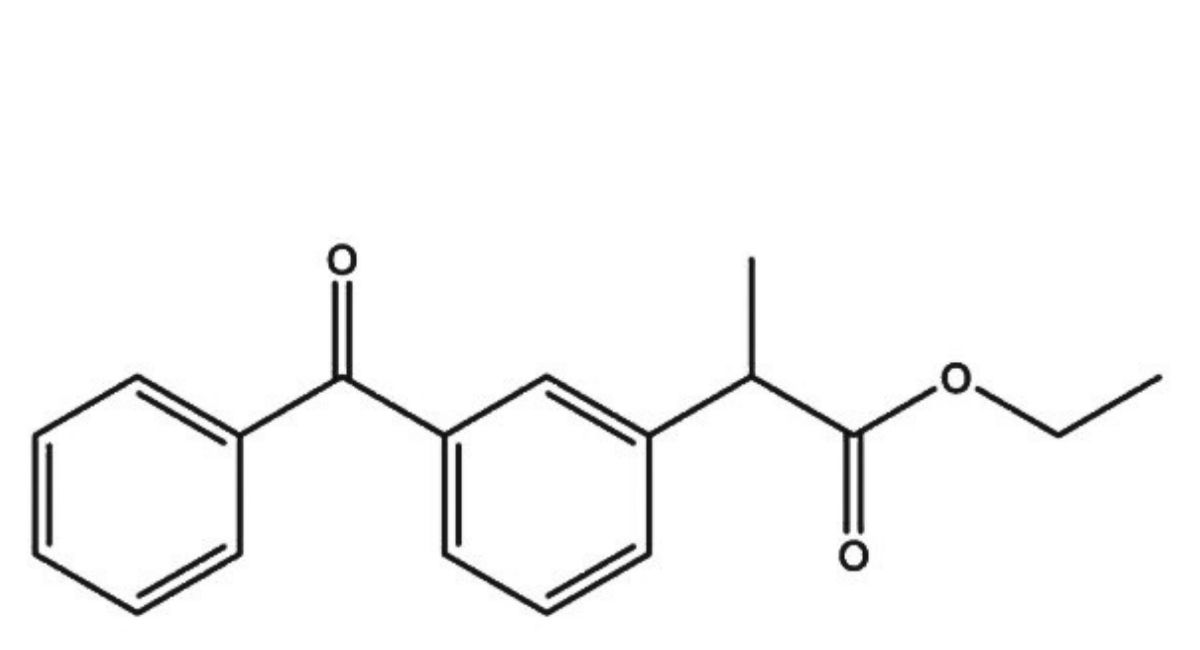
1. ethyl 2-(3-benzoylphenyl)propionate (ketoprofen ethyl ester).