(Ph. Eur. monograph 0394)
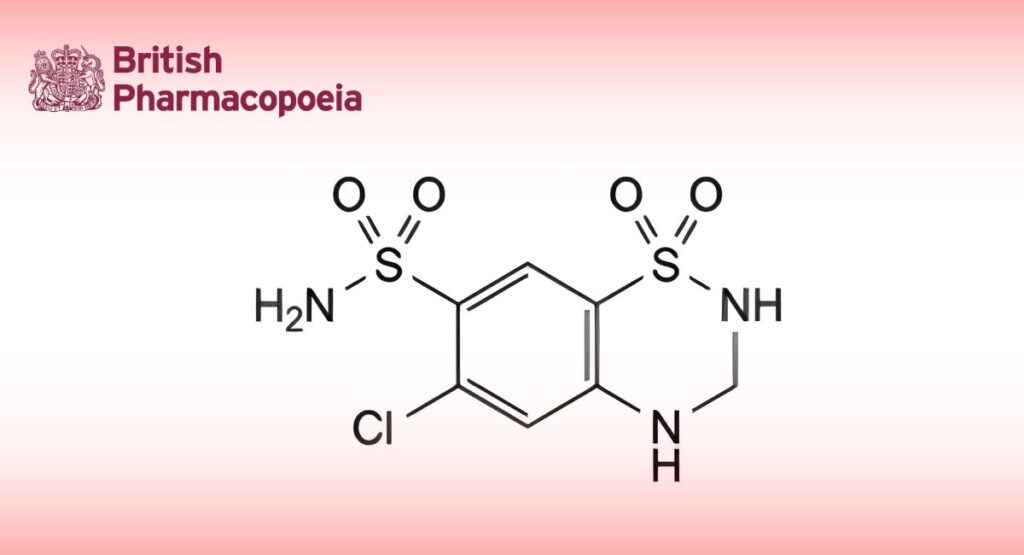
C7H8ClN3O4S2 297.7 58-93-5
Action and use
Thiazide diuretic.
Preparations
Co-amilozide Oral Solution
Co-amilozide Tablets
Co-triamterzide Tablets
Hydrochlorothiazide Tablets
DEFINITION
6-Chloro-3,4-dihydro-2H-1,2,4-benzothiadiazine-7-sulfonamide 1,1-dioxide.
Content
97.5 per cent to 102.0 per cent (dried substance).
CHARACTERS
Appearance
White or almost white, crystalline powder.
Solubility
Very slightly soluble in water, soluble in acetone, sparingly soluble in ethanol (96 per cent). It dissolves in dilute solutions of alkali hydroxides.
It shows polymorphism (5.9).
IDENTIFICATION
First identification: B.
Second identification: A, C, D.
A. Ultraviolet and visible absorption spectrophotometry (2.2.25).
Test solution: Dissolve 50.0 mg in 10 mL of 0.1 M sodium hydroxide and dilute to 100.0 mL with water R. Dilute 2.0 mL of this solution to 100.0 mL with 0.01 M sodium hydroxide.
Spectral range 250-350 nm.
Absorption maxima At 273 nm and 323 nm.
Absorbance ratio A273/A323 = 5.4 to 5.7.
B. Infrared absorption spectrophotometry (2.2.24).
Comparison hydrochlorothiazide CRS.
If the spectra obtained in the solid state show differences, dissolve the substance to be examined and the reference substance separately in the minimum volume of ethanol R1, evaporate to dryness and record new spectra using the residues.
C. Thin-layer chromatography (2.2.27).
Test solution: Dissolve 50 mg of the substance to be examined in acetone R and dilute to 10 mL with the same solvent.
Reference solution (a): Dissolve 50 mg of hydrochlorothiazide CRS in acetone R and dilute to 10 mL with the same solvent.
Reference solution (b): Dissolve 25 mg of chlorothiazide R in reference solution (a) and dilute to 5 mL with reference solution (a).
Plate TLC silica gel F254 plate R.
Mobile phase ethyl acetate R.
Application 2 μL.
Development Over 1/2 of the plate.
Drying In a current of air.
Detection Examine in ultraviolet light at 254 nm.
System suitability Reference solution (b):
— the chromatogram shows 2 clearly separated spots.
Results The principal spot in the chromatogram obtained with the test solution is similar in position and size to the principal spot in the chromatogram obtained with reference solution (a).
D. Gently heat about 1 mg with 2 mL of a freshly prepared 0.5 g/L solution of chromotropic acid, sodium salt R in a cooled mixture of 35 volumes of water R and 65 volumes of sulfuric acid R. A violet colour develops.
TESTS
Acidity or alkalinity
Shake 0.5 g of the powdered substance to be examined with 25 mL of water R for 2 min and filter. To 10 mL of the filtrate, add 0.2 mL of 0.01 M sodium hydroxide and 0.15 mL of methyl red solution R. The solution is yellow. Not more than 0.4 mL of 0.01 M hydrochloric acid is required to change the colour of the indicator to red.
Related substances
Liquid chromatography (2.2.29).
Solvent mixture: Dilute 50.0 mL of a mixture of equal volumes of acetonitrile R1 and methanol R2 to 200.0 mL with phosphate buffer solution pH 3.2 R1.
Test solution (a): Dissolve 30.0 mg of the substance to be examined in 5 mL of a mixture of equal volumes of
acetonitrile R1 and methanol R2, using sonication if necessary, and dilute to 20.0 mL with phosphate buffer solution pH 3.2 R1.
Test solution (b): Dilute 1.0 mL of test solution (a) to 20.0 mL with phosphate buffer solution pH 3.2 R1.
Reference solution (a): Dissolve 3 mg of chlorothiazide CRS (impurity A) and 3 mg of hydrochlorothiazide CRS in 5 mL of a mixture of equal volumes of acetonitrile R1 and methanol R2, using sonication if necessary, and dilute to 20.0 mL with phosphate buffer solution pH 3.2 R1. Dilute 5.0 mL of this solution to 100.0 mL with the solvent mixture.
Reference solution (b): Dilute 1.0 mL of test solution (a) to 100.0 mL with the solvent mixture. Dilute 1.0 mL of this solution to 10.0 mL with the solvent mixture.
Reference solution (c): Dissolve 30.0 mg of hydrochlorothiazide CRS in 5 mL of a mixture of equal volumes of
acetonitrile R1 and methanol R2, using sonication if necessary, and dilute to 20.0 mL with phosphate buffer solution pH 3.2 R1. Dilute 1.0 mL of this solution to 20.0 mL with phosphate buffer solution pH 3.2 R1.
Reference solution (d): Dissolve 3 mg of hydrochlorothiazide for peak identification CRS (containing impurities B and C) in 0.5 mL of a mixture of equal volumes of acetonitrile R1 and methanol R2, using sonication if necessary, and dilute to 2.0 mL with phosphate buffer solution pH 3.2 R1.
Column:
— size: l = 0.1 m, Ø = 4.6 mm;
— stationary phase: octadecylsilyl silica gel for chromatography R (3 μm).
Mobile phase:
— mobile phase A: to 940 mL of phosphate buffer solution pH 3.2 R1 add 60.0 mL of methanol R2 and 10.0 mL of tetrahydrofuran R and mix;
— mobile phase B: to a mixture of 500 mL of methanol R2 and 500 mL of phosphate buffer solution pH 3.2 R1 add 50.0 mL of tetrahydrofuran R and mix;
| Time (min) |
Mobile phase A (per cent V/V) |
Mobile phase B (per cent V/V) |
| 0 – 17 | 100 → 55 | 0 → 45 |
| 17 – 30 | 55 | 45 |
Flow rate 0.8 mL/min.
Detection: Spectrophotometer at 224 nm.
Injection 10 μL of test solution (a) and reference solutions (a), (b) and (d).
Identification of impurities: Use the chromatogram obtained with reference solution (a) to identify the peak due to
impurity A; use the chromatogram supplied with hydrochlorothiazide for peak identification CRS and the chromatogram obtained with reference solution (d) to identify the peaks due to impurities B and C.
Relative retention: With reference to hydrochlorothiazide (retention time = about 8 min): impurity B = about 0.7;
impurity A = about 0.9; impurity C = about 2.8.
System suitability Reference solution (a):
— resolution: minimum 2.5 between the peaks due to impurity A and hydrochlorothiazide.
Limits:
— impurities A, B, C: for each impurity, not more than 5 times the area of the principal peak in the chromatogram
obtained with reference solution (b) (0.5 per cent);
— unspecified impurities: for each impurity, not more than the area of the principal peak in the chromatogram obtained with reference solution (b) (0.10 per cent);
— total: not more than 10 times the area of the principal peak in the chromatogram obtained with reference
solution (b) (1.0 per cent);
— disregard limit: 0.5 times the area of the principal peak in the chromatogram obtained with reference solution (b) (0.05 per cent).
Chlorides (2.4.4)
Maximum 100 ppm.
Dissolve 1.0 g in 25 mL of acetone R and dilute to 30 mL with water R. Prepare the standard using 5 mL of acetone R containing 15 per cent V/V of water R and 10 mL of chloride standard solution (5 ppm Cl) R.
Loss on drying (2.2.32)
Maximum 0.5 per cent, determined on 1.000 g by drying in an oven at 105 °C.
Sulfated ash (2.4.14)
Maximum 0.1 per cent, determined on 1.0 g.
ASSAY
Liquid chromatography (2.2.29) as described in the test for related substances with the following modifications.
Mobile phase:
| Time (min) |
Mobile phase A (per cent V/V) |
Mobile phase B (per cent V/V) |
| 0 – 4 | 80 | 20 |
| 4 – 10 | 80 → 20 | 20 → 80 |
Flow rate 1.6 mL/min.
Injection Test solution (b) and reference solutions (a) and (c).
Relative retention With reference to hydrochlorothiazide (retention time = about 2.2 min): impurity A = about 0.9.
System suitability Reference solution (a):
— resolution: minimum 2.0 between the peaks due to impurity A and hydrochlorothiazide.
Calculate the percentage content of C7H8ClN3O4S2 taking into account the assigned content of hydrochlorothiazide CRS.
IMPURITIES
Specified impurities A, B, C.
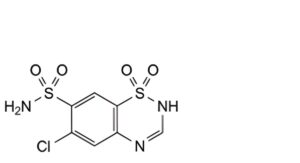
A. 6-chloro-2H-1,2,4-benzothiadiazine-7-sulfonamide 1,1-dioxide (chlorothiazide),
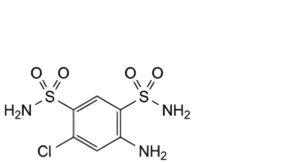
B. 4-amino-6-chlorobenzene-1,3-disulfonamide (salamide),
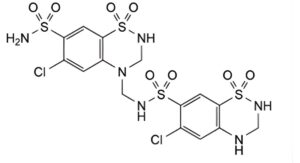
C. 6-chloro-N-[(6-chloro-7-sulfamoyl-2,3-dihydro-4H-1,2,4-benzothiadiazin-4-yl 1,1-dioxide)methyl]-3,4-dihydro-2H-1,2,4-benzothiadiazine-7-sulfonamide 1,1-dioxide.