



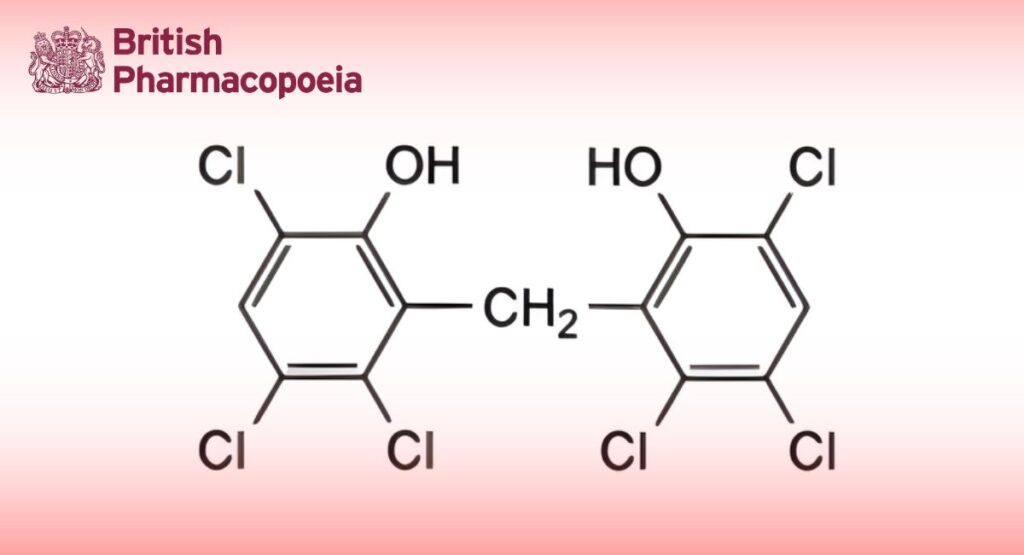
C13H6Cl6O2 406.9 70-30-4
Action and use
Antiseptic.
Preparation
Hexachlorophene Dusting Powder
DEFINITION
Hexachlorophene is 2,2-methylenebis(3,4,6-trichlorophenol). It contains not less than 98.0% and not more than 100.5% of C13H6Cl6O2, calculated with reference to the dried substance.
PRODUCTION
A suitable test is carried out to demonstrate that the level of 2,3,7,8-tetrachlorodibenzo-p-dioxin present does not exceed 2 ppb.
CHARACTERISTICS
A white or pale buff, crystalline powder.
Practically insoluble in water; very soluble in acetone; freely soluble in ethanol (96%). It dissolves in dilute solutions of the alkali hydroxides.
IDENTIFICATION
The infrared absorption spectrum, Appendix II A, is concordant with the reference spectrum of hexachlorophene (RS 174).
TESTS
Chloride
Dissolve 0.50 g in 2 mL of ethanol (96%), dilute to 25 mL with water and filter. 5 mL of the clear filtrate diluted to 15 mL with water complies with the limit test for chlorides, Appendix VII (500 ppm).
Non-phenolic substances
Dissolve 5 g in 38 mL of methanol, add 125 mL of 0.25M sodium hydroxide and extract with three 15 mL quantities of n-pentane, retaining any foamy interphase with the aqueous layer. Dry the combined extracts over anhydrous sodium sulfate and evaporate to dryness at a pressure not exceeding 2 kPa. The residue weighs not more than 37.5 mg when dried to constant weight (0.75%).
Related substances
Carry out the method for liquid chromatography, Appendix III D, using the following solutions in methanol.
(1) 1.0% w/v of the substance being examined.
(2) 0.020% w/v of the substance being examined.
CHROMATOGRAPHIC CONDITIONS
(a) Use a stainless steel column (20 cm × 4.6 mm) packed with octadecylsilyl silica gel for chromatography, (10 μm) (Spherisorb ODS 1 is suitable).
(b) Use isocratic elution and the mobile phase described below.
(c) Use a flow rate of 2 mL per minute.
(d) Use an ambient column temperature.
(e) Use a detection wavelength of 300 nm.
(f) Inject 20 μL of each solution.
MOBILE PHASE
1 volume of glacial acetic acid, 20 volumes of water and 100 volumes of methanol.
LIMITS
In the chromatogram obtained with solution (1):
the sum of the areas of any secondary peaks with a retention time not more than 3 times that of the principal peak is not greater than twice the area of the principal peak in the chromatogram obtained with solution (2) (4.0%) and not more than one such peak has an area greater than half of the area of the principal peak in the chromatogram obtained with solution (2) (1.0%).
Loss on drying
When dried to constant weight at 105°, loses not more than 1.0% of its weight. Use 1 g.
Sulfated ash
Not more than 0.1%, Appendix IX A.
ASSAY
Dissolve 1.000 g in 25 mL of ethanol (96%) previously adjusted to pH 9.0 and titrate with 0.1M sodium hydroxide VS determining the end point potentiometrically. Each mL of 0.1M sodium hydroxide VS is equivalent to 40.69 mg of C13H6Cl6O2.
STORAGE
Hexachlorophene should be protected from light.


