



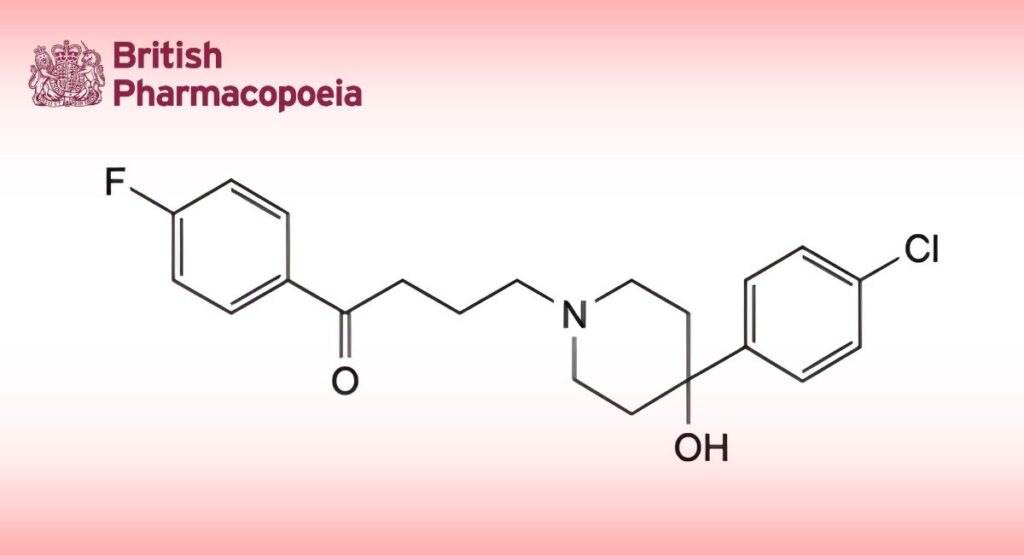
(Ph. Eur. monograph 0616)
C21H23ClFNO2 375.9 52-86-8
Action and use
Dopamine receptor antagonist; neuroleptic.
Preparations
Haloperidol Capsules
Haloperidol Injection
Haloperidol Oral Solution
Haloperidol Tablets
DEFINITION
4-[4-(4-Chlorophenyl)-4-hydroxypiperidin-1-yl]-1-(4-fluorophenyl)butan-1-one.
Content
99.0 per cent to 101.0 per cent (dried substance).
CHARACTERS
Appearance
White or almost white powder.
Solubility
Practically insoluble in water, slightly soluble in ethanol (96 per cent), in methanol and in methylene chloride.
IDENTIFICATION
First identification: B, E.
Second identification: A, C, D, E.
A. Melting point (2.2.14): 150 °C to 153 °C.
B. Infrared absorption spectrophotometry (2.2.24).
Comparison haloperidol CRS.
C. Thin-layer chromatography (2.2.27).
Test solution: Dissolve 10 mg of the substance to be examined in methanol R and dilute to 10 mL with the same solvent.
Reference solution (a): Dissolve 10 mg of haloperidol CRS in methanol R and dilute to 10 mL with the same solvent.
Reference solution (b): Dissolve 10 mg of haloperidol CRS and 10 mg of bromperidol CRS in methanol R and dilute to 10 mL with the same solvent.
Plate TLC octadecylsilyl silica gel plate R.
Mobile phase tetrahydrofuran R, methanol R, 58 g/L solution of sodium chloride R (10:45:45 V/V/V).
Application 1 μL.
Development In an unsaturated tank, over 2/3 of the plate.
Drying In air.
Detection Examine in ultraviolet light at 254 nm.
System suitability Reference solution (b):
— the chromatogram shows 2 spots which may, however, not be completely separated.
Results The principal spot in the chromatogram obtained with the test solution is similar in position and size to the principal spot in the chromatogram obtained with reference solution (a).
D. Dissolve about 10 mg in 5 mL of anhydrous ethanol R. Add 0.5 mL of dinitrobenzene solution R and 0.5 mL of 2 M alcoholic potassium hydroxide R. A violet colour is produced and becomes brownish-red after 20 min.
E. To 0.1 g in a platinum crucible add 0.5 g of anhydrous sodium carbonate R. Heat over an open flame for 10 min. Allow to cool. Take up the residue with 5 mL of dilute nitric acid R and filter. To 1 mL of the filtrate add 1 mL of water R. The solution gives reaction (a) of chlorides (2.3.1).
TESTS
Appearance of solution
The solution is clear (2.2.1) and not more intensely coloured than reference solution Y7 (2.2.2, Method II).
Dissolve 0.2 g in 20 mL of a 1 per cent V/V solution of lactic acid R.
Related substances
Liquid chromatography (2.2.29). Prepare the solutions immediately before use and protect from light.
Test solution: Dissolve 0.100 g of the substance to be examined in methanol R and dilute to 10.0 mL with the same solvent.
Reference solution (a): Dissolve 10 mg of haloperidol for system suitability CRS (containing impurities B and D) in 1.0 mL of methanol R.
Reference solution (b): Dilute 1.0 mL of the test solution to 100.0 mL with methanol R. Dilute 1.0 mL of this solution to 10.0 mL with methanol R.
Reference solution (c): Dissolve 10 mg of haloperidol for peak identification CRS (containing impurities G and H) in 1.0 mL of methanol R.
Column:
— size: l = 0.1 m, Ø = 4.6 mm;
— stationary phase: base-deactivated end-capped octadecylsilyl silica gel for chromatography R (3 μm).
Mobile phase:
— mobile phase A: 17 g/L solution of tetrabutylammonium hydrogen sulfate R1;
— mobile phase B: acetonitrile R;
| Time (min) |
Mobile phase A (per cent V/V) |
Mobile phase B (per cent V/V) |
| 0 – 2 | 90 | 10 |
| 2 – 17 | 90 → 50 | 10 → 50 |
| 17 – 22 | 50 | 50 |
Flow rate 1.5 mL/min.
Detection Spectrophotometer at 230 nm.
Injection 10 μL.
Identification of impurities: Use the chromatogram supplied with haloperidol for system suitability CRS and the chromatogram obtained with reference solution (a) to identify the peaks due to impurities B and D; use the chromatogram supplied with haloperidol for peak identification CRS and the chromatogram obtained with reference solution (c) to identify the peaks due to impurities G and H.
Relative retention: With reference to haloperidol (retention time = about 8 min): impurity B = about 0.9;
impurity D = about 1.6; impurity G = about 1.8; impurity H = about 2.0.
System suitability Reference solution (a):
— resolution: minimum 3.0 between the peaks due to impurity B and haloperidol.
Limits:
— correction factor: for the calculation of content, multiply the peak area of impurity B by 0.7;
— impurity D: not more than 5 times the area of the principal peak in the chromatogram obtained with reference solution (b) (0.5 per cent);
— impurity B: not more than 3 times the area of the principal peak in the chromatogram obtained with reference solution (b) (0.3 per cent);
— impurities G, H: for each impurity, not more than 1.5 times the area of the principal peak in the chromatogram obtained with reference solution (b) (0.15 per cent);
— unspecified impurities: for each impurity, not more than the area of the principal peak in the chromatogram obtained with reference solution (b) (0.10 per cent);
— total: not more than 10 times the area of the principal peak in the chromatogram obtained with reference
solution (b) (1.0 per cent);
— disregard limit: 0.5 times the area of the principal peak in the chromatogram obtained with reference solution (b) (0.05 per cent).
Loss on drying (2.2.32)
Maximum 0.5 per cent, determined on 1.000 g by drying in an oven at 105 °C.
Sulfated ash (2.4.14)
Maximum 0.1 per cent, determined on 1.0 g in a platinum crucible.
ASSAY
Dissolve 0.300 g in 50 mL of a mixture of 1 volume of anhydrous acetic acid R and 7 volumes of methyl ethyl ketone R. Titrate with 0.1 M perchloric acid, using 0.2 mL of naphtholbenzein solution R as indicator.
1 mL of 0.1 M perchloric acid is equivalent to 37.59 mg of C21H23ClFNO2.
STORAGE
Protected from light.
IMPURITIES
Specified impurities B, D, G, H.
Other detectable impurities (the following substances would, if present at a sufficient level, be detected by one or other of the tests in the monograph. They are limited by the general acceptance criterion for other/unspecified impurities and/or by the general monograph Substances for pharmaceutical use (2034). It is therefore not necessary to identify these impurities for demonstration of compliance. See also 5.10. Control of impurities in substances for pharmaceutical use) A, C, E, F.
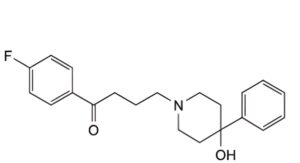
A. 1-(4-fluorophenyl)-4-(4-hydroxy-4-phenylpiperidin-1-yl)butan-1-one,
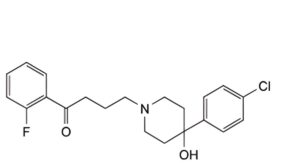
B. 4-[4-(4-chlorophenyl)-4-hydroxypiperidin-1-yl]-1-(2-fluorophenyl)butan-1-one,
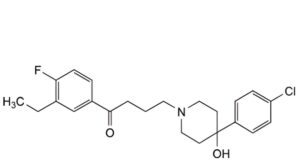
C. 4-[4-(4-chlorophenyl)-4-hydroxypiperidin-1-yl]-1-(3-ethyl-4-fluorophenyl)butan-1-one,
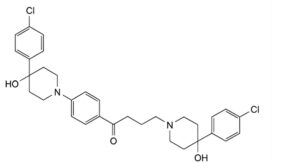
D. 4-[4-(4-chlorophenyl)-4-hydroxypiperidin-1-yl]-1-[4-[4-(4-chlorophenyl)-4-hydroxypiperidin-1-yl]phenyl]butan-1-one,
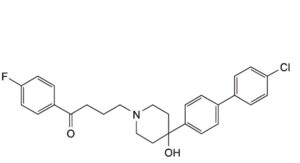
E. 4-[4-(4′-chlorobiphenyl-4-yl)-4-hydroxypiperidin-1-yl]-1-(4-fluorophenyl)butan-1-one,
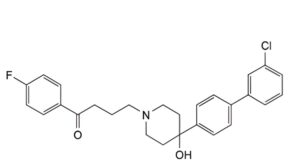
F. 4-[4-(3′-chlorobiphenyl-4-yl)-4-hydroxypiperidin-1-yl]-1-(4-fluorophenyl)butan-1-one,
G. unknown structure,
H. unknown structure.


