



(Ph. Eur. monograph 2392)
DEFINITION
Mixture of monoacylglycerols, mainly mono-O-octanoylglycerol and mono-O-decanoylglycerol, containing variable quantities of di- and triacylglycerols, obtained by direct esterification of glycerol with caprylic (octanoic) and capric (decanoic) acids, followed by a distillation step in the case of glycerol monocaprylocaprate (type II).
Content
— glycerol monocaprylocaprate (type I):
— monoacylglycerols: 45.0 per cent to 75.0 per cent;
— diacylglycerols: 20.0 per cent to 50.0 per cent;
— triacylglycerols: maximum 10.0 per cent;
— glycerol monocaprylocaprate (type II):
— monoacylglycerols: minimum 80.0 per cent;
— diacylglycerols: maximum 20.0 per cent;
— triacylglycerols: maximum 5.0 per cent.
CHARACTERS
Appearance
Colourless or slightly yellow, oily liquid or soft mass.
Solubility
Practically insoluble in water, very soluble in ethanol (96 per cent) and freely soluble in methylene chloride.
IDENTIFICATION
A. Composition of fatty acids (see Tests).
B. It complies with the limits of the assay (monoacylglycerols).
TESTS
Acid value (2.5.1)
Maximum 3.0.
Composition of fatty acids (2.4.22, Method C)
Use the mixture of calibrating substances in Table 2.4.22.-2.
Composition of the fatty acid fraction of the substance:
— caproic acid: maximum 3.0 per cent;
— caprylic acid: 50.0 per cent to 90.0 per cent;
— capric acid: 10.0 per cent to 50.0 per cent;
— lauric acid: maximum 3.0 per cent;
— myristic acid: maximum 1.0 per cent.
Free glycerol
Maximum 3.0 per cent.
Dissolve 1.20 g in 25.0 mL of methylene chloride R. Heat to about 50 °C and allow to cool. Add 100 mL of water R, shake and add 25.0 mL of periodic acetic acid solution R. Shake again and allow to stand for 30 min. Add 40 mL of a 75 g/L solution of potassium iodide R and allow to stand for 1 min. Add 1 mL of starch solution R. Titrate with 0.1 M sodium thiosulfate until the aqueous phase becomes colourless. Carry out a blank titration.
1 mL of 0.1 M sodium thiosulfate is equivalent to 2.3 mg of glycerol.
Water (2.5.12)
Maximum 0.5 per cent, determined on 1.00 g.
Total ash (2.4.16)
Maximum 0.5 per cent.
ASSAY
Gas chromatography (2.2.28): use the normalisation procedure.
Test solution: To 0.25 g of the substance to be examined, add 5.0 mL of tetrahydrofuran R and shake to dissolve.
Reference solution (a): To 0.25 g of glycerol monocaprylocaprate CRS, add 5.0 mL of tetrahydrofuran R and shake to dissolve.
Reference solution (b): To 50 mg of glycerol 1-octanoate R and 50 mg of glycerol 1-decanoate R, add 2.5 mL of tetrahydrofuran R and shake to dissolve.
Column:
— size: l = 10 m, Ø = 0.32 mm;
— stationary phase: phenyl(5)methyl(95)polysiloxane R (film thickness 0.1 μm).
Carrier gas helium for chromatography R.
Flow rate: 2.3 mL/min.
Split ratio: 1:50.
Temperature:
| Time (min) |
Temperature (°C) |
|
| Column | 0 – 3 | 60 |
| 3 – 38 | 60 → 340 | |
| 38 – 50 | 340 | |
| Injection port | 350 | |
| Detector | 370 |
Detection: Flame ionisation.
Injection: 1 μL.
Identification of peaks: Use the chromatogram supplied with glycerol monocaprylocaprate CRS and the chromatogram obtained with reference solution (a) to identify the peaks due to mono-, di- and triacylglycerols.
System suitability: Reference solution (b):
— resolution: minimum 5 between the peaks due to glycerol 1-octanoate and glycerol 1-decanoate.
For the calculation of the contents of mono-, di- and triacylglycerols, disregard the peaks with a retention time less than that of the monoacylglycerols, which are due to the impurities of the solvent and to the free fatty acids.
Calculate the percentage content of free fatty acids (C) using the following equations:
IA x 144/561.1
IA = acid value of the glycerol monocaprylocaprate.
Calculate the content of mono-, di- and triacylglycerols using the following equations:
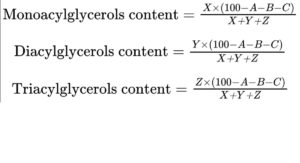
A = percentage content of free glycerol (see Tests);
B = percentage content of water;
X = area of the peak due to monoacylglycerols;
Y = area of the peak due to diacylglycerols;
Z = area of the peak due to triacylglycerols.
LABELLING
The labelling states the type of glycerol monocaprylocaprate (type I or II).


