



(Ph. Eur. monograph 1324)
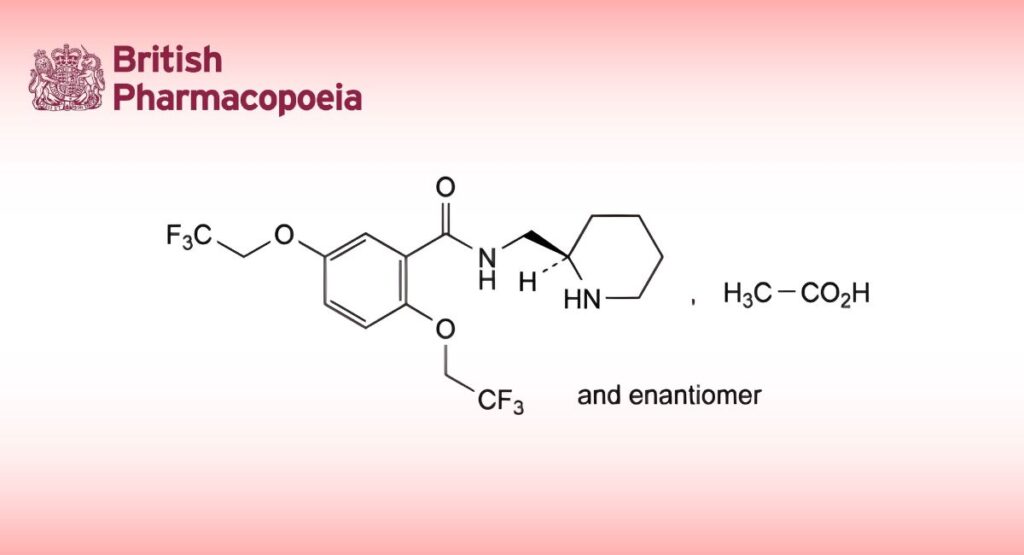
C19H24F6N2O5 474.4 54143-56-5
Action and use
Class I antiarrhythmic.
Preparations
Flecainide Injection
Flecainide Oral Solution
Flecainide Tablets
DEFINITION
N-[(RS)-(Piperidin-2-ylmethyl)]-2,5-bis(2,2,2-trifluoroethoxy)benzamide acetate.
Content
98.0 per cent to 101.0 per cent (dried substance).
CHARACTERS
Appearance
White or almost white, very hygroscopic, crystalline powder.
Solubility
Soluble in water and in anhydrous ethanol. It is freely soluble in dilute acetic acid and practically insoluble in dilute hydrochloric acid.
IDENTIFICATION
First identification: A, C.
Second identification: A, B, D.
A. Melting point (2.2.14): 146 °C to 152 °C, with a melting range not greater than 3 °C.
B. Ultraviolet and visible absorption spectrophotometry (2.2.25).
Test solution Dissolve 50 mg in ethanol (96 per cent) R and dilute to 50.0 mL with the same solvent. Dilute 5.0 mL of the solution to 50.0 mL with ethanol (96 per cent) R.
Spectral range 230-350 nm.
Absorption maximum At 298 nm.
Specific absorbance at the absorption maximum 61 to 65.
C. Infrared absorption spectrophotometry (2.2.24).
Comparison flecainide acetate CRS.
D. It gives reaction (b) of acetates (2.3.1).
TESTS
Appearance of solution
The solution is clear (2.2.1) and colourless (2.2.2, Method II).
Dissolve 0.50 g in water R, add 0.1 mL of glacial acetic acid R and dilute to 20 mL with water R.
pH (2.2.3)
6.7 to 7.1.
Dissolve 0.25 g in carbon dioxide-free water R and dilute to 10 mL with the same solvent.
Impurity B
Thin-layer chromatography (2.2.27).
Test solution: Dissolve 0.10 g of the substance to be examined in methanol R and dilute to 2.0 mL with the same solvent.
Reference solution (a): Dissolve 10.0 mg of flecainide impurity B CRS in methanol R and dilute to 100.0 mL with the same solvent.
Reference solution (b): Dissolve 0.10 g of the substance to be examined in reference solution (a) and dilute to 2.0 mL with reference solution (a).
Plate TLC silica gel F254 plate R.
Mobile phase Freshly prepared mixture of 5 volumes of concentrated ammonia R and 95 volumes of acetone R.
Application 5 μL.
Development Over 1/2 of the plate.
Drying At 100-105 °C until the ammonia has evaporated.
Detection Examine in ultraviolet light at 254 nm to establish the position of the flecainide spot, then spray with a freshly prepared 2 g/L solution of ninhydrin R in methanol R and heat at 100-110 °C for 2-5 min; examine in daylight.
System suitability Reference solution (b):
— the chromatogram shows 2 clearly separated spots.
Limit:
— impurity B: any spot due to impurity B is not more intense than the corresponding spot in the chromatogram obtained with reference solution (a) (0.2 per cent).
Related substances
Liquid chromatography (2.2.29).
Test solution: Dissolve 0.25 g of the substance to be examined in methanol R and dilute to 25.0 mL with the same solvent.
Reference solution (a): Dilute 1.0 mL of the test solution to 100.0 mL with methanol R. Dilute 1.0 mL of this solution to 10.0 mL with methanol R.
Reference solution (b): Dissolve 5 mg of flecainide impurity A CRS in methanol R and dilute to 5.0 mL with the same solvent.
Reference solution (c): Dissolve 5 mg of flecainide for system suitability CRS (containing impurities C, D and E) in 1.0 mL of methanol R.
Column:
— size: l = 0.15 m, Ø = 4.6 mm;
— stationary phase: end-capped octylsilyl silica gel for chromatography R (5 μm).
Mobile phase:
— mobile phase A: mix 2 mL of concentrated ammonia R, 4 mL of triethylamine R and 985 mL of water R; add 6 mL of phosphoric acid R and adjust to pH 2.8 with concentrated ammonia R;
— mobile phase B: acetonitrile R;
| Time (min) |
Mobile phase A (per cent V/V) |
Mobile phase B (per cent V/V) |
| 0 – 5 | 90 | 10 |
| 5 – 17 | 90 → 30 | 10 → 70 |
| 17 – 22 | 30 | 70 |
If a suitable baseline cannot be obtained, use another grade of triethylamine.
Flow rate 2 mL/min.
Detection: Spectrophotometer at 300 nm.
Injection 20 μL.
Identification of impurities: Use the chromatogram supplied with flecainide for system suitability CRS and the chromatogram obtained with reference solution (c) to identify the peaks due to impurities C, D, and E; use the chromatogram obtained with reference solution (b) to identify the peak due to impurity A.
Relative retention: With reference to flecainide (retention time = about 11 min): impurity C = about 0.9;
impurity A = about 1.1; impurity E = about 1.28; impurity D = about 1.32.
System suitability Reference solution (c):
— resolution: minimum 1.5 between the peaks due to impurities E and D.
Limits:
— impurities A, C, D, E: for each impurity, not more than twice the area of the principal peak in the chromatogram obtained with reference solution (a) (0.2 per cent);
— unspecified impurities: for each impurity, not more than the area of the principal peak in the chromatogram obtained with reference solution (a) (0.10 per cent);
— total: not more than 5 times the area of the principal peak in the chromatogram obtained with reference solution (a) (0.5 per cent);
— disregard limit: 0.5 times the area of the principal peak in the chromatogram obtained with reference solution (a) (0.05 per cent).
Loss on drying (2.2.32)
Maximum 0.5 per cent, determined on 1.000 g by drying in an oven at 60 °C at a pressure not exceeding 0.6 kPa for 2 h.
Sulfated ash (2.4.14)
Maximum 0.1 per cent, determined on 1.0 g in a platinum crucible.
ASSAY
Dissolve 0.400 g in 25 mL of anhydrous acetic acid R. Titrate with 0.1 M perchloric acid, determining the end-point potentiometrically (2.2.20).
1 mL of 0.1 M perchloric acid is equivalent to 47.44 mg of C19H24F6N2O5.
STORAGE
In an airtight container, protected from light.
IMPURITIES
Specified impurities A, B, C, D, E.
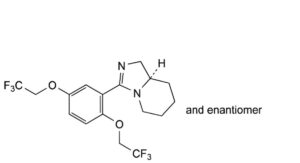
A. (8aRS)-3-[2,5-bis(2,2,2-trifluoroethoxy)phenyl]-1,5,6,7,8,8a-hexahydroimidazo[1,5-a]pyridine,
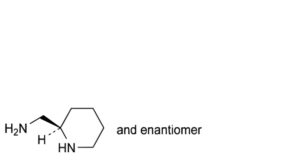
B. (RS)-(piperidin-2-yl)methanamine,
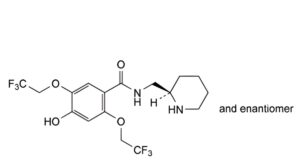
C. (RS)-4-hydroxy-N-(piperidin-2-ylmethyl)-2,5-bis(2,2,2-trifluoroethoxy)benzamide,
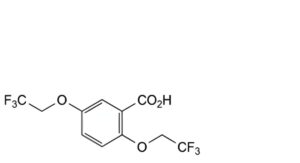
D. 2,5-bis(2,2,2-trifluoroethoxy)benzoic acid,
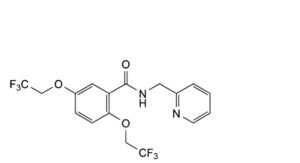
E. N-(pyridin-2-ylmethyl)-2,5-bis(2,2,2-trifluoroethoxy) benzamide.


