Action and use
Antihelminthic.
DEFINITION
Fenbendazole Granules contain Fenbendazole mixed with suitable diluents.
The granules comply with the requirements stated under Granules and with the following requirements.
Content of fenbendazole, C15H13N3O2S
95.0 to 105.0% of the stated amount.
IDENTIFICATION
A. In the Assay, the retention time of the principal peak in the chromatogram obtained with solution (1) is the same as that of the principal peak in the chromatogram obtained with solution (2).
B. Carry out the method for thin-layer chromatography, Appendix III A, using the following solutions.
(1) Mix with the aid of ultrasound a quantity of the powdered granules containing 80 mg of Fenbendazole with 80 mL of 0.1M methanolic hydrochloric acid for 90 minutes, cool, dilute to 100 mL with 0.1M methanolic hydrochloric acid, mix, filter through a 0.4-μm filter (Whatman GF/C is suitable) and use the filtrate.
(2) 0.08% w/v of fenbendazole BPCRS in 0.1M methanolic hydrochloric acid.
CHROMATOGRAPHIC CONDITIONS
(a) Use a TLC silica gel F254 plate (Merck silica gel F254 plates are suitable).
(b) Use the mobile phase as described below.
(c) Apply 5 μL of each solution.
(d) Develop the plate to 10 cm.
(e) After removal of the plate, dry in air for 10 minutes, heat at 100° for 5 minutes and examine under ultraviolet light (254 nm and 365 nm).
MOBILE PHASE
2.5 volumes of water, 6.5 volumes of acetone, 26 volumes of 13.5M ammonia and 65 volumes of toluene.
CONFIRMATION
By each method of visualisation the principal spot in the chromatogram obtained with solution (1) corresponds to that in the chromatogram obtained with solution (2).
TESTS
Related impurities A, B and 1
Carry out the method for liquid chromatography, Appendix III D, using the following solutions.
(1) Mix, with the aid of ultrasound, a quantity of the powdered granules containing 0.1 g of Fenbendazole with 50 mL of 0.1M methanolic hydrochloric acid for 30 minutes, cool, dilute to 100 mL with methanol (65%), mix and filter through a glass-fibre filter (Whatman GF/C is suitable).
(2) Dilute 1 volume of a 0.001% w/v solution of fenbendazole impurity A EPCRS (methyl (1H-benzimidazol-2-yl)carbamate) in 0.1M methanolic hydrochloric acid to 2 volumes with methanol (65%).
(3) Dilute 1 volume of a 0.001% w/v solution of fenbendazole impurity B EPCRS (methyl (5-chloro-1H-benzimidazol-2-yl)carbamate) in 0.1M methanolic hydrochloric acid to 2 volumes with methanol (65%).
(4) Dilute 1 volume of a 0.0010% w/v solution of fenbendazole impurity 1 BPCRS (5-phenylthio)-2-aminobenzimidazole) in 0.1M methanolic hydrochloric acid to 2 volumes with methanol (65%).
(5) Dilute 1 volume of a solution containing 0.002% w/v each of fenbendazole impurity A EPCRS, fenbendazole impurity B EPCRS, fenbendazole impurity 1 BPCRS and 0.20% w/v of fenbendazole BPCRS in 0.1M methanolic hydrochloric acid to 2 volumes with methanol (65%).
CHROMATOGRAPHIC CONDITIONS
(a) Use a stainless steel column (25 cm × 4.6 mm) packed with octadecylsilyl silica gel for chromatography (5 μm) (Nucleosil C18 is suitable).
(b) Use isocratic elution and the mobile phase described below.
(c) Use a flow rate of 1 mL per minute.
(d) Use an ambient column temperature.
(e) Use a detection wavelength of 280 nm.
(f) Inject 20 μL of each solution.
MOBILE PHASE
350 volumes of a 0.5% w/v solution of sodium dihydrogen orthophosphate and 650 volumes of methanol containing 1.88 g of sodium hexanesulfonate, the pH of which has been adjusted to 3.5 with orthophosphoric acid.
SYSTEM SUITABILITY
The test is not valid unless the chromatogram obtained with solution (5) closely resembles the reference chromatogram supplied with fenbendazole BPCRS.
LIMITS
In the chromatogram obtained with solution (1):
the areas of any peaks corresponding to fenbendazole impurity A, fenbendazole impurity B and fenbendazole impurity 1 (5-(phenylthio)-2-aminobenzimidazole) are not greater than the areas of the corresponding peaks in the chromatograms
obtained with solutions (2), (3) and (4) respectively (0.5% each).
ASSAY
Carry out the method for liquid chromatography, Appendix III D, using the following solutions.
(1) Mix with the aid of ultrasound a quantity of the powdered granules containing 0.1 g of Fenbendazole with 50 mL of 0.1M methanolic hydrochloric acid for 30 minutes, cool, dilute to 100 mL with methanol (65%), mix, filter through a glass-fibre filter (Whatman GF/C is suitable). Dilute 5 volumes of the resulting solution to 50 volumes with 0.1M hydrochloric acid in methanol (85%).
(2) 0.01% w/v of fenbendazole BPCRS in a mixture of 1 volume of 0.1M hydrochloric acid and 1 volume of methanol (85%).
CHROMATOGRAPHIC CONDITIONS
The chromatographic procedure described under Related substances may be used.
DETERMINATION OF CONTENT
Calculate the content of C15H13N3O2S in the granules using the declared content of C15H13N3O2S, in fenbendazole BPCRS.
IMPURITIES
The impurities limited by the requirements of this monograph include impurities A and B listed under Fenbendazole and the following:
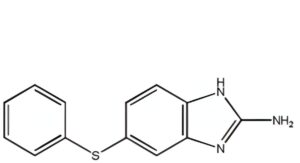
1. (5-phenylthio)-2-aminobenzimidazole.