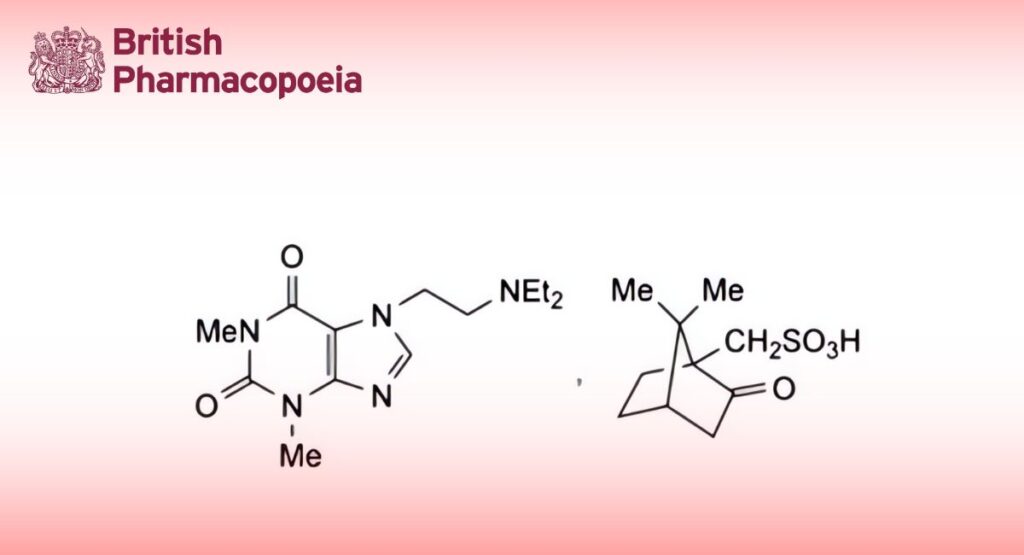
C13H21N5O2,C10H16O4S 511.6 19326-29-5
Action and use
Non-selective phosphodiesterase inhibitor (xanthine); treatment of reversible airways obstruction.
Preparations
Etamiphylline Injection
Etamiphylline Tablets
DEFINITION
Etamiphylline Camsilate is 7-(2-diethylaminoethyl)theophylline camphorsulfonate. It contains not less than 98.0% and not more than 102.0% of C13H21N5O2,C10H16O4S, calculated with reference to the dried substance, when determined by both methods described under the Assay.
CHARACTERISTICS
A white or almost white powder.
Very soluble in water; soluble in chloroform and in ethanol (96%); very slightly soluble in ether.
IDENTIFICATION
A. The light absorption, Appendix II B, in the range 230 to 350 nm of a 0.004% w/v solution exhibits a maximum only at 274 nm. The absorbance at 274 nm is about 0.70.
B. The infrared absorption spectrum, Appendix II A, is concordant with the reference spectrum of etamiphylline camsilate (RSV 51).
C. Fuse 0.1 g with a pellet of sodium hydroxide, dissolve in water and neutralise with hydrochloric acid. The resulting solution yields reaction A characteristic of sulfates, Appendix VI.
TESTS
Melting point
202° to 206°, Appendix V A.
Acidity
pH of a 10% w/v solution, 3.9 to 5.4, Appendix V L.
Free etamiphylline
Not more than 2.0% w/w when determined by Method I for non-aqueous titration, Appendix VIII A, using 2 g dissolved in 75 mL of acetic anhydride and determining the end point potentiometrically. Each mL of 0.1M perchloric acid VS is equivalent to 27.93 mg of free etamiphylline.
Related substances
Carry out the method for thin-layer chromatography, Appendix III A, using silica gel HF254 as the coating substance and a mixture of 80 volumes of chloroform, 20 volumes of ethanol (96%) and 1 volume of 13.5M ammonia as the mobile phase. Apply separately to the plate 10 μL of each of two solutions of the substance being examined in water containing (1) 4.0% w/v and (2) 0.0080% w/v. After removal of the plate, allow it to dry in air and examine under ultraviolet light (254 nm). Any secondary spot in the chromatogram obtained with solution (1) is not more intense than the spot in the chromatogram obtained with solution (2) (0.2%).
Loss on drying
When dried to constant weight at 105°, loses not more than 0.5% of its weight. Use 1 g.
Sulfated ash
Not more than 0.2%, Appendix IX A.
ASSAY
For camphorsulfonic acid
Dissolve 1 g in 25 mL of methanol, previously neutralised with 1M sodium hydroxide VS, and titrate with 0.1M sodium hydroxide VS using thymol blue solution as indicator. Each mL of 0.1M sodium hydroxide VS is equivalent to 51.16 mg of
C13H21N5O2,C10H16O4S.
For etamiphylline
Dissolve 0.15 g in 20 mL of 2M hydrochloric acid, add 12 mL of a 5% w/v solution of silicotungstic acid and allow to stand for 5 hours. Filter, wash the residue with 2M hydrochloric acid until the filtrate yields no precipitate with a 1% w/v solution of quinine hydrochloride and dry at 110°. Each g of residue is equivalent to 0.2830 g of C13H21N5O2,C10H16O4S.