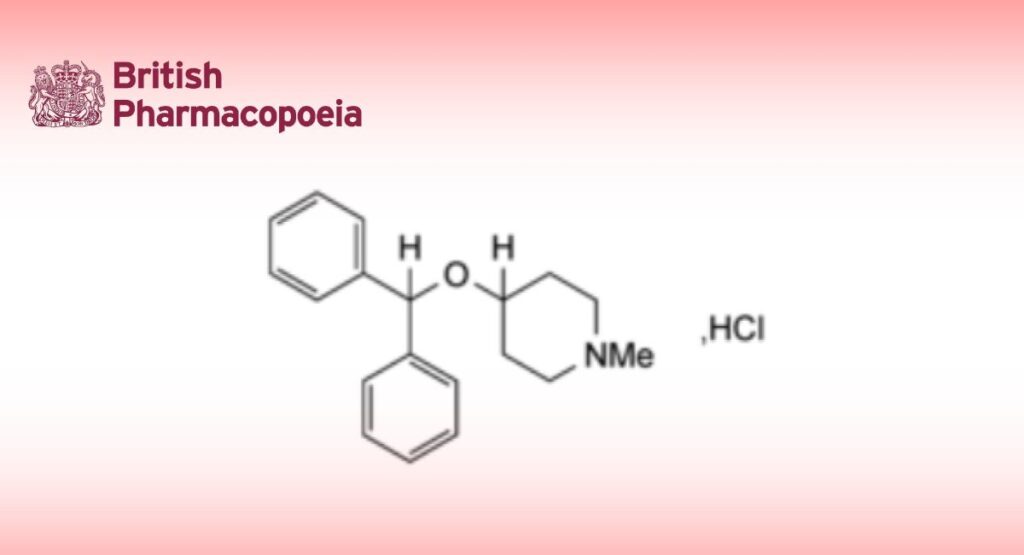
C19H23NO,HCl 317.9 132-18-3
Action and use
Histamine H1 receptor antagonist; antihistamine.
DEFINITION
Diphenylpyraline Hydrochloride is 4-benzhydryloxy-1-methylpiperidine hydrochloride. It contains not less than 98.0% and not more than 101.0% of C19H23NO,HCl, calculated with reference to the dried substance.
CHARACTERISTICS
A white or almost white powder; odourless or almost odourless.
Freely soluble in water and in ethanol (96%); practically insoluble in ether.
IDENTIFICATION
A. The infrared absorption spectrum, Appendix II A, is concordant with the reference spectrum of diphenylpyraline
hydrochloride (RS 106).
B. Yields the reactions characteristic of chlorides, Appendix VI.
TESTS
Related substances
Carry out the method for gas chromatography, Appendix III B, using the following solutions.
(1) Dissolve 45 mg of bibenzyl (internal standard) in sufficient dichloromethane to produce 100 mL.
(2) Dissolve 0.20 g of the substance being examined in 20 mL of water, make the solution alkaline with 5M ammonia and extract with three 25-mL quantities of dichloromethane. Shake the combined extracts with 10 g of anhydrous sodium sulfate, filter, evaporate the filtrate to dryness at about 30° and dissolve the residue in 2 mL of dichloromethane.
(3) Prepare solution (3) in the same manner as solution (2) but dissolve the residue in 2 mL of solution (1).
CHROMATOGRAPHIC CONDITIONS
(a) Use a glass column (1.5 m×4 mm) packed with silanised diatomaceous support (80 to 100 mesh) coated with 3% w/w of phenyl methyl silicone fluid (50% phenyl) (OV-17 is suitable).
(b) Use nitrogen as the carrier gas.
(c) Use an oven temperature of 165°. Allow the chromatography to proceed for 3 times the retention time of bibenzyl.
(d) Increase the oven temperature to 240° to elute the diphenylpyraline from the column.
LIMITS
In the chromatogram obtained with solution (3):
the sum of the areas of any secondary peaks is not greater than the area of the peak due to the internal standard.
Loss on drying
When dried to constant weight at 105°, loses not more than 1.0% of its weight. Use 1 g.
Sulfated ash
Not more than 0.1%, Appendix IX A.
ASSAY
Carry out Method I for non-aqueous titration, Appendix VIII A, using 0.2 g, adding 5 mL of mercury(II) acetate solution and determining the end-point potentiometrically. Each mL of 0.1M perchloric acid VS is equivalent to 31.79 mg of C19H23NO,HCl.