



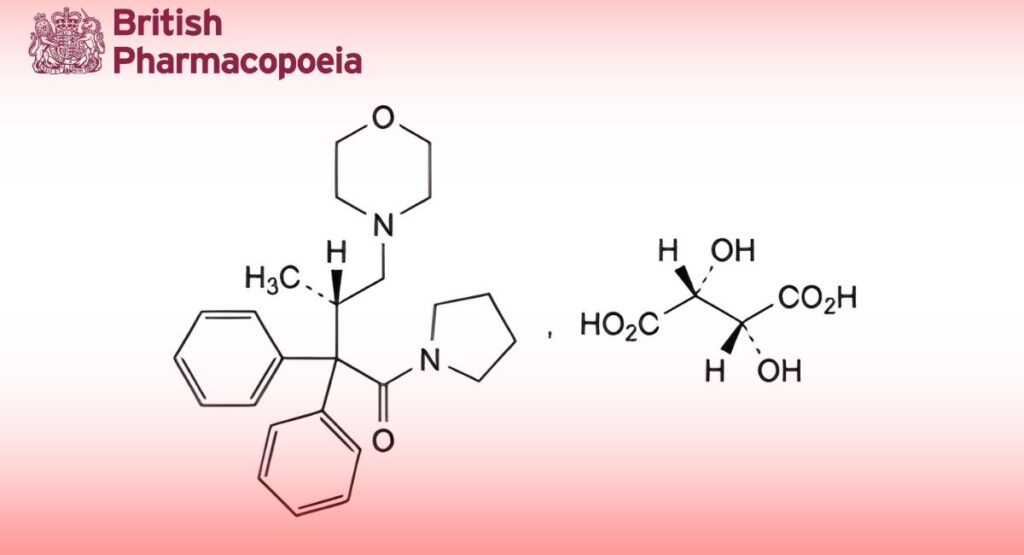
(Ph. Eur. monograph 0021)
C29H38N2O8 542.6 2922-44-3
Action and use
Opioid receptor agonist; analgesic.
DEFINITION
Dextromoramide tartrate contains not less than 98.0 per cent and not more than the equivalent of 101.0 per cent of 1- [(3S)-3-methyl-4-(morpholin-4-yl)-2,2-diphenylbutanoyl]pyrrolidine hydrogen (2R,3R)-2,3-dihydroxybutanedioate, calculated with reference to the dried substance.
CHARACTERS
A white or almost white, amorphous or crystalline powder, soluble in water, sparingly soluble in ethanol (96 per cent).
It melts at about 190 °C, with slight decomposition.
IDENTIFICATION
A. Dissolve 75 mg in 1 M hydrochloric acid and dilute to 100.0 mL with the same acid. Examined between 230 nm and 350 nm (2.2.25), the solution shows 3 absorption maxima, at 254 nm, 259 nm and 264 nm. The specific absorbances at the maxima are about 6.9, 7.7 and 6.5, respectively.
B. Dissolve about 50 mg in water R and dilute to 10 mL with the same solvent. To 2 mL of the solution add 3 mL of ammoniacal silver nitrate solution R and heat on a water-bath. A grey or black precipitate is formed.
C. It gives reaction (b) of tartrates (2.3.1).
TESTS
pH (2.2.3)
Dissolve 0.2 g in carbon dioxide-free water R and dilute to 20 mL with the same solvent. The pH of the solution is 3.0 to 4.0.
Specific optical rotation (2.2.7)
Dissolve 0.50 g in 0.1 M hydrochloric acid and dilute to 10.0 mL with the same acid. The specific optical rotation is + 21 to + 23.
Related substances
Examine by thin-layer chromatography (2.2.27), using silica gel G R as the coating substance.
Test solution: Dissolve 0.2 g of the substance to be examined in methanol R and dilute to 10 mL with the same solvent.
Reference solution: Dilute 1 mL of the test solution to 100 mL with methanol R.
Apply separately to the plate 10 μL of each solution. Develop over a path of 15 cm using methanol R.
Allow the plate to dry in air and spray with dilute potassium iodobismuthate solution R. Any spot in the chromatogram obtained with the test solution, apart from the principal spot, is not more intense than the spot in the chromatogram obtained with the reference solution (1.0 per cent).
Loss on drying (2.2.32)
Not more than 0.5 per cent, determined on 1.00 g by drying in an oven at 105 °C.
Sulfated ash (2.4.14)
Not more than 0.1 per cent, determined on 1.0 g.
ASSAY
Dissolve 0.250 g in 30 mL of anhydrous acetic acid R. Titrate with 0.05 M perchloric acid using 0.15 mL of naphtholbenzein solution R as indicator.
1 mL of 0.05 M perchloric acid is equivalent to 27.13 mg of C29H38N2O8


