



(Ph. Eur. monograph 1666)
C3H2F6O 168.0 57041-67-5
DEFINITION
(2RS)-2-(Difluoromethoxy)-1,1,1,2-tetrafluoroethane.
CHARACTERS
Appearance
Clear, colourless, mobile, heavy liquid.
Solubility
Practically insoluble in water, miscible with anhydrous ethanol.
Relative density
1.47, determined at 15 °C.
bp
About 22 °C.
IDENTIFICATION
Infrared absorption spectrophotometry (2.2.24).
Preparation Examine the substance in the gaseous state.
Comparison Ph. Eur. reference spectrum of desflurane.
TESTS
The substance to be examined must be cooled to a temperature below 10 °C and the tests must be carried out at a
temperature below 20 °C.
Acidity or alkalinity
To 20 mL add 20 mL of carbon dioxide-free water R, shake for 3 min and allow to stand. Collect the upper layer and add 0.2 mL of bromocresol purple solution R. Not more than 0.1 mL of 0.01 M sodium hydroxide or 0.6 mL of 0.01 M hydrochloric acid is required to change the colour of the indicator.
Related substances
Gas chromatography (2.2.28).
Test solution The substance to be examined.
Reference solution (a) Introduce 25 mL of the substance to be examined into a 50 mL flask fitted with a septum, and add 0.50 mL of desflurane impurity A CRS and 1.0 mL of isoflurane CRS (impurity B). Add 50 μL of acetone R (impurity H), 10 μL of chloroform R (impurity F) and 50 μL of methylene chloride R (impurity E) to the solution, using an airtight syringe, and dilute to 50.0 mL with the substance to be examined. Dilute 5.0 mL of this solution to 50.0 mL with the substance to be examined. Store at a temperature below 10 °C.
Reference solution (b): Dilute 5.0 mL of reference solution (a) to 50.0 mL with the substance to be examined. Store at a temperature below 10 °C.
Reference solution (c): Dilute 5.0 mL of reference solution (b) to 25.0 mL with the substance to be examined. Store at a temperature below 10 °C.
Column:
— material: fused silica;
— size: l = 105 m, Ø = 0.32 mm;
— stationary phase: trifluoropropylmethylpolysiloxane R (film thickness 1.5 μm).
Carrier gas helium for chromatography R.
Flow rate 2.0 mL/min.
Split ratio 1:25.
Temperature:
— column: 30 °C;
— injection port: 150 °C;
— detector: 200 °C.
Detection: Flame ionisation.
Injection 2.0 μL.
Run time 35 min.
Relative retention: With reference to desflurane (retention time = about 11.5 min): impurity C = about 1.06;
impurity D = about 1.09; impurity A = about 1.14; impurity G = about 1.39; impurity E = about 1.5; impurity B = about 1.7; impurity F = about 2.2; impurity H = about 2.6.
System suitability Reference solution (a):
— number of theoretical plates: minimum 20 000, calculated for the peak due to impurity A;
— symmetry factor: maximum 2.0 for the peak due to impurity B.
Limits:
— impurity B: not more than the difference between the area of the corresponding peak in the chromatogram obtained with reference solution (a) and the area of the corresponding peak in the chromatogram obtained with the test solution (0.2 per cent V/V);
— impurity A: not more than the difference between the area of the corresponding peak in the chromatogram obtained with reference solution (a) and the area of the corresponding peak in the chromatogram obtained with the test solution (0.1 per cent V/V);
— impurities C, D, G: for each impurity, not more than the difference between the area of the peak due to impurity A in the chromatogram obtained with reference solution (b) and the area of the peak due to impurity A in the chromatogram obtained with the test solution (0.01 per cent V/V);
— impurities E, H: for each impurity, not more than the difference between the area of the corresponding peak in the chromatogram obtained with reference solution (a) and the area of the corresponding peak in the chromatogram obtained with the test solution (0.01 per cent V/V);
— impurity F: not more than the difference between the area of the corresponding peak in the chromatogram obtained with reference solution (a) and the area of the corresponding peak in the chromatogram obtained with the test solution (0.002 per cent V/V);
— unspecified impurities: for each impurity, not more than 0.5 times the difference between the area of the peak due to impurity A in the chromatogram obtained with reference solution (b) and the area of the peak due to impurity A in the chromatogram obtained with the test solution (0.005 per cent V/V);
— sum of impurities other than A, B, C, D, E, F, G and H: not more than the difference between the area of the peak due to impurity A in the chromatogram obtained with reference solution (b) and the area of the peak due to impurity A in the chromatogram obtained with the test solution (0.01 per cent V/V);
— disregard limit: the difference between the area of the peak due to impurity A in the chromatogram obtained with
reference solution (c) and the area of the peak due to impurity A in the chromatogram obtained with the test solution (0.002 per cent V/V).
Fluorides
Maximum 10 ppm.
Potentiometry (2.2.36, Method I).
Test solution: To 10.0 mL in a separating funnel, add 10 mL of a mixture of 30.0 mL of dilute ammonia R2 and 70.0 mL of distilled water R. Shake for 1 min and collect the upper layer. Repeat this extraction procedure twice, collecting the upper layer each time. Adjust the combined upper layers to pH 5.2 with dilute hydrochloric acid R. Add 5.0 mL of fluoride standard solution (1 ppm F) R and dilute to 50.0 mL with distilled water R. To 20.0 mL of this solution add 20.0 mL of total-ionic-strength-adjustment buffer R and dilute to 50.0 mL with distilled water R.
Reference solutions: To each of 1.0 mL, 2.0 mL, 3.0 mL, 4.0 mL and 5.0 mL of fluoride standard solution (10 ppm F) R add 20.0 mL of total-ionic-strength-adjustment buffer R and dilute to 50.0 mL with distilled water R.
Indicator electrode Fluoride selective.
Reference electrode Silver-silver chloride.
Carry out the measurements on 20 mL of each solution. Calculate the concentration of fluorides using the calibration curve, taking into account the addition of fluoride to the test solution.
Non-volatile matter
Maximum 100 mg/L.
Evaporate 20.0 mL to dryness with the aid of a stream of nitrogen R. The residue weighs not more than 2.0 mg.
STORAGE
In a glass bottle fitted with a polyethylene-lined cap. Before opening the bottle, cool the contents to below 10 °C.
IMPURITIES
Specified impurities A, B, C, D, E, F, G, H.
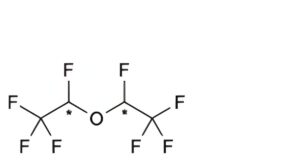
A. 1,1′-oxybis[(1Ξ)-1,2,2,2-tetrafluoroethane],
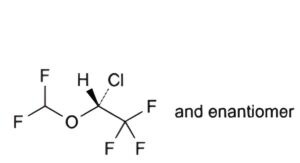
B. (2RS)-2-chloro-2-(difluoromethoxy)-1,1,1-trifluoroethane (isofluorane),
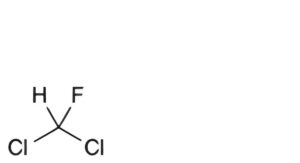
C. dichlorofluoromethane,
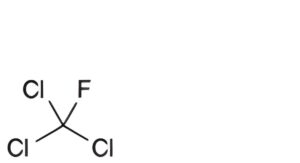
D. trichlorofluoromethane,
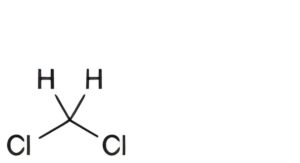
E. dichloromethane (methylene chloride),
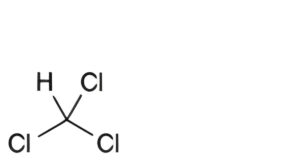
F. trichloromethane (chloroform),
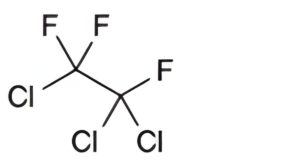
G. 1,1,2-trichloro-1,2,2-trifluoroethane,
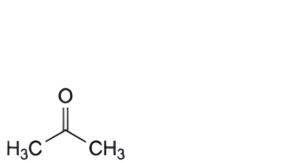
H. propan-2-one (acetone).


